




Operations
Can Public Fleets Trust the Data Driving Their Decisions?
Public fleets have more data than ever, but inconsistent records and missing information can still undermine maintenance, replacement, and cost decisions.
 MENU
MENU SEARCH
David Renschler walked into Fairfield with plenty to learn and no idea what awaited him. Twenty years later, the lessons from what came next are still shaping his approach to fleet.
From learning from those who came before him to mentoring those who will follow, David Renschler reflects on 38 years of growth in fleet.
Government Fleet
David Renschler stepped into his role as Fleet Division Manager with much to learn about public fleet management. Just 30 days in, the FTA triennial review revealed that he had inherited a fleet that was 78% out of compliance on preventive maintenance.
By the time Renschler arrived in Fairfield, he already had 18 years of fleet experience under his belt, spanning civilian, military, and local government operations. He had worked as a mechanic and managed shops, but Fairfield would present a different set of challenges.
With the threat of losing federal funding for their transit fleet looming, Renschler was about to embark on a journey that would impact his life on all sides.
After 20 years in Fairfield, with accolades earned, connections made, and lessons learned, Renschler is gearing up for retirement and making sure he leaves the City of Fairfield better than he found it.
With his feet still wet and still so much to learn, Renschler had to make a decision. Stay and try to clean the mess left by his predecessor or throw in the towel.
“I had been here 30 days,” Renschler recalled. “I wanted to help this organization, and I wanted to … make it better. So, I made that decision to take the challenge on, head on, and figure out a way to fix it, even though I didn’t know how to fix everything.”
While the problems were not of his making, the solutions would be. Once he decided to stay and do the work, he got right to it.
Without the digital tools available to fleet managers today, Renschler hit the ground hard, printing all the work orders and laying them out across the tables in the break room. From there, he analyzed preventive maintenance histories and mileage to understand where the problem lay.
It took him eight months' worth of work shifts that spanned from 4 a.m. to 9 – 10 p.m. The hours took a personal toll on Renschler, with the long hours replacing time spent with his family, something his youngest daughter, now an adult, still reminds him of.
Still, he took it on with a true desire to make a difference.
Though he did not have all the answers on how to fix everything that needed fixing, he did have two things: a willingness to ask for help and a network he had already begun building before arriving in Fairfield.
That willingness to ask for help would eventually lead him to become one of fleet’s most trusted advisers. He would learn from his peers and spend the next 20 years cultivating a network of relationships that would make him “someone who had the answers”.
“We all, at one point or another, have the same problems or very similar. And, you know, when you build your network, and you're able to pick up that phone or shoot off an e-mail to someone and ask for help when you can't figure it out,” Renschler noted.
For Renschler, networking was worth the investment, not an afterthought.
Early in his career, when his organization would not send him to the Government Fleet Expo and Conference (GFX), he funded his own trips and used personal vacation time to attend.
He paid his own way for those first three conference visits and has attended every in-person event since.
“I thought it was very important to learn from others,” he said. “'Get out there and network and learn from others' is the best piece of advice I could give a new Fleet Manager.”
The network he built would prove especially valuable as he navigated the rough waters of repairing Fairfield’s fleet operations. The people he turned to in those times gave him the solutions he needed to make Fairfield better.
Over time, Renschler became a resource that other fleet managers could rely on. The fleet manager who called on others became the fleet manager others would call on.
As his career progressed, he would begin presenting at conferences across the country, sharing all the lessons he learned along the way.
“As a leader in the industry, you need to help those who are trying to become better be better,” he added.
If I have learned anything about public fleet leaders in my time at Government Fleet Magazine, it is that trust is central to the philosophy of today's fleet legends, and Renschler is no exception.
During his 20 years with the City of Fairfield, Renschler has worked with six city managers, six police chiefs, five fire chiefs, five public works directors, and a partridge in a pear tree. Each transition, he said, can feel like “starting over,” and required him to prove the fleet's value over and over again.
For Renschler, this meant making sure that the fleet's work was visible beyond the garage. Over time, Fairfield’s fleet operation earned industry recognition and several appearances in the local newspaper. Those recognitions helped build the credibility Renschler was looking for.
In 2009, a private company would approach Fairfield’s mayor with a proposition: they could outperform the municipal fleet operation “better, faster and cheaper.” However, Fairfield's fleet reputation was pristine. The mayor knew what his city's fleet was capable of, and he didn’t think the company could do better.
“The awards, you know, along with 5 bucks still won't get you a cup of coffee, but they'll get you credibility with the citizens, with the electeds, and with the executive management of your organization,” Renschler said.
Maintaining that trust through changing administrations has required a consistent message about what a public fleet owes the community it serves. No matter who occupies the city manager's office or sits on the city council, his priorities remain the same: safety and stewardship.
After two decades building that credibility, Renschler has learned an important lesson. Doing good work is a priority, but so is making sure decision-makers understand the value of that work.
Now that he is nearing the end of his career, it is time to prepare the operation for a successful transition to its next leader.
“I want to be able to sleep at night when I retire and know that I did everything humanly possible to make sure that the staff here are going to be able to keep going and maybe even take it to the next level,” he said.
Renschler remembers what it was like to walk into an operation that wasn’t ready for its next leader. As he prepares for the end of his career in fleet, he hopes to leave things better for his successor.
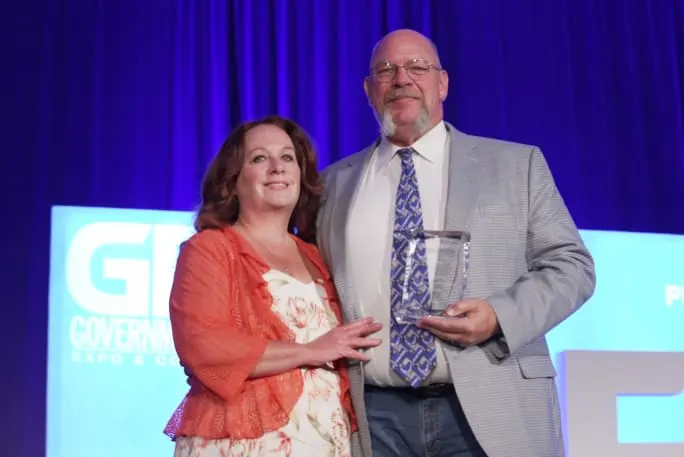
Renschler was joined by his wife on stage at GFX as he received the 2026 Legendary Lifetime Achievement Award.
Government Fleet
For the past few years, he has focused on mentoring the people who will continue the work after he leaves. He intends to make sure that the foundation he has built over the decades is strong enough for the next generation to continue to improve.
Renschler likened the responsibility to an umbrella.
“I don't want the umbrella to have a bunch of holes in it for the next person to take over,” Renschler said.
This commitment to leaving the operation prepared is fitting for a career built on collaboration. He started his career relying on the experience of peers, and as retirement approaches, mentorship allows him to pay it forward.
The timing of Renschler’s Legendary Lifetime Achievement Award reflects that legacy. As he prepares to leave Fairfield, he isn’t simply leaving; he’s leaving it better.
Loading data...
Operations
Public fleets have more data than ever, but inconsistent records and missing information can still undermine maintenance, replacement, and cost decisions.


Operations
David Renschler walked into Fairfield with plenty to learn and no idea what awaited him. Twenty years later, the lessons from what came next are still shaping his approach to fleet.
Safety
How a strong accident response process helps government fleets move from the initial report to recovery while building a clearer record for what needs to change next.
Maintenance
Downtime is rarely caused by a single surprise failure but rather by an issue that builds over time through setbacks ranging from deferred maintenance to poor replacement planning. So what's the fix?
Operations
A look at where to find good talent, what fleets are doing to incentivize those techs to stay within the fleet, and what promotion looks like for a technician within the public sector.
Safety
Behind every wildfire response is a complex network of vehicles, data, and decisions that must work in sync under extreme pressure. Global heating trends require strong fleet coordination and reliable communications to keep crews safe and operations running smoothly.
Spring officially started Friday, March 20, and while some fleets may still be waiting for all the snow to melt, now is the time to shift from winter survival to summer readiness.
Operations
Every fleet operation has a team that works in its own unique way. What matters is that each person understands how their role fits into the bigger workflow, and how the team functions as one.
Operations
When it comes to the public sector, outcomes are usually driven by three areas fleet leaders can actually control, but it’s combining these into one operating model where operations see the most success.
Operations
A look back at some key leadership points from the year and how that advice can shape the decisions for your fleet's future.