





California City Marks Milestone in Charging Initiative
The city of Fairfield, California, hosted a ribbon-cutting ceremony to celebrate the addition of new vehicles and equipment in a move toward more sustainability.
September 17, 2024
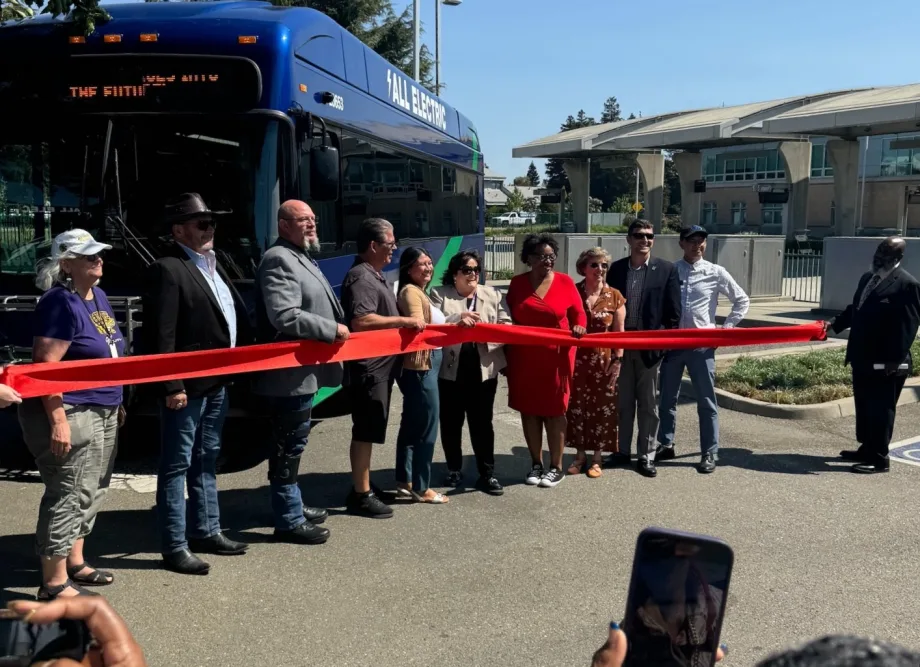
Fairfield held a ribbon-cutting ceremony for the Public Works Transportation Division on Aug. 29, 20204.
Photo: AssetWorks
3 min to read
The city of Fairfield, California, Transportation Division, responsible for the city’s transit service (FAST), has added new cutaway buses, microtransit vans, a Pioneer eBoost charging trailer, and the first three 35-foot Gillig Battery-Electric Zero-Emission Buses.
The buses mark FAST’s first zero-emission transit vehicles and are part of an effort to transition to a 100% zero-emission fleet by 2040. The city is waiting to order the next five BEBs until the permanent infrastructure is closer to being completed.
The city is addding seven new cutaway (paratransit) buses and five new micro transit vans to the existing fleet of:
20 Gillig fixed route buses
10 cutaway (paratransit) buses
Cutaway buses are used for paratransit service and the vans will be used for microtransit, which is a form of dial-a-ride.
A Breakdown of Fairfield’s Move to Zero Emissions
In 2016, the Fairfield City Council adopted the FAST Alternative Fuels and Fleet Replacement Policy. This was completed in anticipation of the Innovative Clean Transit regulation, which requires fully zero-emission transit fleets by 2040.
In 2017, FAST was awarded $1.2 million to purchase zero-emission buses through the Federal Transit Administration’s Bus and Bus Facilities Competitive Program.
In 2022, FAST was awarded another $12 million through the same program for battery-electric buses, infrastructure, and workforce development.
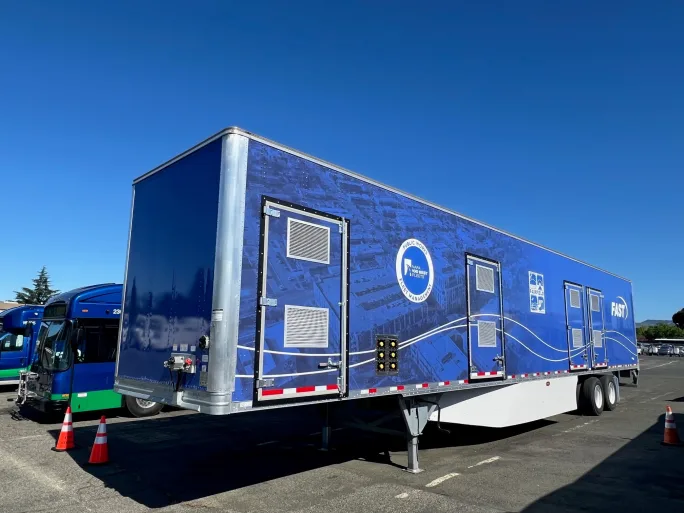
The 53’ semi-trailer has a renewable propane-powered genset that powers a Charge Point Power Block 200kWh level 3 DC charger.
Photo: City of Fairfield
FAST’s path to a zero-emission fleet is guided by the city of Fairfield’s Corporation Yard Electrification Buildout Plan Report which was completed in April. The report outlines a buildout and implementation plan that identifies available technology, infrastructure needs, funding, and maintenance requirements that will be key for a successful transition to zero-emission.
The city’s zero-emission bus rollout plan, approved by the California Air Resources Board (CARB) in July 2023, included FAST successfully securing three grants over five years from the Federal Transit Administration totaling almost $15 million, according to Public Works Transportation Manager Diane Feinstein, who oversees the city’s FAST transit system called FAST.
This funding was matched with Transportation Development Act funds to purchase the three new electric buses. City Fleet Division and FAST staff collaborated to oversee the procurement of FAST’s first three battery electric buses.
This FTA funding will also be used to cover the cost of the first phase of infrastructure improvements at the Fairfield Corporation Yard. This project is 70% designed with construction set to begin in 2025 with completion in late 2026.
Finding a Charging Solution in the Interim
Because the infrastructure improvements will not be completed for two-plus years, FAST had to identify another charging alternative.
“This was challenging because there is still limited availability of temporary or backup power solutions if the power grid is unavailable," Feinstein said during the unveiling. FAST, along with fleet staff, decided to work with AssetWorks to purchase a propane-powered generator, which is capable of simultaneously charging two battery electric buses.
The city obtained a permit from the Bay Area Air Quality Management District to operate the unit, which can also be used as a backup charging solution during Public Safety Power Shutoffs (PSPS) or other power outages.
The 53’ semi-trailer has a renewable propane-powered genset that powers a Charge Point Power Block 200kWh level 3 DC charger. The dual port charger can charge two BEBs at 100kWh each.
According to Mike Terreri, senior EV product manager at AssetWorks, the process of designing and delivering the equipment took approximately eight months from the order date.
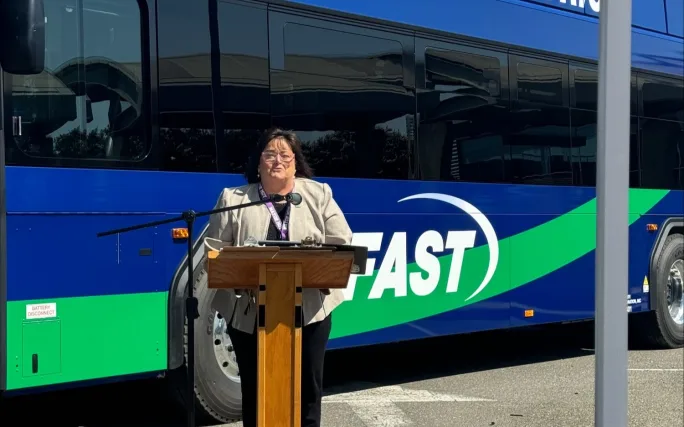
Fairfield Mayor Catherine Moy.
Photo: AssetWorks
When the permanent charging and infrastructure project is completed, the generator will continue to be used as a backup charging option in case of a PSPS.
“Charging infrastructure has significantly evolved over the past few years. Previously, charging options were limited and comparatively slow, making it challenging for fleet operations,” noted Terreri. “Today, with advancements in DC Fast Charging technology, vehicles can be charged much more quickly…enabling more efficient fleet charging operations. For the future, fleets need to plan for increased usage, site upgrades, and resiliency.”
More Operations

Is Keeping Older Fleet Vehicles Really Saving Money?
Is keeping vehicles longer saving money, and what happens when a diagnostic test points to the wrong fix?
Read More →
How Smart Fleet Strategy Can Help Local Government Agencies Do More with Less
Keeping a vehicle longer may ease this year’s budget, but what does it cost the next one? A closer look at fleet decisions can reveal opportunities to reduce spending while protecting essential services.
Read More →
Connect with Government Fleet on LinkedIn
From industry news and fleet management strategies to conversations with peers, Government Fleet's LinkedIn page offers public-sector fleet professionals another way to stay informed and connected.
Read More →
Town of Queen Creek Named Most Successful Fleet Award Winner of Inaugural RTA Fleet Success Awards
Five fleets were honored at RTA Connect 2026 in Chicago for excellence across resource efficiency, intentional culture, risk management, and stakeholder satisfaction.
Read More →
Sponsored•October 14, 2026
A buyer's guide to fleet management software in 2027
Buying fleet management software in 2027 means looking beyond features and price. As fleet operations, technology and expectations evolve, this guide explores what today’s fleet professionals should consider when choosing a system that can deliver value now and adapt to what comes next.
Read More →
Hazard Alerts, Fleet Car Sales Rise and a New Shuttle Concept
Fleet car sales doubled, but the bigger picture tells a different story in this week’s roundup.
Read More →
How St. Johns County Turned Fleet Data Into Better Replacement Decisions
St. Johns County, Florida, had fleet data, but turning it into reliable decision guidance was another matter. Instead of starting over with a new fleet management system, the county connected existing tools and built a scoring system that gives managers an objective look at fleet health.
Read More →
Fleet Forward Conference Introduces One-Day Passes for 2026
New one-day registration lets fleet professionals attend Tuesday, Wednesday, or Thursday, with passes available for $249.
Read More →
ENC Unveils its ZAVIR Medium-Duty Shuttle
Two variants of the concept shuttles were revealed: a low-floor configuration and a high-floor configuration.
Read More →
Could Your Next Fleet Technician Start as an Intern?
What if your next technician hasn’t worked in a fleet shop yet? What fleets are doing to free up time.
Read More →