




Inside Buckeye’s Road to Success: How the 2024 Leading Small Fleet is Building for the Future
With the Government Fleet Expo & Conference right around the corner, we're taking a moment to highlight one of last year’s top-performing fleets.
June 10, 2025


Meet the 2024 No. 1 Small Fleet.
Photo: Government Fleet
4 min to read
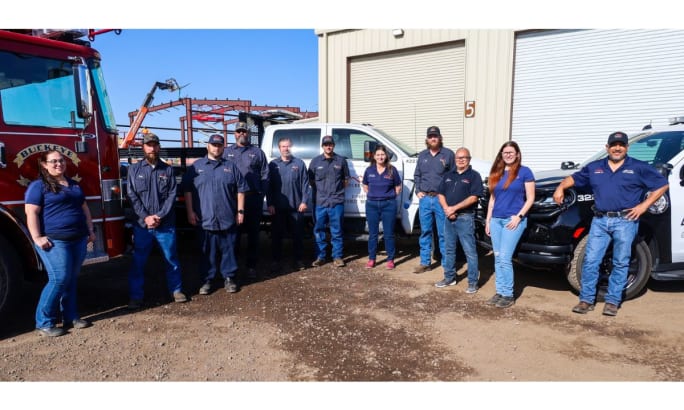
The team at Buckeye, Ariozona, Public Works Fleet Management department poses for a picture in front of some of their fleet.
Photo: The City of Buckeye
Each year, the Government Fleet Expo & Conference brings together fleet leaders from across the country to share best practices and recognize outstanding performance. Among the fleets honored, Buckeye, Arizona, stood out for its exceptional approach to fleet management and operational excellence.
One of the fastest-growing cities in the nation, the city of Buckeye, Arizona, earned the spotlight as the 2024 Leading Fleets No. 1 small fleet. Through innovation, leadership, and scaling, the city exemplifie has exemplified effective fleet management.
Since 2020, Buckeye has seen an explosion in its population, boasting 119,007 residents, up from 6,500 in 2000.
We spoke with Beth Casillas, the city’s fleet manager, to learn more about how they earned their top spot.
Rapid Growth
The Buckeye Public Works Department Fleet Management Division provides a full range of fleet management services. It is an Automotive Service Excellence (ASE) Blue Seal Shop committed to advancing the field using technology and procedures.
As the city continues to grow exponentially, so does its fleet. As a fleet manager, Casillas faced many challenges with a rapidly expanding fleet, including the lack of adequate accommodation for the expanding inventory of vehicles.
“Our existing maintenance shop was not designed to handle the scale and diversity of our current fleet, which now includes light-duty, medium-duty, heavy-duty vehicles, and fire apparatus. Servicing a single fire apparatus did consume up to a quarter of our available shop space, severely limiting our capacity to maintain other vehicles efficiently,” said Casillas about the previous accommodations.
Thankfully, they achieved a critical milestone this past year – they expanded their maintenance facilities to accommodate heavy-duty vehicles and fire apparatus. This improvement has enabled the City to fortify its services, allowing for the addition of technicians to alleviate the workload on existing staff.
These upgrades have allowed Buckeye to improve its operational efficiency and ability to service the fleet more effectively.
Modernization at the Forefront
When asked about the strategies Buckeye has implemented to become as successful as they are, Casillas laid out the processes that have helped them reach the number one spot.
First, she upgraded positions to be competitive with the industry and retain talent. They also created a Service Writer position to manage service scheduling more efficiently. She also upgraded their PM program with various programs that extend oil intervals and reduce engine wear from high idle hours. She also implemented GPS for trouble codes and oil life monitoring.
Additionally, Casillas streamlined processes to include technology that reduces the need for paper and employed smart devices that allow patrol light bars to be reused after servicing.
Amid it all, she kept the community informed by using LinkedIn to highlight and update the public on what is happening with the fleet. She also developed an intern program with West-Mec automotive students to maintain a pipeline of qualified technicians to fortify the industry and the community.
Fleet management is currently upgrading both its Fleet and Fuel Management Software. These upgrades are expected to dramatically improve efficiency by reducing manual processing hours and streamlining key workflows.
“In addition, we have implemented GPS technology to monitor driver behavior and track equipment fault codes. This enhancement has already proven successful, particularly with our fire apparatus, which operates 24/7. When a fault code is detected, our Emergency Vehicle Technicians (EVTs) receive real-time diagnostic data via email,” said Casillas when asked about fleet technologies.
She added that this capability improves safety and response readiness by enabling the team to make informed after-hours decisions.
A Bright Future
As the team at Buckeye continues to move forward, fleet management will continue to play a vital role in its sustainability. They are certain their recent investments in expansion, technology, and personnel will continue to prove more beneficial as time passes.
The tools implemented by Beth Casillas are laying the foundation for the modernization of the Buckeye fleet that is data-driven, strategic, efficient, and responsive.
“Looking further ahead, we are hopeful of the development of a new fleet facility, designed to meet not only
our current operational demands but also the future needs of a growing and evolving fleet. This facility would represent a significant step forward in our commitment to innovation, sustainability, and long-term planning,” said Beth when asked about what the future holds for Buckeye.
How can your fleet work toward reaching the #1 spot? Casillas says that any step toward a new initiative is a step in the right direction.
“Always trying to be more efficient and resourceful from day to day will start the process and lay the foundation for long-term progress. Empower and listen to staff, they are the front line and have great ideas of how to initiate these changes that will not only benefit them but the entire organization. Document your processes and be the champion of your organization and the driving force behind position change within your team and organization,” she explained.
Subscribe to Our Newsletter
More Operations
Is Keeping Older Fleet Vehicles Really Saving Money?
Is keeping vehicles longer saving money, and what happens when a diagnostic test points to the wrong fix?
Read More →
How Smart Fleet Strategy Can Help Local Government Agencies Do More with Less
Keeping a vehicle longer may ease this year’s budget, but what does it cost the next one? A closer look at fleet decisions can reveal opportunities to reduce spending while protecting essential services.
Read More →
Connect with Government Fleet on LinkedIn
From industry news and fleet management strategies to conversations with peers, Government Fleet's LinkedIn page offers public-sector fleet professionals another way to stay informed and connected.
Read More →
Town of Queen Creek Named Most Successful Fleet Award Winner of Inaugural RTA Fleet Success Awards
Five fleets were honored at RTA Connect 2026 in Chicago for excellence across resource efficiency, intentional culture, risk management, and stakeholder satisfaction.
Read More →
Sponsored•October 14, 2026
A buyer's guide to fleet management software in 2027
Buying fleet management software in 2027 means looking beyond features and price. As fleet operations, technology and expectations evolve, this guide explores what today’s fleet professionals should consider when choosing a system that can deliver value now and adapt to what comes next.
Read More →
Hazard Alerts, Fleet Car Sales Rise and a New Shuttle Concept
Fleet car sales doubled, but the bigger picture tells a different story in this week’s roundup.
Read More →
How St. Johns County Turned Fleet Data Into Better Replacement Decisions
St. Johns County, Florida, had fleet data, but turning it into reliable decision guidance was another matter. Instead of starting over with a new fleet management system, the county connected existing tools and built a scoring system that gives managers an objective look at fleet health.
Read More →
Fleet Forward Conference Introduces One-Day Passes for 2026
New one-day registration lets fleet professionals attend Tuesday, Wednesday, or Thursday, with passes available for $249.
Read More →
ENC Unveils its ZAVIR Medium-Duty Shuttle
Two variants of the concept shuttles were revealed: a low-floor configuration and a high-floor configuration.
Read More →
Could Your Next Fleet Technician Start as an Intern?
What if your next technician hasn’t worked in a fleet shop yet? What fleets are doing to free up time.
Read More →