Continuous training can pave the way for career advancement and technical excellence in the automotive industry.
Photo: Government Fleet
8 min to read
The automotive industry is continually changing. That’s great for safety, efficiency, and sustainability, but if your technicians’ knowledge base doesn’t evolve with the industry, your shop is going to suffer.
Technician training is the key to keeping your shop humming.
Ad Loading...
Providing training to shop employees is about more than making sure they can work on the latest vehicles. Technician training ultimately helps minimize downtime, optimize vehicle performance, and enhance safety for both shop employees and drivers.
When training is a must, how do you ensure technicians get what they need to do their best work? The most effective training plans are tailored to technician skill levels and the vehicles and equipment they work on. Fortunately, fleet managers have several training options they can mix and match to create the right plan for their fleet.
ASE Certifications
The National Institute for Automotive Service Excellence (ASE) offers 58 ASE certification tests that cover just about every vehicle class, propulsion system, and type of work required to be successful in the automotive repair and service industry.
ASE certification is the only national, industry-wide credential for automotive service professionals. Three levels of certification are available:
Entry Level Certification for students new to the industry
Professional Technician for working technicians
Master Technician for advanced professionals
Ad Loading...
“I recommend ASE certifications, which are industry-recognized, and ensure technicians have up-to-date knowledge in specialized areas such as electrical systems, brakes, or advanced diagnostics,” said Brandy LeBeau, Fleet Manager for the city of Roseville, California.
Assess individual skill levels to tailor training and provide additional support for technicians who need it. This makes learning more effective and personalized.
Photo: Government Fleet
Al Curtis, Fleet Director for Cobb County Fleet Management, also recommends ASE Certifications and suggests rewarding technicians for their achievements. “ASE Certification is widely respected and includes certifications across various areas,” he said. “We encourage technicians to pursue certifications and offer incentives for completing them. This validates their skills, increases job satisfaction, and provides career growth opportunities.”
Manufacturer Trainings
Original equipment manufacturers (OEMs) also offer training and certification on their vehicles.
Charlotte Ashcraft, Director of Franklin County Fleet Management, whose fleet consists mostly of Ford vehicles, leverages the Ford Fleet Training Package for service technicians. Technicians start with online education then, once they pass that portion, they head to a training facility for the hands-on portion of the training. Technicians have to pass both sections to become certified.
“The manufacturer program keeps our technicians updated on the current technology,” Ashcraft said. “This is so beneficial to both the tech and the fleet.”
Ad Loading...
Ford also offers New Ford Tech, which offers programs designed for beginners.
LeBeau also provides manufacturer-specific training to her technicians. “Manufacturer-specific training for the vehicles in our fleet—whether Ford, GM, or EV-related—is key to maintaining their warranties and optimizing their longevity,” she said. “Continuous education on safety protocols, evolving technologies, and software-based diagnostics should also be a priority.”
LeBeau said the fleet’s investment in OEM and component-specific training for technicians has paid off.
“We've streamlined maintenance and repairs in-house by equipping our team with the knowledge to handle advanced technologies across various vehicle types and systems. This training has improved vehicle uptime and performance, significantly reducing the need for external contractors and costly repairs,” she said. “Additionally, it has enabled us to optimize the reliability and efficiency of our fleet. Without this ongoing education, implementing these improvements would have been slower and more expensive.”
Emerging Technologies
The fleet industry is always introducing new technologies, so it’s critical for technicians to receive continuous training on the latest advancements.
Ad Loading...
Electric vehicles (EVs) are a prime example. Electric propulsion systems have far different maintenance, repair, and safety requirements than their ICE counterparts, so fleets can’t assume technicians can work on them without training. While maintenance is far simpler on EVs, working with high-voltage systems requires specific precautions, making EV training an important part of keeping technicians safe.
“As fleets adopt more EVs, training on electric propulsion, high-voltage safety, and EV-specific diagnostics is essential,” Curtis said. “We started very early with electric vehicles and infrastructure; we would not have been able to move so aggressively if it were not for the training of our technicians. They are willing to learn all about these vehicles and charging station maintenance.”
Ashcraft points out that training on electronics is becoming a must-have for all fleet vehicles, not just EVs.
“Our industry is slowly evolving into more electronics and less mechanical gears and physical components. This is a new skill set, and as the industry and technology evolves so must the technicians,” she said. “Continuous training is the key. You can't be left behind in this industry because you will never catch up.”
“We found it necessary to have our technicians training on ADAS System programing. This has saved us on dealer charges as well as allows us to check camera and other safety features on the vehicles coming back from the body shop,” Curtis explained.
Service and Repair Basics
While many training options are designed for experienced technicians, training is also available for those new to the automotive service and repair industry.
Ashcraft said educating technicians on service and repair basics is of growing importance.
“One of the things I think we skip over these days is basics. Many of us have had the same techs for years and years who already knew the basics when they got here,” she said. “We've hired so many new people, and some of them don't have the base knowledge that we are accustomed to. And that's because the skills have changed. Vehicles and equipment are a lot more electronic and electrical than they used to be. We've lost that focus on needing to know the basics, but they’re important.”
Ashcraft said local automotive training schools, like community colleges and training academies, can help with the basics and serve as an introduction to the industry.
Ad Loading...
The ASE Entry-Level Certification Program is another way to give new technicians a solid foundation to build on.
Curtis recommends looking into apprenticeship programs offered by the Department of Labor or local trade schools. “Apprenticeship programs provide comprehensive, hands-on training for aspiring fleet technicians and allow existing technicians to advance their skills,” he said.
Non-Technical Training
Beyond technical skills, technicians can benefit from training related to other aspects of their role.
“While technical skills are paramount, the ability to communicate effectively with colleagues, drivers, and supervisors is often overlooked,” LeBeau said. “Training in communication, teamwork, and problem-solving can improve overall shop efficiency.”
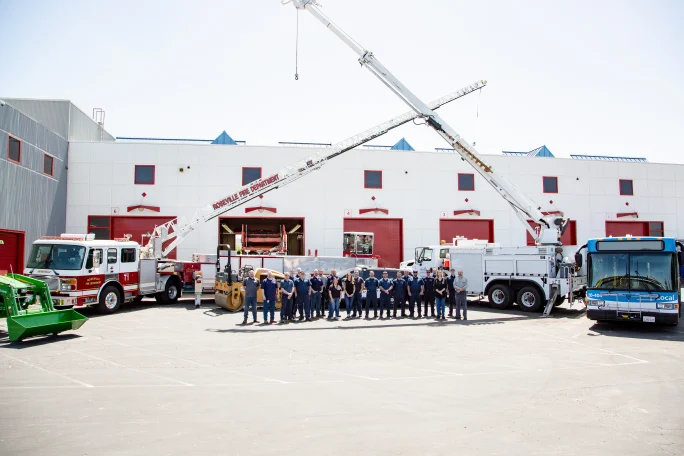
The city of Roseville, California's Fire Department
Photo: The city of Roseville, California
Curtis recommends fleet management courses for technicians who want to take the next step in their careers.
Ad Loading...
“For technicians aspiring to grow into management roles, fleet management courses cover topics such as asset management, procurement, and budgeting, providing skills beyond hands-on technical work,” he said.
External training opportunities equip technicians with knowledge, but providing hands-on training in your own shop is also important, as it reinforces what they’ve learned.
As Ashcraft points out: “Anyone who gets into the mechanical field wants to use their hands. Reading lessons on a computer screen or in a book gives them a base, but it doesn't click until they can touch it.”
Ad Loading...
Curtis recommends providing real-world experience on diagnostic equipment, tools, and vehicle systems. “Practical exercises help technicians understand complex systems, which is especially valuable for skills like diagnostics and repairs,” he said.
Professional Organizations
When technicians participate in professional organizations, they can access formal training and gain valuable networking opportunities, which serve as their own form of training.
“Networking and participating in fleet organizations like the National Association of Fleet Administrators (NAFA) or local government fleet groups provide valuable educational experiences,” LeBeau said. “These organizations offer access to the latest industry trends, best practices, and training opportunities. Through networking, fleet professionals can learn from peers, share solutions, and stay ahead of challenges such as regulatory changes or advancements in sustainable fleet practices.”
Professional organizations also offer educational opportunities.
“Many of the fleet organizations like NAFA, APWA, FLAGFA, SGFMA, BFN, and others offer pathways to advancements and educational programs to elevate skills as well as networking opportunities with likeminded individuals,” Curtis said. “Many offer certification programs and recognition programs that highlight top performing fleets and technicians.”
Ad Loading...
Technician Training Is Worth the Investment
If technician training has a downside, it’s the cost. Teaming up with other local fleets to share training costs can help.
“We use group purchasing power to be able to provide training to many smaller organizations that don’t have the staff to fill the class and/or can’t afford to do it,” Ashcraft explained. “MEMA sets up the training, then we collect techs from the member organizations to fill the classes.”
For fleets that balk at the cost of technician training, LeBeau recommends looking at is as a strategic investment rather than an expense.
“Investing in training is cost-effective in the long term,” she explained. “The savings far outweigh the upfront training costs realized through reduced vehicle downtime, fewer costly repairs, and the extended life of fleet assets. Properly trained technicians can spot and address issues before they become major problems, keeping the fleet running smoothly and efficiently.”
“Technicians want to feel valued. If you are not willing to spend the money on training them it shows you do not value them, and they will surely look elsewhere,” he explained. “Trained and educated technicians are better prepared to handle the demands of a modern fleet, contributing to a safer, more sustainable, and cost-effective operation.”
Technician Training Dos and Don’ts
Do:
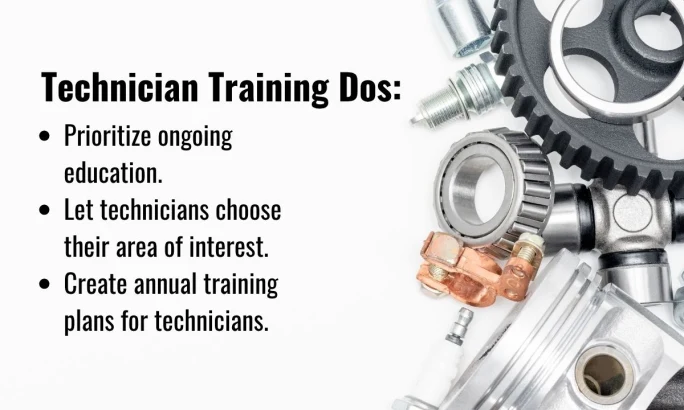
Prioritize ongoing education.
Ensure training is relevant to the specific needs of your fleet.
Combine hands-on, practical experience with classroom-based learning.
Crosstrain technicians in multiple areas (e.g., hydraulics, diagnostics, or electrical systems).
Set a standard for basic technician training and make it a requirement for everyone in the shop.
Let technicians choose their area of interest.
Create annual training plans for technicians.
Reward drivers who participate in training with pay or other incentives.
Don’t:
Take a one-size-fits-all approach. Assess individual skill levels to tailor training and provide additional support for technicians who need it. This makes learning more effective and personalized.
Cut training budgets as a short-term solution; it can lead to higher long-term maintenance, repairs, and vehicle downtime costs.
Assume all your technicians are the same. Let them have a say in what focus they take.
Let education become stale. Offer regular refreshers and advanced sessions to keep skills sharp.
Keeping a vehicle longer may ease this year’s budget, but what does it cost the next one? A closer look at fleet decisions can reveal opportunities to reduce spending while protecting essential services.
From industry news and fleet management strategies to conversations with peers, Government Fleet's LinkedIn page offers public-sector fleet professionals another way to stay informed and connected.
Five fleets were honored at RTA Connect 2026 in Chicago for excellence across resource efficiency, intentional culture, risk management, and stakeholder satisfaction.
Buying fleet management software in 2027 means looking beyond features and price. As fleet operations, technology and expectations evolve, this guide explores what today’s fleet professionals should consider when choosing a system that can deliver value now and adapt to what comes next.
St. Johns County, Florida, had fleet data, but turning it into reliable decision guidance was another matter. Instead of starting over with a new fleet management system, the county connected existing tools and built a scoring system that gives managers an objective look at fleet health.