





Good to Know: Future of Fleet Friday FleetGap Q&A sessions take place on the last Friday of each month.
The FleetGap Initiative: Transitioning from Military to Civilian Fleet Roles
FleetGap is working to build the missing bridge between service members preparing for civilian careers and fleet employers facing workforce shortages.
June 26, 2026
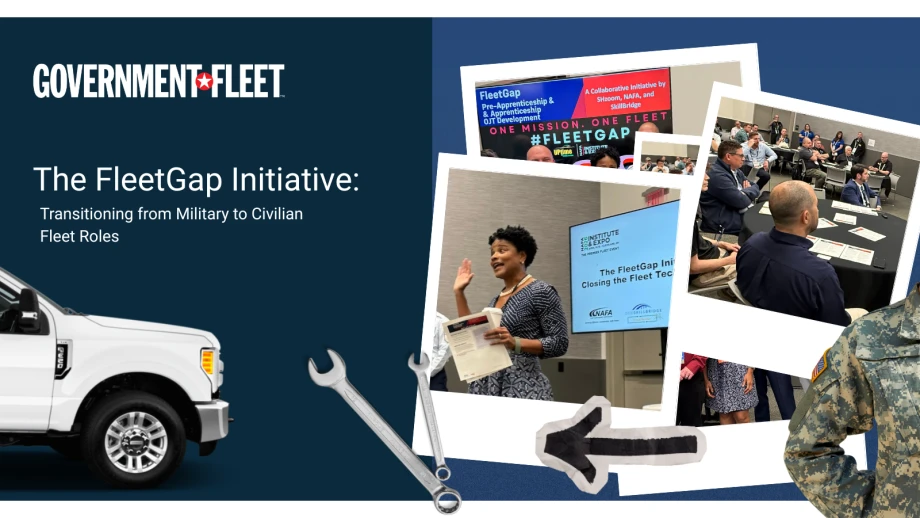
The FleetGap Initiative aims to address the workforce shortage in fleets by leveraging the skills of transitioning service members.
Credit:
Government Fleet | Schzoom
10 min to read
“There was no pathway for military talent to move into public or private fleet roles.”
That gap became impossible for Ingrid Cook Moravitz to ignore as SHzoom’s work took her team deeper into Air Force environments through its accident governance solution, UPtime.
What began with a Small Business Innovation Research award soon revealed something much larger than a technology opportunity. It exposed a workforce problem spanning fleet sectors and a transition pipeline that did not exist for military professionals with relevant experience.
“The FleetGap initiative began through the SHzoom team’s work with their accident governance solution, UPtime,” Cook Moravitz said. “We won a Small Business Innovation Research award through that work, which took us across many Air Force spaces, and it really transcended fleet sectors.”
As she moved through those spaces, Cook Moravitz said she saw how closely military logistics and fleet operations aligned with the broader fleet industry. “What I found is that what fleets do, whether in the private sector, public sector, or federal government, still comes down to the same skill set,” she said. “They may call it something a little different, but they deal with the same problems.”
That realization led her to retired United States Air Force Chief Master Sergeant Adam M. Walker, who introduced her to SkillBridge and helped sharpen her view of the disconnect facing service members preparing to transition out of the military.
“Before our Air Force contract and visiting those spaces, I had no idea there were so many fleet professionals within the military and logistics who had no pathway as they were transitioning out,” she said. “There was no pathway for military talent to move into public or private fleet roles. SkillBridge existed, and other programs existed, but nothing specific to fleet.”
Another piece clicked into place during that same SBIR work. Cook Moravitz said she learned that the federal government funds the transition period, a detail that stood out because of what she had recently heard from fleet leaders struggling to hire technicians. “I thought, are you kidding me?” she said. “I had just finished doing a course at NAFA about workforce development, specifically around finding qualified technicians with all the emerging technology. More than 60 hands went up from leaders who said they were short on techs. Some had been down technicians for six months or more. One had been down for over a year.”
One key gap that Hernandez noticed while writing his initial resume was the lack of effective recognition of his military experience in civilian hiring processes.
"Military personnel often struggle to articulate their skills and responsibilities in a way that aligns with civilian standards, making it difficult for employers to understand their capabilities fully," he said.
Additionally, one of the biggest challenges that Hernandez saw was the terminology gap: military personnel perform duties similar to those of their civilian counterparts, but often describe their work using specialized military jargon unfamiliar to civilian employers.
"This language barrier can lead to misunderstandings or undervaluation of their skills, even though they are performing at a comparable level," Hernandez explained. "Military members may also find it difficult to highlight their accomplishments in a way that resonates with civilian hiring managers, making it harder for them to communicate their qualifications effectively."
Taken together, those realities helped shape FleetGap into a program that is designed to connect transitioning military talent with fleets that urgently need skilled workers. “So this really came together,” Cook Moravitz said. “It ensures a strong match and helps fleets get staffed.”
Preparing Talent for Civilian Fleet Roles
FleetGap’s training model was built to do more than place candidates. It was designed to prepare transitioning military personnel for civilian fleet careers through a combination of formal instruction, hands-on experience, and peer support that helps translate military experience into the language of the industry.
“There is an online training process and a hands-on training process,” Cook Moravitz said. “The first phase is 30 days of blended training, virtual and in-person. After that, participants receive structured on-the-job training, ranging from roughly 420 to 580 hours.”
Cook Moravitz said the curriculum includes core civilian fleet leadership topics such as budgeting, SOP development, and lifecycle management. It also reflects SHzoom’s emphasis on the technology side of fleet, with material covering cybersecurity, telematics, EVs, workplace communication, and fleet operations beyond accident governance.
The program also addresses the transition into civilian employment itself, helping participants build resumes that speak to civilian fleet leaders while introducing workplace conduct and shop orientation. After that, the training shifts into two to three months of on-the-job learning, with employers able to tailor that experience around their own operational needs, whether in preventive maintenance, diagnostic repair, or shop administration.
A civilian fleet peer mentor is another part of the model. That role gives participants a connection not only to the hiring leader, but also to someone who has already made the move into a civilian fleet position. Cook Moravitz said that piece has already shown its value, including through SHzoom’s LinkedIn series, Future Fleet Fridays, where those connections began forming in real time.
For Cook Moravitz, that mentorship matters because the challenge is often not the work itself, but how that work is described. Through SHzoom’s work with local government, the Air Force, and the federal sector, she said she came to see that many of the processes are essentially the same, even when the terminology is not. That difference can make it harder for military professionals to explain how closely their experience aligns with civilian fleet roles.
“That is why civilian fleet peer mentorship matters,” she said. “It helps close the gap and helps people translate military skills into civilian terms. That can be scary. Imagine being in the military for more than 20 years, and then struggling to articulate that you have been doing the same work all along, just under different terminology.”
Hernandez hopes that civilian fleet leaders recognize the immense value of the skills and qualities that military personnel bring, including technical expertise, discipline, leadership, adaptability, and problem-solving.
"Many of those individuals are trained to operate complex systems, work under pressure, and lead teams, attributes highly transferable to civilian fleet management," he stated. "Understanding and appreciating these strengths can help leaders better integrate military talent into their organizations and create pathways for successful transitions, ultimately enriching the civilian fleet workforce with highly capable and disciplined professionals."
Why Employers Matter to FleetGap’s Success
Chesterfield County, Virginia, has become an early proof of concept for how the model can work in practice. As the first employer bringing on a participant, the county is helping SHzoom build the framework for what FleetGap could look like at scale. What might normally have been a difficult and time-consuming process for an employer, Cook Moravitz said, has been streamlined into a more repeatable model.
Craig Willingham, CAFM, Chesterfield County assistant director of general services, said the county was drawn to FleetGap because it saw the program as a meaningful opportunity to help service members transition from military to civilian life while addressing a challenge many public fleets face: an aging technician workforce, increasing retirements, and a shrinking talent pool.
"Several members of our team served in the military and can understand the transition, but they also understand structure, accountability, responsibility, and the mission," said Willingham.
Chesterfield County Fleet Manager David Cottingham Jr. added thatthe program "provides public fleets with another source to find quality talent that could potentially stabilize their future workforce for both the short and long term."
Cottingham recommended that other interested fleets view the program as a strategic opportunity to strengthen their operations.
"Whether you need technicians in the shop or support in administrative or supervisory roles, these military professionals could be the critical talent your organization is missing."
Another advantage is that employers enter the process early. By the time a participant is selected, that individual has already completed a month of online training through NAFA, giving both sides a stronger foundation before the hands-on portion begins. Cook Moravitz said the structure has generated enthusiasm among SkillBridge partners and has positioned the program for a high rate of eventual hires.
Under that framework, everything moves through a single umbrella approval rather than requiring repeated HR or legal approvals or a new memorandum of understanding each time. Once that is in place, SHzoom and NAFA post and source the position through the SkillBridge website, after which the hiring leader or HR team screens candidates.
The participant then moves through the 30-day online training and the on-the-job phase while receiving mentorship from both the hiring leader and a peer mentor.
Only after fully separating from the Air Force can that individual be hired on with full compensation. Cook Moravitz said that point is especially important because employers are not allowed to pay participants during the program itself.
She recalled that Chesterfield County was ready to place someone on payroll immediately, only to learn that compensation cannot begin until military separation is complete.
For now, she said, that makes FleetGap a low-risk program from the employer’s perspective.
Cook Moravitz said SkillBridge has also encouraged stronger alignment between federal experience and local government fleet opportunities, making the public sector an important part of the initiative.
At the same time, she said many transitioning service members are less focused on sector than on staying in fleet and logistics work that matters to them. In that sense, FleetGap’s value is in creating a dedicated pathway into either public or private fleet roles, even as early traction has been especially strong with Chesterfield County’s public sector opening.
Scaling the Effort Across Operations
As interest in FleetGap grows, Cook Moravitz said the next challenge is building an infrastructure that can scale without becoming burdensome for any one organization. At the moment, SHzoom is still managing the form process, but she said that will need to become more centralized as the initiative expands in order to better serve transitioning military personnel.
That shift, she said, will require NAFA to take on a larger role, particularly in bringing more employers into the program.
“NAFA understands how important training and connections are, as that is our core mission, and programs like this fill an important gap in our industry,” said Bill Schankel, CAE, CEO of NAFA Fleet Management Association. “Connecting active military, veterans, and our member organizations is something we are very proud to facilitate and bring new, very qualified professionals into the fleet space.”
Cook Moravitz made clear that candidate interest is not the issue. Transitioning military talent is already coming in steadily. The bigger need now is employer participation.
With that in mind, she said one of the goals for NAFA I&E is to bring more hiring leaders into the conversation and show them how simple the framework can be in practice.
A Call to Government Fleets
For Cook Moravitz, the message to government fleet leaders is straightforward: FleetGap is designed to help federal fleet professionals transition into local government roles, but its success will depend on broad participation. She said SHzoom, NAFA, and SkillBridge remain committed to that goal, and that the foundation is now in place to move the initiative forward.
At the center of that effort is FleetGap’s guiding idea, “One Mission. One Fleet.” Cook Moravitz said that sense of unity is essential if the program is going to scale. The interest is already there. The next step is finding ways to engage more employers and partners in a meaningful, sustainable way.
Cook Moravitz said support does not have to begin with hiring. Fleet professionals can also get involved by serving as civilian peer mentors or by helping transitioning military personnel better understand what local government fleet jobs actually look like through role overviews, shop tours, or discussions of day-to-day responsibilities. She said that kind of visibility can help participants see where they fit while giving employers a stronger pool of informed applicants.
That perspective is shared by Adam M. Walker, chief master sergeant, U.S. Air Force, Vehicle Management MFM, who said military fleet professionals bring more than technical experience to the civilian workforce.
“Our military members bring a sense of service and commitment,” Walker said. “Our background in fleet is the same one that has become the industry standard, and is bolstered by critical thinking, analysis, and an overwhelming dedication to completing the mission.”
Cook Moravitz pointed to the April event as an important step in that process. Attendees, she said, will hear directly from the first hiring leader to use the framework and, ideally, meet the first participant moving through the cohort. But she was also clear that the program is still evolving. FleetGap, she said, is a collaborative effort, not a finished product, and it will take support from across the fleet community to reach its potential.
In her view, awareness may now be the biggest remaining barrier. The framework is in place, but its long-term success will depend on whether more fleet employers step forward to mentor, train, and ultimately hire the first wave of participants.
Subscribe to Our Newsletter
More Operations

Is Keeping Older Fleet Vehicles Really Saving Money?
Is keeping vehicles longer saving money, and what happens when a diagnostic test points to the wrong fix?
Read More →
How Smart Fleet Strategy Can Help Local Government Agencies Do More with Less
Keeping a vehicle longer may ease this year’s budget, but what does it cost the next one? A closer look at fleet decisions can reveal opportunities to reduce spending while protecting essential services.
Read More →
Connect with Government Fleet on LinkedIn
From industry news and fleet management strategies to conversations with peers, Government Fleet's LinkedIn page offers public-sector fleet professionals another way to stay informed and connected.
Read More →
Town of Queen Creek Named Most Successful Fleet Award Winner of Inaugural RTA Fleet Success Awards
Five fleets were honored at RTA Connect 2026 in Chicago for excellence across resource efficiency, intentional culture, risk management, and stakeholder satisfaction.
Read More →
Sponsored•October 14, 2026
A buyer's guide to fleet management software in 2027
Buying fleet management software in 2027 means looking beyond features and price. As fleet operations, technology and expectations evolve, this guide explores what today’s fleet professionals should consider when choosing a system that can deliver value now and adapt to what comes next.
Read More →
Hazard Alerts, Fleet Car Sales Rise and a New Shuttle Concept
Fleet car sales doubled, but the bigger picture tells a different story in this week’s roundup.
Read More →
How St. Johns County Turned Fleet Data Into Better Replacement Decisions
St. Johns County, Florida, had fleet data, but turning it into reliable decision guidance was another matter. Instead of starting over with a new fleet management system, the county connected existing tools and built a scoring system that gives managers an objective look at fleet health.
Read More →
Fleet Forward Conference Introduces One-Day Passes for 2026
New one-day registration lets fleet professionals attend Tuesday, Wednesday, or Thursday, with passes available for $249.
Read More →
ENC Unveils its ZAVIR Medium-Duty Shuttle
Two variants of the concept shuttles were revealed: a low-floor configuration and a high-floor configuration.
Read More →
Could Your Next Fleet Technician Start as an Intern?
What if your next technician hasn’t worked in a fleet shop yet? What fleets are doing to free up time.
Read More →