




Public Sector Fleet Manager Salaries Rise Slightly
Most respondents in Government Fleet’s biennial Industry Handbook survey saw at least a minor salary increase. A breakdown and analysis of the data.

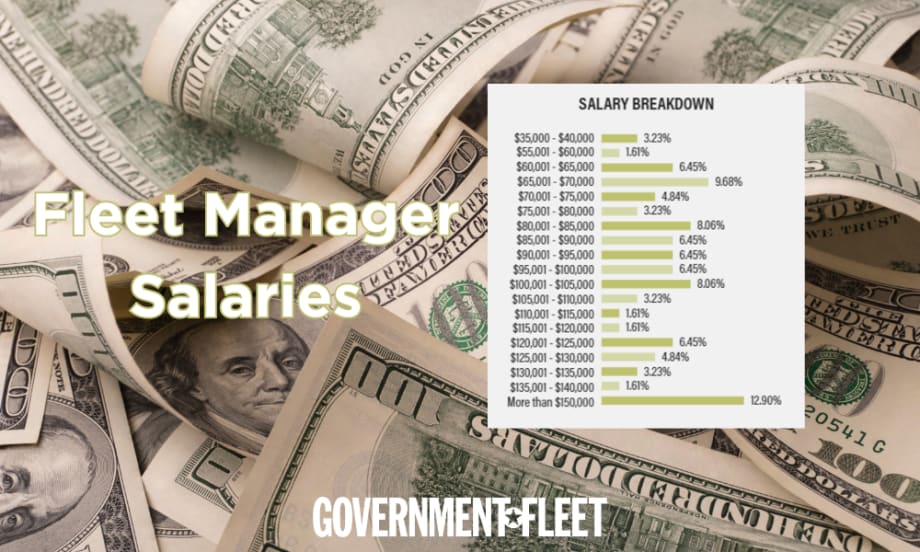
More than half of respondents — 56.45% — make less than $100,001 annually.
Photo: Canva/Government Fleet
The 2023 Salaries survey in Government Fleet’s biennial Industry Handbook for public sector fleet managers provided a clear picture of what fleet managers are seeing on their paychecks.
The handbook can act as a good general gauge for the state of the industry, but there are a few things to keep in mind, including the respondents’ backgrounds.
Experienced Fleet Managers Make Up Majority of Survey Respondents
The vast majority of respondents have been in the workforce for several decades. Here’s how the age groups break down, based on what generation the respondents identify with:
Baby Boomer (born 1946-1964): 36.36%.
Generation X (born 1965-1980): 54.55%.
Millennial (born 1981-1994): 9.09%.
Additionally, the state where the most fleet managers responded to the survey from was California. The other state with the most respondents was Florida. Both age and geographical location can affect salary.
The average salary of fleet manager survey respondents was $105,080.65. Overall, that’s 6.45% higher than the average reported in 2021 — $98,514.
Breaking Down the Salaries
Nearly 13% of respondents make more than $150,000 annually. That’s the range that represented the highest number of survey respondents. After that was $65,001-$70,000, which represented 9.68% of respondents. Tied for third was 8.06% of respondents each making between $80,001-$85,000 and $100,001-$105,000.
More than half of respondents — 56.45% — make less than $100,001 annually.
Are Fleet Managers Seeing Raises?
Most survey respondents saw at least some sort of salary change within the last year. Nearly 41% of respondents had an increase of up to 3%, while almost 40% of respondents received a salary increase between 4% and 6%. Just over 3% of those surveyed saw an increase of 7% or more.
Still, 13.64% of respondents saw no change to their salary in the last year. Another 1.52% of respondents had a decrease of 7% or more.

Most survey respondents saw at least some sort of salary change within the last year.
Photo: Canva/Government Fleet
About the Data
In June and July 2023, Government Fleet magazine solicited responses to a biennial survey from its readership, receiving 81 qualified responses from a diverse group of public fleet professionals.
The information and analysis above come from this opt-in survey.
Want to participate in Government Fleet’s next survey? Government Fleet is teaming up with Work Truck and Automotive Fleet to conduct a salary survey for fleet managers to determine the average salary for a fleet management position in both commercial and public sector fleets. The deadline for responses is Jan. 31, 2024.
More Operations

What Can Disappear After a Fleet Crash?
This week, we look at drone footage, what fleets should document before repairs begin, and share a quick poll.

Does Your Government Fleet Handle Refuse and Waste Operations? Take Our Poll
Government Fleet wants to hear from public-sector fleet professionals about their responsibilities for refuse collection and waste management equipment.

Fleet Replacement Decisions, Waste Fleet Technology and the GFX Deadline
Is your next vehicle the right fit, can your records settle a missed pickup dispute, and what could your fleet teach others at GFX 2027?

Is Delaying Fleet Replacement Really Saving Money?
Could delaying replacement cost your fleet more than it saves? This week’s recap takes a closer look, plus an update on GFX 2027.

What Government Fleets Are Missing About Their True Costs
What are fleet budgets missing, and how can agencies use the data they already collect to make a stronger case for change?

Rethinking Fleet Decisions From the Budget Office to the Shop
This October we looked back at how public fleets are reconsidering familiar processes and using what they learn to make better decisions.

Who Owns the Message on a Refuse Truck?
Refuse trucks can carry public messages into neighborhoods, but keeping those messages current takes planning and clear responsibility.

Who Deserves Fleet Recognition and What Could You Teach at GFX?
Who helped shape your fleet career, and what have you learned that could help someone else?

What’s Haunting Public Sector Fleets?
Public sector fleet challenges rarely happen in isolation, and addressing one often means understanding how it connects to another.

Is Keeping Older Fleet Vehicles Really Saving Money?
Is keeping vehicles longer saving money, and what happens when a diagnostic test points to the wrong fix?