





Keep Reading: Building Stronger Cultures and Smarter Leadership in Fleet Organizations
Making It Work: Practical Fleet Hacks From Across the Country
How public sector fleets are finding practical, low-cost ways to maintain service levels and adapt to long lead times, tight budgets, and staffing challenges.
November 15, 2025

Public-sector fleets are finding practical, low-cost ways to maintain service levels and adapt to long lead times, tight budgets, and staffing challenges.
Photo: Government Fleet
8 min to read
From extended delivery delays to strained budgets, staffing shortages, and more, today's challenges have reshaped how municipal fleets operate. Instead of waiting for ideal conditions, fleet managers are adapting by stretching equipment further, shifting staff where they’re needed most, and leaning on telematics and fabrication work to fill the gaps. What's emerged is a sector defined not by scarcity, but by resourcefulness.
Those adjustments often start with simple, practical hacks that keep vehicles in service and shops functioning despite ongoing constraints. The following examples highlight how agencies are finding workable solutions in less-than-ideal conditions.
Hacks and Workarounds for Stretching Fleet Resources
Extended build and delivery timelines continue to be one of the biggest operational hurdles for municipal fleets, according to Kelly Reagan, fleet administrator for the City of Columbus, Ohio, Fleet Management Division. The fleet's heavy trucks—especially refuse front loaders and automated side loaders—have been on order for more than three years.
"We’re still waiting on almost 35 units," Reagan said. "The same holds true for specialized equipment like mid-mount and tiller ladders, which now take two to three years from order to delivery."
To keep services running, the Columbus fleet developed an aggressive asset-life management strategy: investing repair dollars only where they produce meaningful uptime. Rather than retiring “end-of-life” trucks outright, the operation assesses which ones can safely provide another season or two of service.
As Reagan put it, "It’s not ideal—but it keeps our operations moving until replacements arrive."
"Managing a public-sector fleet is ultimately about providing reliable transportation solutions for the community. Challenges will always surface—supply shortages, staff turnover, shifting budgets—but our role is to translate those problems into actionable solutions. Taking an issue to leadership without bringing a plan alongside it is a recipe for frustration. Bring the solutions. That’s how public-sector fleets earn trust and prove their value.” — Kelly Reagan, fleet administrator for the City of Columbus, Ohio, Fleet Management Division
For the City of Raleigh, North Carolina, Fleet Management Operations Division, it all comes down to working with various departments as well as the community.
"We often use interns, fellows, and climate action interns and work closely with other departments, such as the office of sustainability, parks and recreation, stormwater, and the police department, to work jointly on various projects when additional resources are needed," explained Fleet Operations Manager Rick Longobart.
Staffing flexibility is also a key strategy for Alison Kerstetter, fleet manager for the City of Sacramento, California. She said their most valuable resource is their staff, and that recruitment and retention remain industry-wide challenges. To keep shops staffed and service to customers, the fleet temporarily moves employees to different shops to fill vacancies. The city has five maintenance shops with different mixes of vehicles and equipment.
“Not only does this allow us to keep service levels up, but it allows newer staff to get more mechanical experience on the different types of fleet assets the city operates,” Kerstetter said.
Darryl Syler, CPFP, fleet services director for the City of Alexandria, Virginia, leans on a temporary staffing service and cross-trains staff to wear multiple hats, rather than adding full-time positions they can’t sustain. On the asset side, Alexandria extends the lifecycle of equipment where it makes sense and reallocates underutilized vehicles to other departments that can put them to work.
Unique Solutions for Everyday Fleet Operations
The Raleigh team always makes sure to find new and fun events to get together during and after hours. The operation holds monthly get-togethers after hours called “Fleet Geeks, " a monthly spotlight on an employee, with pictures of employees' past, younger pictures, first car owned, and favorite dream cars. They also have a “Beat the Heat with Fleet” summer activity, featuring games, fun, and recognition, including food and a dunk tank for the boss.
"Better to beg for forgiveness than to seek permission.” — Darryl Syler, CPFP, fleet services director for the City of Alexandria, Virginia
The Alexandria fleet uses route planning and cameras as part of its telematics and fleet software system. The operation has also standardized technician work hours and uses a compressed schedule. The team also fabricates brackets for the salt boxes to drop into the trucks.
Dakota County, Minnesota, Fleet Manager Kevin Schlangen, CPFP, CAFM, CEM, described reusing plow cutting edges to make curb scrubbers. His team reuses worn plow cutting edges by cutting off the end of the edge while keeping the last three bolt holes. They weld a solid three-inch cold roll pipe on the end, which becomes the wear item that rubs against the curb when plowing snow so the plow does not take as much damage as it scrapes along the curb.
For a “MacGyver” solution, he pointed to the fabrication of bison pushers out of steel fence that can attach onto a Bobcat to help move bison from one paddock to another.
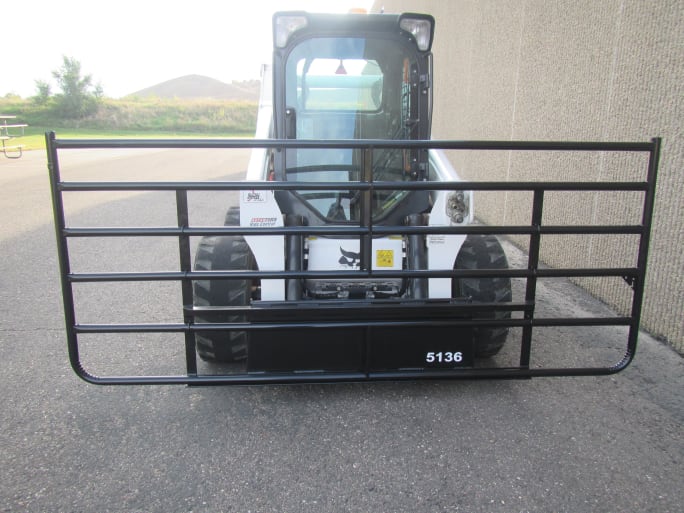
Dakota County has fabricated Bison pushers out of steel fence that can attach onto a Bobcat to help move Bison from one paddock to another.
Photo: Dakota County
Making the Most of Telematics and Fleet Software
Raleigh's fleet team uses telematics to measure driver behavior and send out a monthly driver scorecard. The operation uses telematics to automate a keyless, Bluetooth web-enabled motor pool application, eliminating the need for keys or human intervention.
"Our telematics data is the backbone of our annual underutilization review," explained Reagan. "While most organizations track mileage, we dig deeper—analyzing “key-on” events and total run-time hours."
This approach captures the true workload of a vehicle and gives the Columbus operation the evidence to reallocate resources citywide. Reagan noted that this is a more accurate reflection of how equipment is being used, or in some cases, underused.
"Using this data-driven lens, we’ve been able to make defensible decisions about redeployment and right-sizing—something leadership appreciates during tight budget cycles," said Reagan.
The City of Sacramento began conducting its monthly shop inspections, as well as daily fuel island inspections, through a telematics program. The fleet takes advantage of using tablets for staff to use, along with forms for the inspections on which they can enter notes for items that may need to be noted or repaired. The move has helped them go paperless, and the inspections are stored in the cloud-based telematics system, allowing them to access any of them at any time.
"Learn to deal with multiple personality disorders. To survive in fleet, you need to realize that the vehicles or equipment are only part of your job. Trust your data and not what you are told. Learn to say NO…with supporting documentation for the NO answer. Long-standing, saying that relates to fleet even more today than in the past. We have done so much with so little for so long that soon we will be expected to do everything with nothing at all.” — Kevin Schlangen, CPFP, CAFM, CEM, fleet manager for Dakota County, Minnesota
Schlangen said his team uses telematics to track the number of hours spent in the parks system for enforcement and patrol by the sheriff’s office. They created geofences around all the county parks and set up a rule to track every time one of the sheriff’s park rangers was in the various parks.
This generates a detailed report for each park, along with summary reports for reporting and tracking. It is a monthly automated report that can also be run manually as needed, saving a large amount of time and effort.
In Alexandria, Syler’s team leans on its systems for route planning and camera integration. Using telematics-supported routing helps the fleet tighten up runs, reduce wasted miles, and better align resources with daily demand, while onboard cameras provide additional visibility into operations and driver behavior.
Small Operational Changes for Big Results
Some of the most important lessons in fleet don’t come from big projects, but from small habits hidden in the workday. At the City of Sacramento fleet, one of the biggest gains came from taking a hard look at a simple daily routine. Years ago, under a different fleet team, a cleanup period was instituted.
"Don’t be an a--, allow employees to learn more skills and teach them everything they need to know to be successful.” — Rick Longobart, Fleet Operations Manager for the City of Raleigh, North Carolina
Staff members would have 10 minutes prior to their lunchtime and 10 minutes prior to their quitting time to wash their hands, clean their workstations, and remove their uniforms if needed. In some cases, this time was being used for cleanup, and in others, it was used for other purposes other than what it was intended.
“It doesn’t seem like a lot, but annually it came out to 4,500 billable hours that were not being utilized,” Kerstetter noted. “Of course, over the course of a year, we didn’t gain all those hours for billing, but it did assist with more billable hours for staff.”
Until recently, the City of Columbus fleet drivers juggled two fuel cards—one assigned to more than 4,000 employees and another linked to roughly 4,500 vehicles. The fleet operation has now replaced both systems with a single digital fob solution.
The fob automatically pulls a vehicle’s mileage from its GPS unit at the pump, eliminating the need for manual entry. The change has saved hundreds of administrative hours, improved fuel-use accuracy, and dramatically reduced data-correction work. It’s a classic example of a simple technology shift delivering a large operational payoff.
“Listen to your staff about things that could make their work better; listen to shop staff for ideas for efficiencies through tooling, diagnostic devices, or process changes. Speak with your administrative staff about procedures and ways to make their jobs easier as well. Not all of the ideas may be able to come to fruition, but if they make sense and are doable, it can make a big difference in your operation.” — Alison Kerstetter, fleet manager for the City of Sacramento, California
Schlangen said one small change that delivered big results was going to foam-filled tires for all off-road utility vehicles. He called it a relatively small expense that saves a large amount of time with flat tires.
Over in Raleigh, it's all about collaboration with other departments and internal staff with the goal to empower employees to "try new responsibilities and programs that impact the operation and build professional development," according to Longobart.
Subscribe to Our Newsletter
More Operations

Is Keeping Older Fleet Vehicles Really Saving Money?
Is keeping vehicles longer saving money, and what happens when a diagnostic test points to the wrong fix?
Read More →
How Smart Fleet Strategy Can Help Local Government Agencies Do More with Less
Keeping a vehicle longer may ease this year’s budget, but what does it cost the next one? A closer look at fleet decisions can reveal opportunities to reduce spending while protecting essential services.
Read More →
Connect with Government Fleet on LinkedIn
From industry news and fleet management strategies to conversations with peers, Government Fleet's LinkedIn page offers public-sector fleet professionals another way to stay informed and connected.
Read More →
Town of Queen Creek Named Most Successful Fleet Award Winner of Inaugural RTA Fleet Success Awards
Five fleets were honored at RTA Connect 2026 in Chicago for excellence across resource efficiency, intentional culture, risk management, and stakeholder satisfaction.
Read More →
Sponsored•October 14, 2026
A buyer's guide to fleet management software in 2027
Buying fleet management software in 2027 means looking beyond features and price. As fleet operations, technology and expectations evolve, this guide explores what today’s fleet professionals should consider when choosing a system that can deliver value now and adapt to what comes next.
Read More →
Hazard Alerts, Fleet Car Sales Rise and a New Shuttle Concept
Fleet car sales doubled, but the bigger picture tells a different story in this week’s roundup.
Read More →
How St. Johns County Turned Fleet Data Into Better Replacement Decisions
St. Johns County, Florida, had fleet data, but turning it into reliable decision guidance was another matter. Instead of starting over with a new fleet management system, the county connected existing tools and built a scoring system that gives managers an objective look at fleet health.
Read More →
Fleet Forward Conference Introduces One-Day Passes for 2026
New one-day registration lets fleet professionals attend Tuesday, Wednesday, or Thursday, with passes available for $249.
Read More →
ENC Unveils its ZAVIR Medium-Duty Shuttle
Two variants of the concept shuttles were revealed: a low-floor configuration and a high-floor configuration.
Read More →
Could Your Next Fleet Technician Start as an Intern?
What if your next technician hasn’t worked in a fleet shop yet? What fleets are doing to free up time.
Read More →