





Similar Content: Leading with Care: Robert Stine Named 2021 Public Sector Fleet Manager of the Year
Here are the Public Fleet Hall of Fame Inductees
Inductees are recognized for their significant contributions to the industry.
February 23, 2022
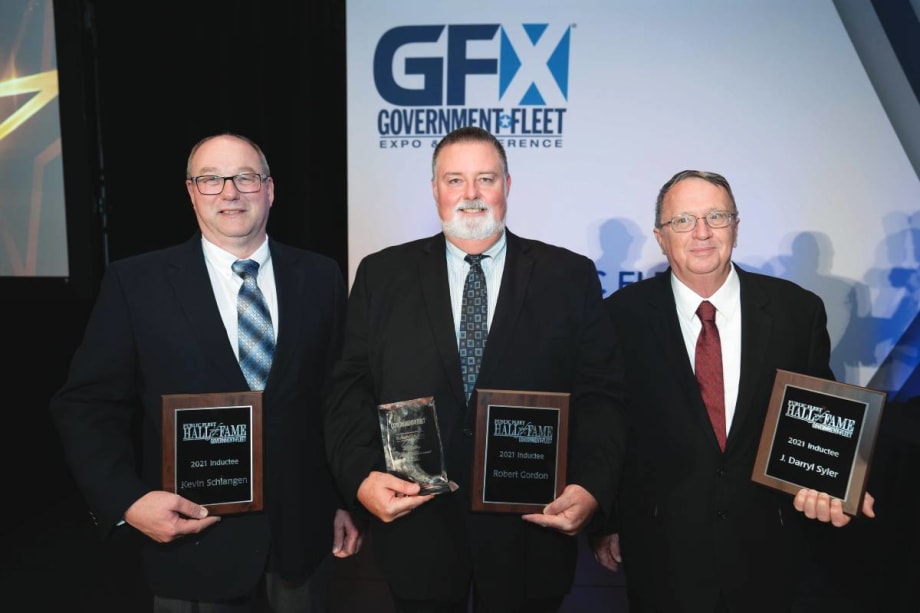
(L-R) Kevin Schlangen, Robert Gordon, and J. Darryl Syler are pictured here at the Government Fleet Expo & Conference (GFX) in Orlando in November 2021.
Photo: Ross Stewart Photoraphy
3 min to read
The government fleet industry welcomed the latest inductees to the Public Fleet Hall of Fame at the Government Fleet Expo & Conference (GFX) on Nov. 16, 2021. The award, sponsored by Sourcewell, recognizes fleet leaders who have contributed significantly to the public fleet profession.
Fleet professionals, suppliers, and other members of the industry select the inductees via an online ballot. Hall of Fame members must have at least 20 years of industry experience, including 10 years working for a public fleet or a private company contracted to manage a public fleet.
These fleet professionals join a group of 37 who have been inducted into the Public Fleet Hall of Fame since its establishment in 2014.
Robert Gordon, DeKalb County, Georgia
Years in fleet: 34
Robert Gordon started an apprenticeship program at DeKalb County in 2018 that has grown to eight positions and is in partnership with six tech schools; he has hired four technicians from the program. Gordon and the fleet team changed the vehicle replacement process from a subjective to an analytical process and developed a process to extract fleet management information system (FMIS) data to easily identify units needed for replacement.
Gordon is on the board of directors for Clean Cities Georgia and advisory committees for various technical colleges. Gordon has been a speaker at fleet conferences. He earned a 2018 NAFA FLEXY award and is an active member of NAFA, APWA, and the Southeast Governmental Fleet Managers Association. Under his leadership, the fleet achieved first place in the 100 Best Fleets award in 2018.
Kevin Schlangen, CAFM, CEM, CPFP, Dakota County, Minnesota
Years in fleet: 40
The county consolidated 16 departments, including law enforcement, to create the Fleet Management Department in 2007. Kevin Schlangen, then managing the transportation fleet, took over. He oversaw the creation of county-wide fleet programs, operational procedures, capital program, policy development, and reporting.
Schlangen has developed community engagement and outreach programs to demonstrate the value of professional fleet management and encourage a new generation to develop a career in fleet management. During his time at Dakota County, the fleet operation received local and national recognition, including the NAFA FLEXY, AEMP Fleet Masters, 100 Best Fleets, Government Green Fleets, and Leading Fleets awards. He has written articles for trade magazines and has been a speaker at various local and national events. He was named APWA’s Professional Manager of the Year in public fleet in 2011.
J. Darryl Syler, State of Ohio; City of Dublin, Ohio; City of Little Rock, Arkansas; U.S. Army
Years in fleet: 41
J. Darryl Syler is currently the state fleet administrator for Ohio. Since coming over to the state, he has reduced the managed fleet by 5% and written a new sustainability policy.
At Dublin, he oversaw the building of a compressed natural gas (CNG) fueling station and the addition of 50 CNG assets. Dublin was awarded the Leading Public Fleet for Green Sustainability at the 2018 Advanced Clean Transportation (ACT) Expo and the No. 1 Small Fleet in the Leading Fleets award in 2018 and 2019. Syler is an active member of APWA, NAFA, and the National Conference of State Fleet Administrators (NCSFA). Syler retired from the U.S. Army in 2003 after 24 years and served as a Motor Sergeant in Germany, South Korea, Kuwait, Kansas, and Georgia.
Subscribe to Our Newsletter
More Operations

Is Keeping Older Fleet Vehicles Really Saving Money?
Is keeping vehicles longer saving money, and what happens when a diagnostic test points to the wrong fix?
Read More →
How Smart Fleet Strategy Can Help Local Government Agencies Do More with Less
Keeping a vehicle longer may ease this year’s budget, but what does it cost the next one? A closer look at fleet decisions can reveal opportunities to reduce spending while protecting essential services.
Read More →
Connect with Government Fleet on LinkedIn
From industry news and fleet management strategies to conversations with peers, Government Fleet's LinkedIn page offers public-sector fleet professionals another way to stay informed and connected.
Read More →
Town of Queen Creek Named Most Successful Fleet Award Winner of Inaugural RTA Fleet Success Awards
Five fleets were honored at RTA Connect 2026 in Chicago for excellence across resource efficiency, intentional culture, risk management, and stakeholder satisfaction.
Read More →
Sponsored•October 14, 2026
A buyer's guide to fleet management software in 2027
Buying fleet management software in 2027 means looking beyond features and price. As fleet operations, technology and expectations evolve, this guide explores what today’s fleet professionals should consider when choosing a system that can deliver value now and adapt to what comes next.
Read More →
Hazard Alerts, Fleet Car Sales Rise and a New Shuttle Concept
Fleet car sales doubled, but the bigger picture tells a different story in this week’s roundup.
Read More →
How St. Johns County Turned Fleet Data Into Better Replacement Decisions
St. Johns County, Florida, had fleet data, but turning it into reliable decision guidance was another matter. Instead of starting over with a new fleet management system, the county connected existing tools and built a scoring system that gives managers an objective look at fleet health.
Read More →
Fleet Forward Conference Introduces One-Day Passes for 2026
New one-day registration lets fleet professionals attend Tuesday, Wednesday, or Thursday, with passes available for $249.
Read More →
ENC Unveils its ZAVIR Medium-Duty Shuttle
Two variants of the concept shuttles were revealed: a low-floor configuration and a high-floor configuration.
Read More →
Could Your Next Fleet Technician Start as an Intern?
What if your next technician hasn’t worked in a fleet shop yet? What fleets are doing to free up time.
Read More →