




How Salem, Oregon, Turned Culture Change Into a No. 1 Fleet Ranking
Fleet availability reached 98.95% after Salem empowered employees and used performance data to guide years of steady improvement.
August 24, 2026

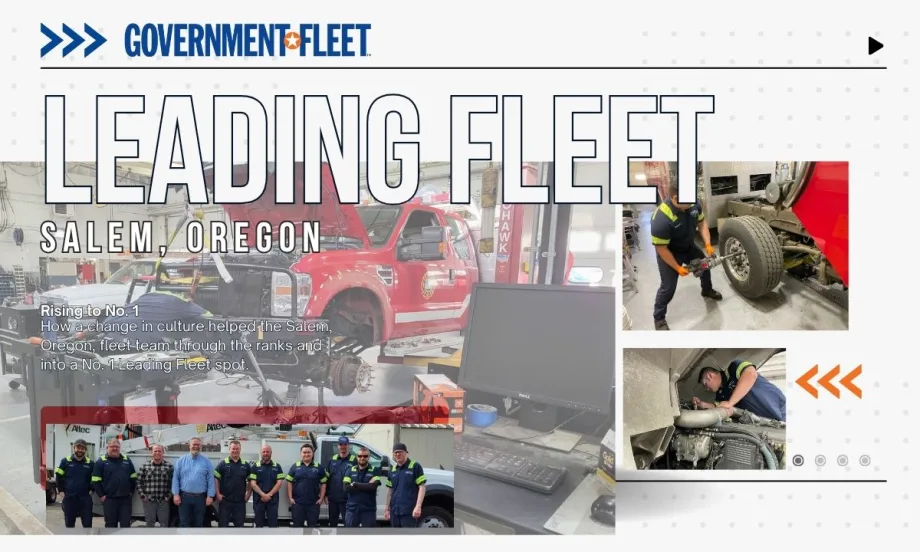
Fleet availability reached 98.95% after Salem empowered employees and used performance data to guide years of steady improvement.
Credit:
Government Fleet | Salem
8 min to read
Each year, a new No. 1 Leading Fleet is named and, each year, Government Fleet asks the same question: What led you to this moment in the fleet operation?
Salem, Oregon, has shifted positions on the Leading Fleets leaderboard each year finally taking the number one spot this year. So what changed?
We caught up with Salem’s Fleet Supervisor Gabe Grooms and IT Director Jim Schmidt to dig into just this.
The Shift That Brought Salem to the Top
When asked about what changed within Salem’s fleet operation Schmidt brought up one word: culture.
When the team began to reflect inward on that culture, the operation became more proactive, positive, empowered, and data-informed. Schmidt said the staff gained a voice in decisions and took greater ownership of customer service, shop safety, equipment, and work processes.
It was that cultural shift that created the foundation for every operational improvement that followed. Customers even noticed the difference and complimented the team's progress. And, according to Schmidt, fleet availability increased from 88.4% in 2016 to 98.95% in 2025.
“Attitude had the greatest effect,” Schmidt said. “When the team's attitude toward customers, one another, the work, and the operation became more positive, customers noticed and told us.”
Another change happened when staff began putting forward their own ideas and taking ownership, while communication became more timely and useful. An organization-wide survey drew more than 80% positive feedback, with respondents recognizing fleet as one of the most improved operations.
“Fleet exists to support the departments that serve the community, so customer feedback was the clearest sign that the change was working,” Schmidt said.
Grooms also sees the ranking as the result of momentum built over several years.
“Each year, we made practical improvements, whether updating vendor agreements, implementing new software, or improving the shop so work could be completed more efficiently,” he said. “Participation in fleet competitions also gave us an outside benchmark and encouraged us to keep improving. The individual changes varied in size, but their cumulative effect moved the operation forward.”
Telematics also had a significant reach throughout the operation. The Geographic Information System team uses it for mapping, Risk uses it to review accident information, supervisors track equipment, and operators complete pre- and post-trip inspections. Fleet receives current mileage and operating hours, along with check-engine, low-battery, and flat-tire alerts.
“Its value was visible across the organization because each department found practical ways to use the same information,” said Grooms.
Evaluating Fleet Performance to Guide Decisions
Fleet availability is the fleet’s primary service measure, according to Schmidt who pointed to 2025 when overall availability was 98.95% against a 98% goal; Fire was 99.0% and Police was 98.43%.
The fleet also tracks turnaround, preventive maintenance, labor, comebacks, parts, road calls, downtime, asset age, and utilization. The operation completed 87.3% of work within 24 hours against an 85% goal, and the three-hour parts fill rate reached 94.2% against an 85% goal.
“Preventive maintenance compliance at 67.5% and average asset age at 10.6 years show where work remains,” Schmidt said. “Telematics and the fleet management system connect the measures. Replacement decisions consider age, maintenance history, reliability, utilization, and operational importance. Shop measures identify workflow, staffing, scheduling, parts, or asset-condition issues.”
And where has the Salem fleet reduced costs without affecting service?
Their partnership with NAPA IBS to manage parts inventory produced the clearest example. The first-year results reported $258,287 in savings and the divestment of $187,480 in city-owned inventory.
The three-hour parts fill rate has now reached 94.2%, well above the 85% contractual goal, allowing them to support faster repairs and high vehicle availability. The fleet also reclassified two vacant parts positions to a grant writer and a data analyst, expanding organizational capacity without adding positions. Grant funding covered $187,000 of a $357,000 electric vehicle infrastructure project.
At the shop level, the team is continually looking for small savings that may also improve service, according to Grooms.
“Replacing individual bottles of windshield washer fluid with a 180-gallon bulk tank will save almost $2,500 annually, reduce plastic waste, and provide washer fluid on tap in the first three bays,” he said. “We also obtain three bids for product purchases, upfitting, repairs, and auto-body work. That practice controls cost while keeping us current on vendor pricing, capacity, and availability.”
Quick Takeaways from Schmidt and Grooms On:
Identifying Vehicles That are Underused or No Longer Needed
Salem uses telematics, the fleet management system, annual preventive maintenance inspections, and work-order history to compare mileage, operating hours, days used, assignment, and operational purpose. The reports identify assets suitable for reassignment, disposal, replacement, or conversion to an electric vehicle.
The fleet also used artificial intelligence to help create its utilization pilot, which reviewed vehicles used fewer than 60 days annually and removed six. They are now expanding the standard to vehicles used fewer than 90 days unless the department can demonstrate a clear operational need.
Customer Departments and Vehicle Planning
The Salem fleettreats departments as partners. Each year, they document service needs, operating conditions, desired features, photos, quotes, and other requests through the Vehicle Equipment Acquisition Request form.
Fleet reviews the request, applies maintenance, lifecycle cost, utilization, replacement, and standardization information, then works with the department to source the requested asset or a comparable option. Departments generally support standardization because they understand its effect on downtime, parts, and maintenance.
When a preference conflicts with a recommendation, they explain the impacts and return to the documented business need. Specialized equipment is supported when the work requires it, and the added cost or complexity is justified.
How Salem is Addressing technician recruitment, retention, and development
Recruitment begins with the operation’s local pipeline. The fleet participates in mock interviews for Chemeketa Community College's automotive and diesel programs, and currently employs three graduates.
They made the commercial driver's license optional at hire and provide paid training to obtain it. Retention depends on culture, flexible schedules, work-life balance, tool and boot allowances, tool replacement, and certification incentives of up to 15% of base pay.
All technicians hold Automotive Service Excellence certifications in truck and automotive repair; two are Master Automotive Service Excellence and Master Emergency Vehicle Technician certified. Staff averaged 42.2 training hours against a 40-hour goal and receive opportunities to serve in lead roles. The fleet still needs more affordable training suited to a diverse municipal fleet.
How Salem Balances Standardization with Departments’ Specialized Vehicle Needs
Salem standardizes platforms, components, and specifications to improve purchasing, technician training, parts availability, uptime, and resale value.
Departments support the approach because it reduces downtime, while the customer still drives the final configuration. Exceptions include a Puma 2400 ECO pond skimmer used in drinking-water treatment, Foursom electric golf carts at the wastewater facility, and a Tiny Mobile Robot that paints Parks fields.
These assets make up a small share of the fleet. The fleet works with users and technicians to ensure each asset meets the need and can be supported throughout its service life.
Areas of Improvement and Advice for Other Fleets Pursuing Similar Goals
Salem’s availability is strong, while the supporting measures show where the fleet still needs to improve. Preventive maintenance compliance increased from 59.2% to 67.5% but remains below the 90% standard. Average asset age is 10.6 years against a nine-year goal.
The operation’s next priorities include completing the 90-day utilization standard, rolling out the finalized Master Service Level Agreement, expanding predictive maintenance, and finding purposeful training within a constrained budget.
Schmidt and Grooms’ advice is to start with culture, build trust, involve the team, and keep customer service at the center. They also advise establishing an honest baseline, selecting a few meaningful measures, and making practical improvements that fit your staffing and budget. Small improvements add up over time.
Operational Challenges and Lessons Learned
One of the fleet’s most difficult challenges was a recent leadership transition. Using the succession plan that was in place fleet leadership appointed a Lead Technician as interim supervisor for six months while the shop was also short a technician.
“The team maintained morale and service through the summer workload while preventive maintenance compliance improved from 59.2% to 67.5%,” said Schmidt. “The experience confirmed that cross-training and succession planning protect service continuity.”
Still, the fleet continues to face common challenges seen across the public sector. Currently, nine technicians remain stretched by continuous police and fire operations and the daily needs of every other department.
Other hurdles include cooperative vendor agreements for auto-body work, decals, upfitting, fabrication, towing, and vehicle repairs, which add capacity when demand exceeds staffing and protect critical service.
Navigating these obstacles while continuing to make the fleet stronger has, nevertheless, brought about several learning opportunities for both Schmidt and Grooms.
“The biggest lesson is that improvement lasts when the team understands the reason for the change and has a role in shaping it,” Schmidt said, adding that completing the Leading Fleets application each year has become part of that process.
“It makes us step back from daily operations, recognize our progress, identify service gaps, and decide where to focus next,” he explained.
The team is also using the Fleet Assistant (an AI pilot project) to organize vehicle operator complaint information, analyze data, and help technicians work through diagnostics and repair steps more efficiently. Artificial intelligence helped develop the utilization pilot that identified six vehicles for removal. Staff validate the information and remain responsible for decisions.
“Looking back, I would have established clearer preventive maintenance and utilization standards earlier and invested sooner in data quality and customer communication,” Schmidt said. “The No. 1 ranking belongs to the fleet team and reflects years of consistent work and improvement.”
One Final Note
The value of the Leading Fleet application process itself from Schmidt and Grooms: "Each year, completing the application requires us to step back from daily operations and take an honest look at the services we provide.
It helps us recognize progress, identify gaps, validate our measures, and decide where to focus next. We review prior applications, compare results, and turn the gaps into improvement priorities.
Over time, those small improvements became significant operational change. Our focus remained on supporting customer departments and the community. The No. 1 ranking recognizes that discipline and the Fleet team’s willingness to keep learning and improving."
Subscribe to Our Newsletter
More Operations

Is Keeping Older Fleet Vehicles Really Saving Money?
Is keeping vehicles longer saving money, and what happens when a diagnostic test points to the wrong fix?
Read More →
How Smart Fleet Strategy Can Help Local Government Agencies Do More with Less
Keeping a vehicle longer may ease this year’s budget, but what does it cost the next one? A closer look at fleet decisions can reveal opportunities to reduce spending while protecting essential services.
Read More →
Connect with Government Fleet on LinkedIn
From industry news and fleet management strategies to conversations with peers, Government Fleet's LinkedIn page offers public-sector fleet professionals another way to stay informed and connected.
Read More →
Town of Queen Creek Named Most Successful Fleet Award Winner of Inaugural RTA Fleet Success Awards
Five fleets were honored at RTA Connect 2026 in Chicago for excellence across resource efficiency, intentional culture, risk management, and stakeholder satisfaction.
Read More →
Sponsored•October 14, 2026
A buyer's guide to fleet management software in 2027
Buying fleet management software in 2027 means looking beyond features and price. As fleet operations, technology and expectations evolve, this guide explores what today’s fleet professionals should consider when choosing a system that can deliver value now and adapt to what comes next.
Read More →
Hazard Alerts, Fleet Car Sales Rise and a New Shuttle Concept
Fleet car sales doubled, but the bigger picture tells a different story in this week’s roundup.
Read More →
How St. Johns County Turned Fleet Data Into Better Replacement Decisions
St. Johns County, Florida, had fleet data, but turning it into reliable decision guidance was another matter. Instead of starting over with a new fleet management system, the county connected existing tools and built a scoring system that gives managers an objective look at fleet health.
Read More →
Fleet Forward Conference Introduces One-Day Passes for 2026
New one-day registration lets fleet professionals attend Tuesday, Wednesday, or Thursday, with passes available for $249.
Read More →
ENC Unveils its ZAVIR Medium-Duty Shuttle
Two variants of the concept shuttles were revealed: a low-floor configuration and a high-floor configuration.
Read More →
Could Your Next Fleet Technician Start as an Intern?
What if your next technician hasn’t worked in a fleet shop yet? What fleets are doing to free up time.
Read More →