




Related: Welcome the 2020 Public Fleet Hall of Fame Inductees
A Lifetime of Lasting Firsts
Fleet Manager Bruce Halliday from the City of Rochester Hills, Mich., receives the 2020 Legendary Lifetime Achievement Award.
by Shelley Ernst
July 31, 2020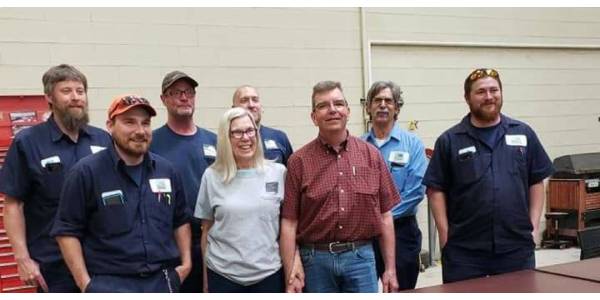
5 min to read
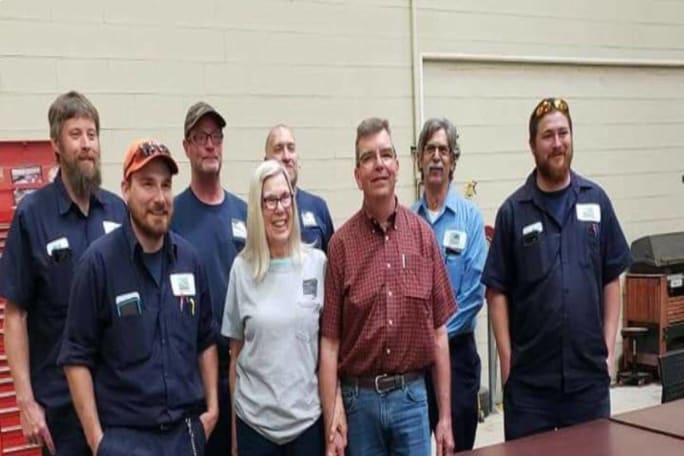
Bruce Halliday (in red) is pictured here with the Rochester Hills fleet team on his last day of work.
Photos: City Of Rochester Hills, Bruce Halliday
On Tuesday, June 2, Bruce Halliday retired following a 39-year career with the City of Rochester Hills, Mich. His retirement capped off a nearly four-decades-long career of implementing long-lasting fleet practices, developing his team, and learning from his colleagues to make his fleet the best it can be. He has brought his fleet to award-winning status and in March, he was inducted into the Public Fleet Hall of Fame. All of these achievements — and more — earned him this year’s Legendary Lifetime Achievement Award, sponsored by Sourcewell.
Blazing a Trail
Halliday joined the City of Rochester Hills fleet in 1981 as a mechanic. He’s always liked working with his hands and said he’s happiest when he’s turning a wrench. In 1991, he became fleet manager, and what would follow were many innovations that are still in place today.
For instance, in 1995, the fleet relied on a paper-based work order system. Halliday decided it was time to modernize, and eventually installed the city’s first fleet management information system (FMIS). “I replaced a fleet manager who didn’t embrace technology,” he said. “So I talked my superiors into doing it. It was a lot of work, but it really paid off.”
That same year, Halliday also developed the fleet’s first technician training and certification program, which continues to be in place. In fact, the fleet has one of the largest training budgets in the city, with the exception of the Fire Department — and it’s never been cut. Investing in training keeps technicians on the forefront of constantly changing vehicle technology, but it has also helped the city retain its technicians — the fleet hasn’t lost a single one to another city or private entity, despite their recruiting efforts.
“People are an organization’s best asset,” Halliday said. “You have to invest in your people and provide them an environment that helps them grow personally and professionally.”
Five years later, Halliday was responsible for another first. With no dedicated program to replace equipment and vehicles, he was instrumental in the development of the fleet’s first capital asset replacement program. “Now, everything is funded and on a schedule,” he said. “It keeps vehicles and equipment up all the time so that our user departments can have access to them.”
Challenges and Proud Moments
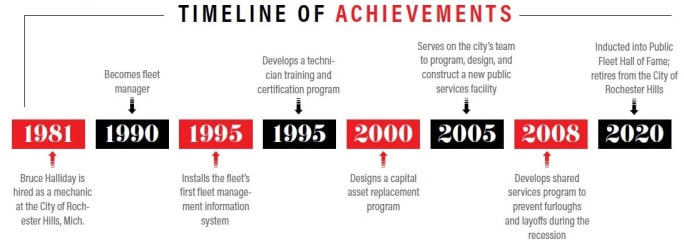
Halliday’s most challenging moment came in 2008, at a time when workers of all kinds across the country were being furloughed or laid off due to the Great Recession. “That’s the last thing you want to do to your people,” he said. “They have families to feed.”
Halliday’s concern for his employees resulted in yet another first — establishing shared services contracts with nearby communities. At the time, nearby communities were outsourcing service and repairs to private shops. “We had the diagnostic equipment and tools to do the work. We could do it more efficiently,” he said. So Halliday turned the model on its head and changed outsourced work into insourced work that kept his technicians busy. Doing so generated additional revenue for the fleet — and more importantly, the city didn’t have to furlough or lay off a single fleet employee. “We’re pretty proud of that,” Halliday said. The fleet has kept this program running, with 14 contracts currently in place with surrounding communities.
All of these achievements could easily be at the top of a fleet manager’s list of proudest moments. But for Halliday, it’s not about the hard work he’s personally done — it’s about his team and the recognition the fleet has received from others. “I’m most proud of my team of dedicated, motivated, and highly trained professionals,” he said. “I’m proud of being named among the 100 Best Fleets for several years. Being inducted into the Public Fleet Hall of Fame is a big source of pride.”
Relying on ‘The Dinosaurs’
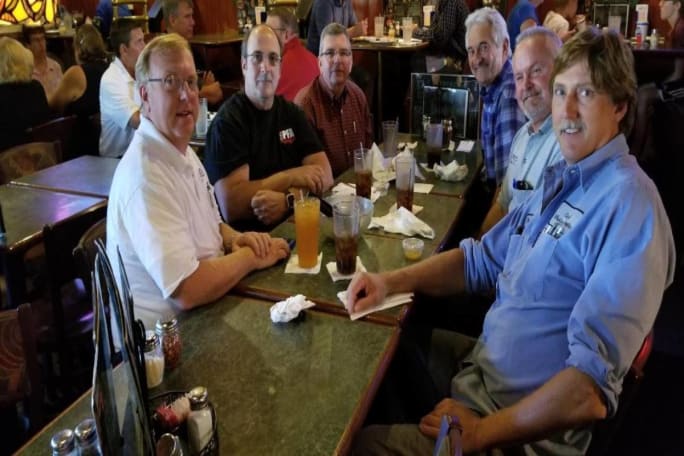
The “fleet dinosaurs,” a group of fleet managers who have now all retired, meet regularly to brainstorm and solve issues.
Photos: City Of Rochester Hills, Bruce Halliday
A mainstay of Halliday’s career has been what he calls the “fleet dinosaurs” — a group of four fleet managers (including Halliday) from southeast lower Michigan. The group includes fleet managers Jerry Brock, retired from City of Farmington Hills; Terry McGran, retired from the City of Madison Heights; and Sam Lamerato, retired from the City of Troy. The four met in training early on in their careers and relied on each other in the decades that followed.
“We solved issues together and brainstormed together. Having these three other guys there to run things by and talk to if I was having a bad day has helped throughout my career,” Halliday said. “The cool thing is, we’re all really good friends now. I’ll be friends with these guys until I’m no longer on this earth.”
Retiring with No Regrets
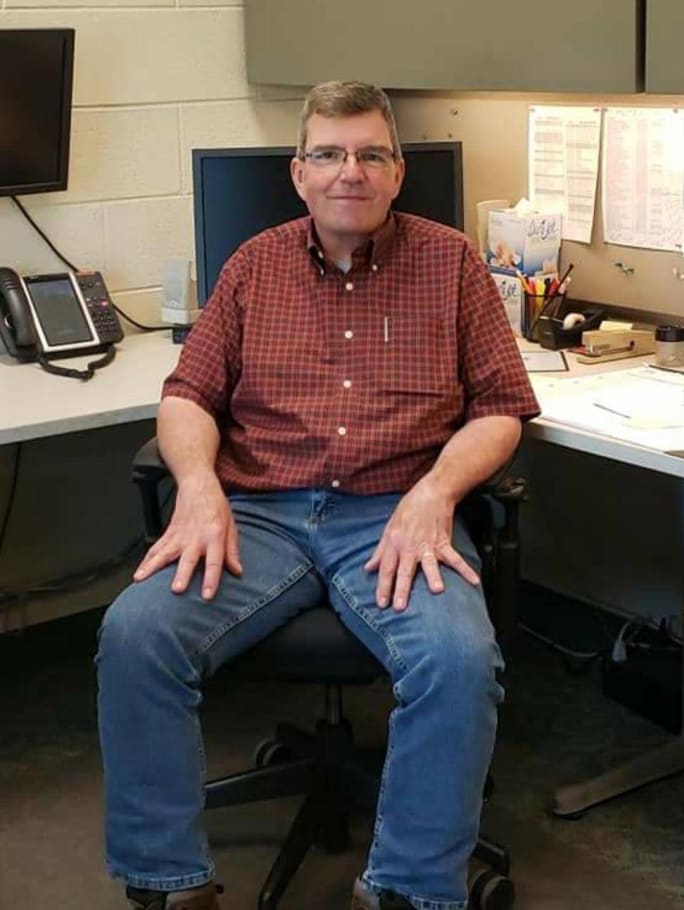
Bruce Halliday is pictured here on his last day of work after 39 years at the City of Rochester Hills.
Photos: City Of Rochester Hills, Bruce Halliday
Now that Halliday is retired, he plans to relax for a while — hiking, kayaking, riding bikes, and taking long walks with his wife at their home in Northern Michigan. But he’s not opposed to helping out fleets in the area. He knows he’ll always keep a tool in his grasp. “I’ve been a mechanic my whole life; if my hands weren’t working, I wouldn’t be happy,” he said.
Being happy with his work won’t be a new theme in retirement. “If I had to do it all over again, I would pick the same career,” he said. “I have enjoyed it every day — the people I work with and the work I did. Not many people can say they have loved their career as much as I did. I am blessed to have had that.”
Subscribe to Our Newsletter
More Operations
Is Keeping Older Fleet Vehicles Really Saving Money?
Is keeping vehicles longer saving money, and what happens when a diagnostic test points to the wrong fix?
Read More →
How Smart Fleet Strategy Can Help Local Government Agencies Do More with Less
Keeping a vehicle longer may ease this year’s budget, but what does it cost the next one? A closer look at fleet decisions can reveal opportunities to reduce spending while protecting essential services.
Read More →
Connect with Government Fleet on LinkedIn
From industry news and fleet management strategies to conversations with peers, Government Fleet's LinkedIn page offers public-sector fleet professionals another way to stay informed and connected.
Read More →
Town of Queen Creek Named Most Successful Fleet Award Winner of Inaugural RTA Fleet Success Awards
Five fleets were honored at RTA Connect 2026 in Chicago for excellence across resource efficiency, intentional culture, risk management, and stakeholder satisfaction.
Read More →
Sponsored•October 14, 2026
A buyer's guide to fleet management software in 2027
Buying fleet management software in 2027 means looking beyond features and price. As fleet operations, technology and expectations evolve, this guide explores what today’s fleet professionals should consider when choosing a system that can deliver value now and adapt to what comes next.
Read More →
Hazard Alerts, Fleet Car Sales Rise and a New Shuttle Concept
Fleet car sales doubled, but the bigger picture tells a different story in this week’s roundup.
Read More →
How St. Johns County Turned Fleet Data Into Better Replacement Decisions
St. Johns County, Florida, had fleet data, but turning it into reliable decision guidance was another matter. Instead of starting over with a new fleet management system, the county connected existing tools and built a scoring system that gives managers an objective look at fleet health.
Read More →
Fleet Forward Conference Introduces One-Day Passes for 2026
New one-day registration lets fleet professionals attend Tuesday, Wednesday, or Thursday, with passes available for $249.
Read More →
ENC Unveils its ZAVIR Medium-Duty Shuttle
Two variants of the concept shuttles were revealed: a low-floor configuration and a high-floor configuration.
Read More →
Could Your Next Fleet Technician Start as an Intern?
What if your next technician hasn’t worked in a fleet shop yet? What fleets are doing to free up time.
Read More →