





Don't Miss: How Law Enforcement Has Been Using Drones
Drone Program to Enhance Rural Georgia Emergency Response
Troup County will be the nation’s first local government in a rural region to acquire and train on the equipment and operationalize the technology.
August 15, 2023
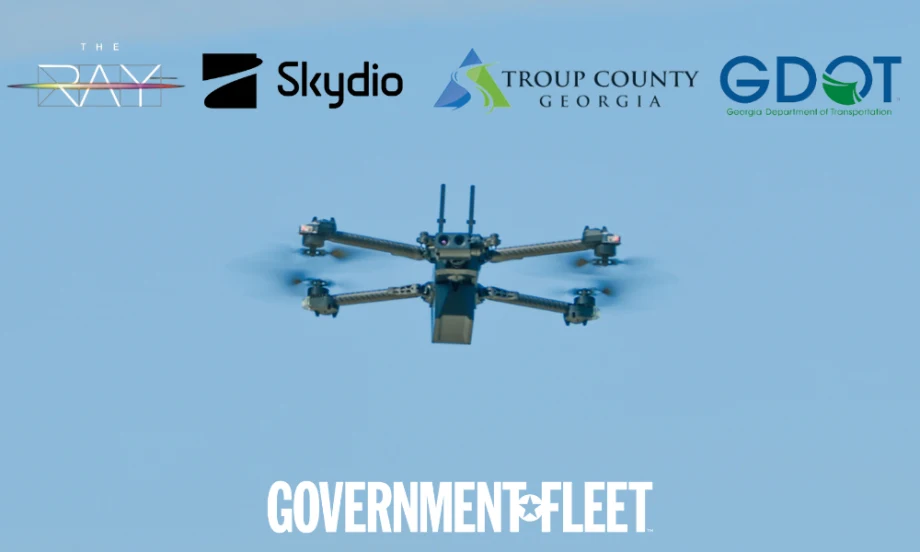
The Ray partnered with GDOT, Troup County, and Skydio to develop a drone as a first responder program along Interstate 85. Skydio's X2 drone is pictured here.
Photo: Skydio/The Ray/Troup County/GDOT/Canva
4 min to read
A new partnership between a nonprofit, the Georgia Department of Transportation, Troup County, and a drone manufacturer will allow for a quicker emergency response along multiple interstate corridors.
The Ray, a nonprofit organization advancing net-zero transportation and energy infrastructure, partnered with GDOT, Troup County, and drone manufacturer Skydio to develop a drone as a first responder program along "The Ray Highway" on Interstate 85. The new initiative is meant to enhance safety and emergency response capabilities in the entire west Georgia region. The rural area hosts multiple key interstate corridors including Interstates 85, 185 and 75, which provide freight connectivity for major southeast manufacturing and logistics facilities.
The collaboration also includes Troup County’s Marshal Office and the county fire department, which recently received Skydio drones and training as technology donations from The Ray.
Situational Awareness for Better Incident Response
Drones allow first responders to capture photos and videos of an incident, providing key situational awareness to police, fire, and public health agencies to help them better prepare for incident response.
Troup County will be the nation’s first local government in a rural region to acquire and train on the equipment and operationalize the technology, according to a press release.
“Drones acting as first responders bring critical capability for crisis and emergency management and are already deployed across the country in small, medium and large communities, including Chula Vista, California; and Brookhaven, Georgia,” The Ray Executive Director Allie Kelly said. “We at The Ray are proud to bring an opportunity home to The Ray Highway, to help Troup County develop robust, reliable, and safe drone operations. In the near future, we hope to grow the operation into a cost-efficient program that can offer remote operation of drones as a first responder to interstates 85, 185, and surrounding west Georgia counties.”
The partnership is preparing to apply for the second round of awards from the U.S. Department of Transportation's Strengthening Mobility and Revolutionizing Transportation Grant Program. The SMART Grant leverages federal funds to accelerate innovation and technology interventions to solve real-world challenges communities face.
Using DFR to Enhance Emergency Response Efforts in Rural Areas
Troup County’s application with The Ray is expected to be among the first requests for the SMART Grant to support the development and implementation of DFR anywhere in the nation.
If successful, Troup County intends to acquire remote operations equipment, additional training, and pursue the required Federal Aviation Administration authorizations to engage in DFR operations. This will enable the county to build a functional DFR program that relies on remote operations and future autonomous drone operations.
To help launch the initiative, The Ray donated two Skydio drones to Troup County, and has provided the county with training resources through Skydio. The training sessions will equip Troup County drone pilots with the necessary skills and knowledge to safely and effectively operate the drones.
Currently, Troup County has a limited drone program with four trained pilots and one basic drone in use. The county lacks a comprehensive program that allows trained pilots to incorporate drones into their regular emergency response activities. Through this new partnership, Troup County is working to establish a formal drone program, complete with a trained team and verified hours of operation.
“The Troup County Community Development Department is excited about incorporating drones into the team,” said Jenny Parmer, Community Development Director for Troup County. “These drones are going to bring some incredible benefits to emergency response and infrastructure safety. Led by Chris Bagley, a former U.S. Army unmanned aerial vehicle master instructor, this project is getting off the ground with the Marshal Office, but the long–term vision is a collaborative effort across local public safety and emergency response departments.”
Drones enable rapid assessment of crashes, missing persons, animals or livestock, disasters, and hazardous situations, providing valuable data and insights to emergency response teams, oftentimes more quickly than vehicles on the ground can do so.
With drones, responders can make informed decisions before responding on the ground, so they can deploy the appropriate resources quickly, potentially saving lives and minimizing risks to human responders.
Equipped with advanced sensors and cameras, drones provide situational awareness, identify hazards, and reach inaccessible areas safely. The drones will enhance coordination through live video feeds and communication with on-the-ground teams, optimizing resource allocation.
“At Skydio we are proud to partner with The Ray and Troup County in their pursuit to make their community a safer place. Drones enable enforcement agencies to assess potential dangerous scenes and get to hard to reach areas where every minute is critical,” Skydio Head of Public Safety Integration Fritz Reber said. “We are committed to supporting Troup County and The Ray as they seek to grow the county’s drone program into a sophisticated DFR program.”
More Operations
Is Keeping Older Fleet Vehicles Really Saving Money?
Is keeping vehicles longer saving money, and what happens when a diagnostic test points to the wrong fix?
Read More →
How Smart Fleet Strategy Can Help Local Government Agencies Do More with Less
Keeping a vehicle longer may ease this year’s budget, but what does it cost the next one? A closer look at fleet decisions can reveal opportunities to reduce spending while protecting essential services.
Read More →
Connect with Government Fleet on LinkedIn
From industry news and fleet management strategies to conversations with peers, Government Fleet's LinkedIn page offers public-sector fleet professionals another way to stay informed and connected.
Read More →
Town of Queen Creek Named Most Successful Fleet Award Winner of Inaugural RTA Fleet Success Awards
Five fleets were honored at RTA Connect 2026 in Chicago for excellence across resource efficiency, intentional culture, risk management, and stakeholder satisfaction.
Read More →
Sponsored•October 14, 2026
A buyer's guide to fleet management software in 2027
Buying fleet management software in 2027 means looking beyond features and price. As fleet operations, technology and expectations evolve, this guide explores what today’s fleet professionals should consider when choosing a system that can deliver value now and adapt to what comes next.
Read More →
Hazard Alerts, Fleet Car Sales Rise and a New Shuttle Concept
Fleet car sales doubled, but the bigger picture tells a different story in this week’s roundup.
Read More →
How St. Johns County Turned Fleet Data Into Better Replacement Decisions
St. Johns County, Florida, had fleet data, but turning it into reliable decision guidance was another matter. Instead of starting over with a new fleet management system, the county connected existing tools and built a scoring system that gives managers an objective look at fleet health.
Read More →
Fleet Forward Conference Introduces One-Day Passes for 2026
New one-day registration lets fleet professionals attend Tuesday, Wednesday, or Thursday, with passes available for $249.
Read More →
ENC Unveils its ZAVIR Medium-Duty Shuttle
Two variants of the concept shuttles were revealed: a low-floor configuration and a high-floor configuration.
Read More →
Could Your Next Fleet Technician Start as an Intern?
What if your next technician hasn’t worked in a fleet shop yet? What fleets are doing to free up time.
Read More →