The Value of Leadership, Calculated Risks, and Understanding Your Fleet’s Processes
Kevin Devery, former fleet manager for the city of Goodyear, Arizona, looks back on his time in the public sector, reflecting on lessons learned and offering advice for other fleets.
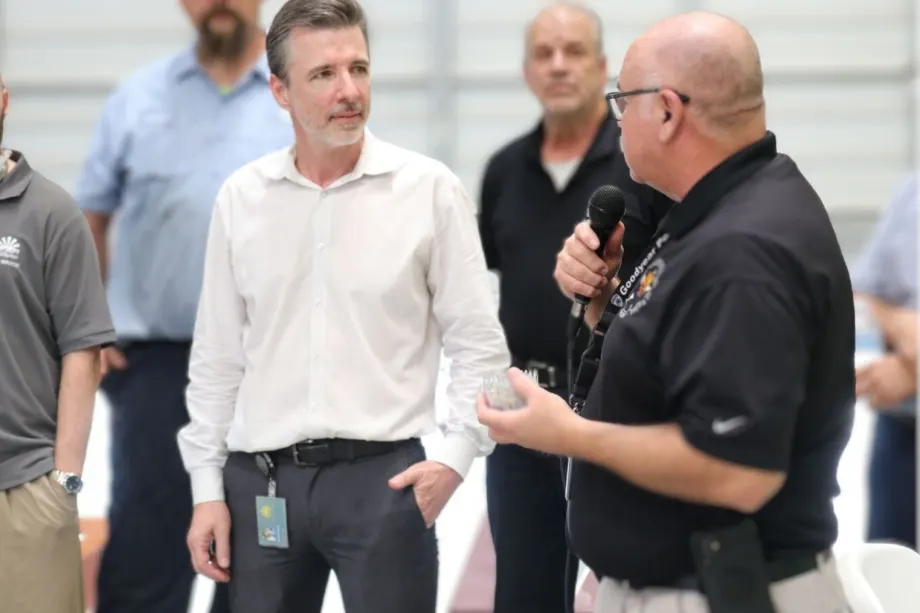
Devery and the entire fleet team receiving Police Department Challenge Coins from the Goodyear Chief of Police, Jimmy Santiago for excellence in operations and maintenance of PD vehicles.
Photo: Goodyear, Arizona, Fleet Foreman Mike Hules
9 min to read
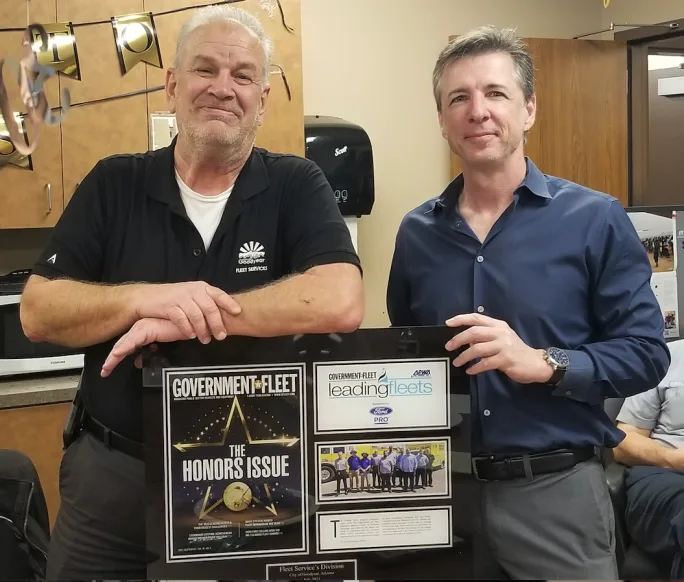
The city of Goodyear, Arizona, has been ranked as a Leading Fleet multiple times. (L-R) Goodyear, Arizona, Fleet Foreman, Mike Hules and Kevin Devery.
Photo: Goodyear, Arizona, Fleet Service Advisor Matt Seitz
“If two years into my job [as fleet manager] somebody asked, ‘What's the most important thing in fleet?’ I'd give you an answer, but now it'd be a completely different answer," said Kevin Devery. "Now, what's important in fleet is less about the actual technical sides of the job and more about the human sides of the job. Because you find out, you can't do it alone.”
Devery, who spent 10 years as the fleet manager at the city of Tempe, Arizona, and four years as the fleet manager for the city of Goodyear, Arizona, beforee most recently becoming the senior manager of Logistics with Willscot Mobile Mini, Looking back on his time in the public sector, Devery acknowledges that as a new fleet manager, there’s a desire to do a lot at once but that it doesn’t take much time to realize that it takes reliance on other people to make everything happen.
Ad Loading...
“You’re going to have to work with those people, and you're going to have to get them to understand what you're looking for them to do,” he said. “You need them to be qualified, of course, but more than anything, you’ve got to respect them, and they need to respect you. Otherwise, you're not going to get anything done.”
Something Devery passed down to his fleet was that everything should have a process and that everybody should know that process at any time. An individual should be able to step in and recognize where the fleet is at any point in a specified process, enabling the fleet to move forward easily.
Because of this, Devery was able to confidently step out of his role, allowing the fleet’s shop foreman to hold his position in the interim.
“I feel 100% confident they're going to be able to pick up the ball and run with it and be able to score a touchdown without a problem,” he said.
This process was something that was set in place and observed while he was the fleet manager. During periods he had been away, he found on his return that the team had been able to run the operation in his absence easily. The previous two times he left, he returned to find no issues, no questions, and no hiccups. It all led back to setting up the organization to know what to do at any time.
Ad Loading...
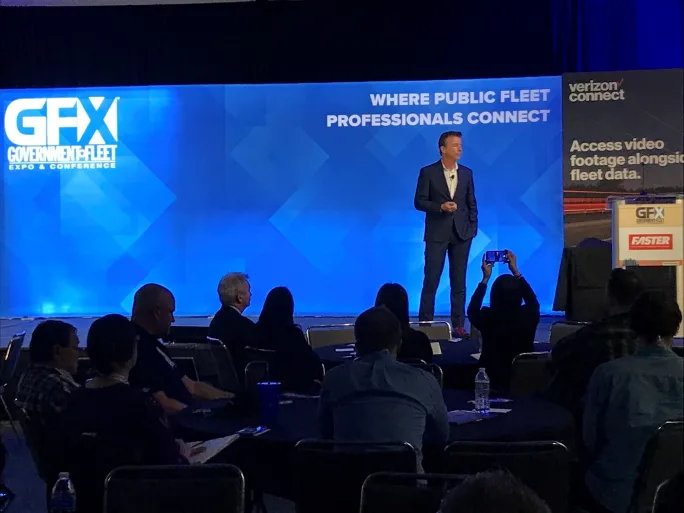
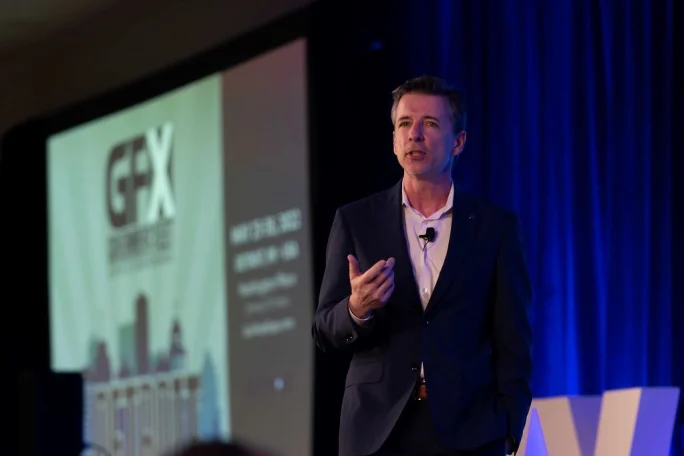
Devery delivering the Keynote speech at the Government Fleet Expo & Conference.
Photo: Ross Stewart Photography
Understanding the Learning Curves to Operations
Still, Devery acknowledges that getting to a place where transitions can be made without issue means there will be a period needed for everyone to adjust and learn their roles inside and out. However, he adds that the question is whether or not a fleet is willing to put in time with somebody who can grow and learn internally or if they’re looking for a superstar from the outside.
In addition to recognizing that the job can’t be done alone, Devery said he’s found that it’s not possible to please everybody all the time and that sometimes you'll make decisions that people don't necessarily agree with.
Early on in his fleet career, the team brought in a consultant to conduct personality tests to assess each person’s strengths and weaknesses. Devery’s results showed that he wasn’t a high-risk taker, which at the time seemed like a good score. Devery considered himself data-driven, basing his decisions on what he knew would be the smartest thing to do.
Ad Loading...
However, the consultant told him that this was different from the score he should want and that he should take risks as a leader. This, he was told, was because risks can mean big jumps from where you are to where you need to be. There will be setbacks at times, but when you do hit the mark, that win will be huge.
Taking this to heart, Devery looked back on the times he had taken risks and realized that many times, end result was well worth it. This changed how he led the fleet moving forward.
Soon after, one of the next risks he took was moving into the electric vehicle field.
“When I was with Tempe, we were the EV adoption leaders in the state for municipalities,” Devery said. “I just started doing it. I took operational funds, so I didn’t need capital, and started buying units, put them in the motor pool, wrapped them, made it big and loud, and started to put chargers in a little bit here and a little bit there and, over the course of two and a half, three years, we ended up with around 24 electric vehicles and 28 chargers.”
At first, Devery said there were some outside doubts; however, a year and a half later, city leaders congratulated him and the team on the electrification success.
Ad Loading...
“That was a risk for sure, but it paid off in a huge way,” he said. “So take risks.”
Looking at Changes Throughout the Fleet Industry
One of the main changes Devery has seen throughout his career is the adoption of EVs, something he says has changed the industry.
From propane to CNG to LNG and E85 to the renewable fuels beyond, Devery feels that nothing has quite an impact like EVs. For him, electrification is inevitable, especially as technology improves.
“I think it is a fantastically positive thing in so many ways,” he said. “It’s just going to keep coming.”
Challenges Surrounding Vocational Fields within Fleet
While Devery sees EVs as a positive part of the fleet industry, he feels there is still room for improvement in encouraging people to pursue fleet jobs.
Ad Loading...
“When did it become looked down upon to be in a vocational field? Now we have this huge shortfall of technicians, and that's a real challenge for all fleets out there,” he said.
According to Devery, a smart move to counteract this shortage was to start promoting from within and developing those people. Sometimes, that meant training individuals who may not have had much experience or the exact skillset needed but who were willing to learn.
“When hiring people, it's less about their skills and more about what kind of person they are, you know, are they smart? Are they adaptable? Can they learn? Do they work well with others? What's the personality like.”
Devery and his team realized that when teaching someone who is pursuing a technician role, for example, it takes about one to two years for them to be solid in their role. Moreover, investing in this training incentivized employee loyalty.
“The fact is it’s hard to find good technicians and people that are well trained right out of school,” he said. “And now we're seeing a flip flop where technicians can easily make $100,000 a year in the private sector if they're good at what they do.”
Ad Loading...
Fleet managers should be able to take risks to move the operation forward, according to Devery.
Photo: Ross Stewart Photography
Looking Back for a New Perspective on Fleet Operations
When asked if he would have done anything differently in his fleet career, Devery noted that he would have spent more time understanding people and what makes them tick rather than working on his own technical skills.
“I thought in the beginning that if I just do a great job, and I work hard, and I put my nose to the grindstone, people are going to see it, they're going to notice it, and we're going to get things done,” Devery recalled. “But I missed the part where, again, you can't do it by yourself, and you're going to need the help from other people.”
Devery emphasizes the need to work with others, collaborate, and understand how other people operate.
“Especially in leadership, know your people, understand your people, work with your people, respect your people, and give them a voice,” he added. “Be transparent with them; tell them what you're facing, what your challenges are, and get them involved in the solutions.”
Devery also wishes he had learned how to tell his story early on. It wasn’t until about 12 years ago that he learned how to tell people about what he was doing and the success the fleet saw.
Ad Loading...
He encourages fleets to brag on their teams and accomplishments. One way to do this is to apply for awards, such as the Leading Fleets.
“If you receive the award, ensure everybody in your stratosphere knows you want it branded that way. That's what we did,” Devery said. “We held celebrations for it. We invited a lot of people within the city. We called news organizations…I brought up the team's successes whenever I could…tell your story, tell your story.”
Advice for Anyone Who’s New to Fleet
For those just setting off down the road of fleet, Devery recommends this: learn all you can and don’t try to reinvent the wheel. As he pointed out, “there are very rarely things that come up that nobody's ever come across before.”
Instead, he advises networking and talking with those individuals who have already done it. Then, take that knowledge and advice back and use it within your fleet. It may not directly apply, but the principle is to take the exact template of what they have and apply it, tweaking it to make it work for your respective organization.
Not certain about something? Go back to the basics. Many times, problems can be solved simply by reaching out to your team and letting them know there's a challenge. Ask how projects can be done as a team.
Ad Loading...
“Everybody has something to teach you, everybody,” Devery said. “Even the person that just started with the organization, whether they were an entry-level service worker or PM lube tech, everybody has something to teach you.”
The Future of Fleet and the Hurdles Along the Way
Once again, Devery looks to EVs not only as a significant player in fleet during the past few years but as a larger part of fleet’s future. For fleets to continue moving forward with electrification, Devery said infrastructures will be the biggest hurdle to overcome.
“There's a bit of a paradigm shift on how you think about fueling your vehicle with electrics, but I think the exchange from the ICE engine to electric vehicles is going to just keep ramping up,” Devery said.
He also believes that autonomous vehicles will become more common in the future. He uses Waymo, an autonomous, driverless, ride-share service in Phoenix, Arizona, to illustrate how it is changing transportation in the area.
However, with the addition of EVs and autonomous vehicles, Devery notes that these changes don’t come without hurdles. These include understanding how they can be incorporated into a fleet, where they would be used, and how to start an electrification or bring in an autonomous vehicle.
Ad Loading...
Devery’s advice? One step at a time.
“Learn a little bit here and there, learn about other electric vehicles, add some electric vehicle chargers, get some of the team to poke around, look at the vehicles, put them up on the lift, and get some training on them,” he advised. “Eventually, we'll get there, but there are still some challenges that need to be overcome in order to expand it on a wider scale.”
Keeping a vehicle longer may ease this year’s budget, but what does it cost the next one? A closer look at fleet decisions can reveal opportunities to reduce spending while protecting essential services.
From industry news and fleet management strategies to conversations with peers, Government Fleet's LinkedIn page offers public-sector fleet professionals another way to stay informed and connected.
Five fleets were honored at RTA Connect 2026 in Chicago for excellence across resource efficiency, intentional culture, risk management, and stakeholder satisfaction.
Buying fleet management software in 2027 means looking beyond features and price. As fleet operations, technology and expectations evolve, this guide explores what today’s fleet professionals should consider when choosing a system that can deliver value now and adapt to what comes next.
St. Johns County, Florida, had fleet data, but turning it into reliable decision guidance was another matter. Instead of starting over with a new fleet management system, the county connected existing tools and built a scoring system that gives managers an objective look at fleet health.