




Michigan State Police 2027 Police Vehicle Testing: Preliminary Results
From electric patrol vehicles to pursuit-rated SUVs and pickups, the latest Michigan State Police testing highlights differences in acceleration, braking, and handling that could influence law enforcement fleet purchasing decisions.
November 19, 2026

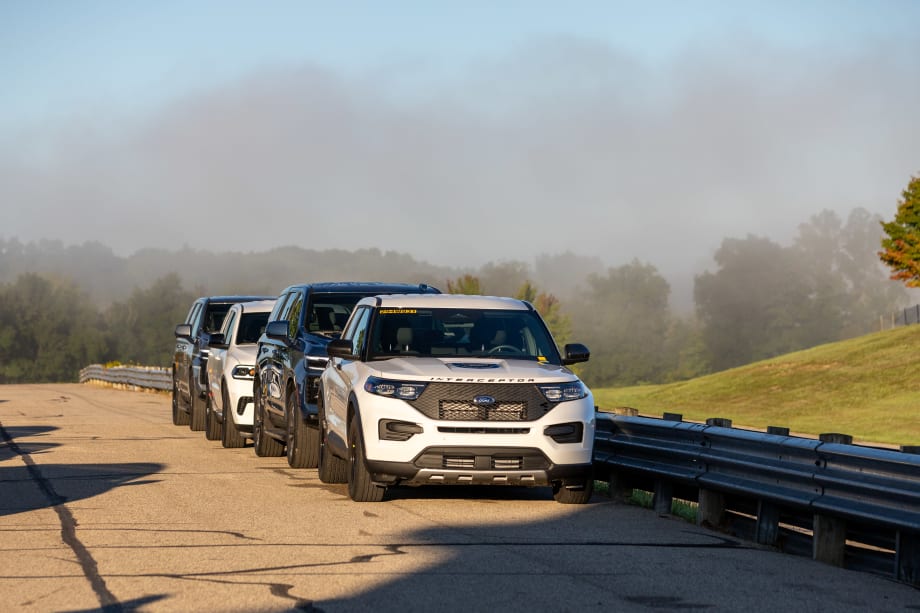
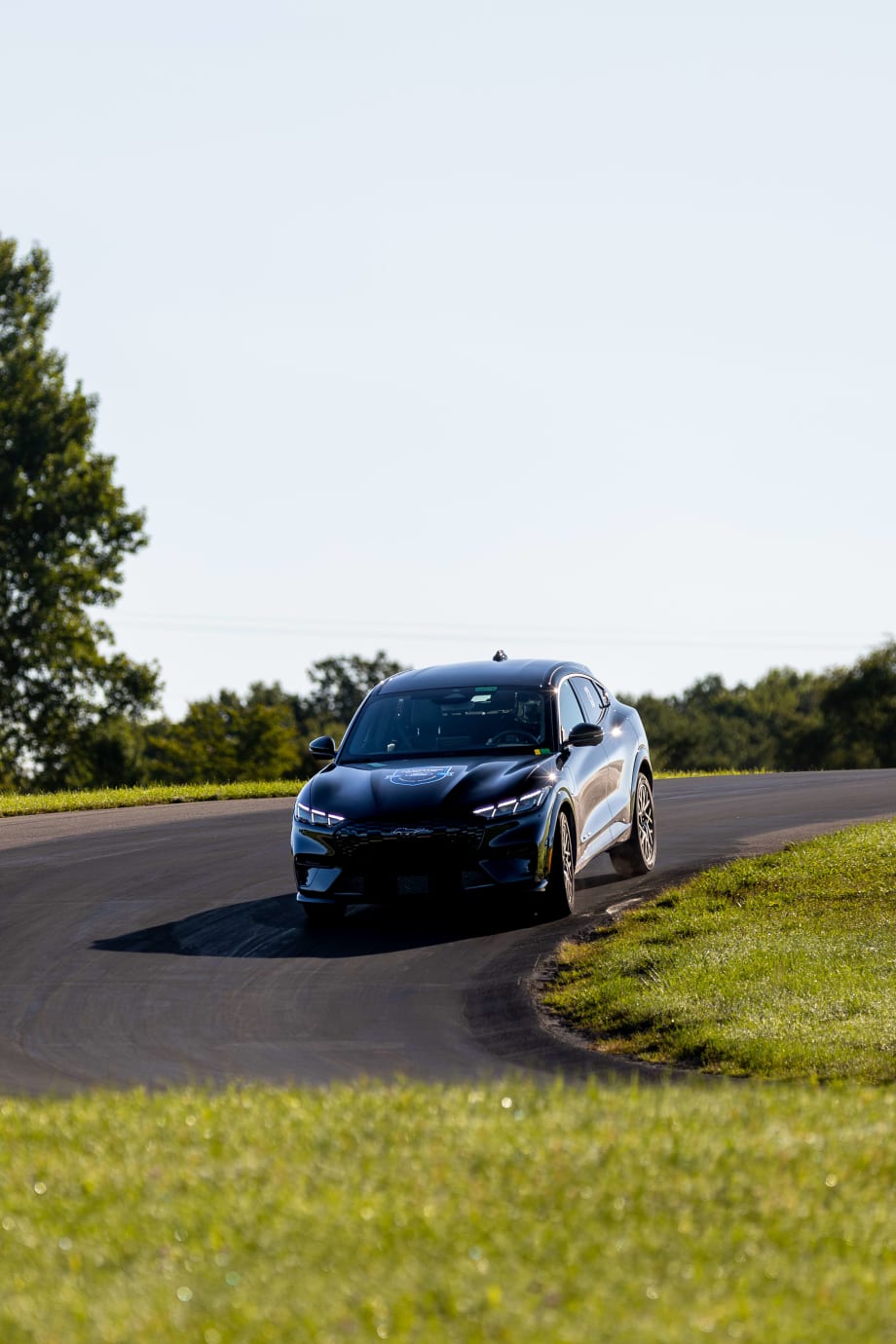
Ford Police Interceptor Utility SUVs line up during police vehicle testing.
Credit:
Adam Allport - Motorized Moments Co.
1/5
5 min to read
The Michigan State Police (MSP) released preliminary results from its 2027 Model Year Police Vehicle Evaluation Program, providing an early look at how the latest police vehicles perform in acceleration, top speed, braking, and vehicle dynamics testing.
The results cover 13 passenger vehicle and pickup configurations, along with four motorcycle configurations, and include Chevrolet, Dodge, Ford, Ram, BMW, Harley-Davidson, and Honda.
The 2027 preliminary results show strong performance from electric vehicles, particularly in acceleration and braking, while traditional pursuit-rated vehicles remain competitive in top speeds and handling.
We spoke to Sergeant Harris Edwards III of the Precision Driving Unit to learn what these results mean.
New This Year
This year's testing procedures included a standardized climate control setting.
“During testing, vehicles were required to operate with the air conditioning set to maximum cooling and the blower fan at its lowest speed,” Sgt. Edwards explained. “This adjustment was made to better reflect real-world law enforcement operating conditions. Officers routinely operate patrol vehicles in varying climates while wearing duty uniforms, equipment, and body armor, making climate control an essential part of daily vehicle operation.”
He noted another update to this year's evaluation was the revised powertrain configuration on the Chevrolet Silverado Z7X PPV 4WD and Silverado Z71 PPV 4WD.
Both vehicles were equipped with updated 5.7L engines rated at 402 horsepower and 428 lb-ft of torque. This improved overall vehicle performance.
Top Acceleration
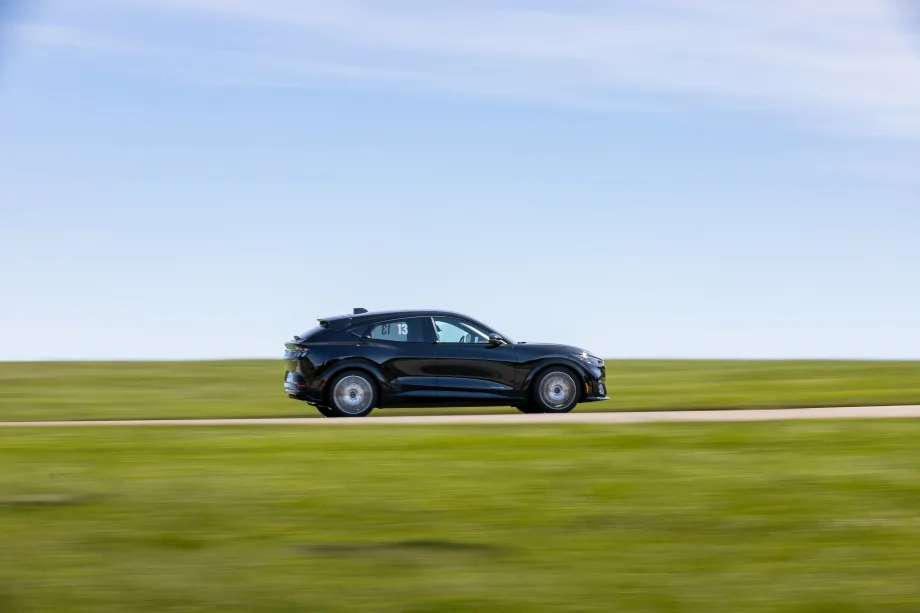
The Ford Mustang Mach-E GT eAWD recorded the fastest 0–60 mph acceleration time at 4.01 seconds. The Chevrolet Blazer EV PPV AWD followed at 4.99 seconds.
The Ford F-150 Police Responder 3.5L EcoBoost 4WD was the fastest gas-powered vehicle, reaching 60 mph in 5.94 seconds. The Ford Police Interceptor Utility 3.0L EcoBoost AWD followed at 6.26 seconds.
The Mustang Mach-E GT reached 100 mph in 10.41 seconds, followed by the Blazer EV at 10.79 seconds, becoming the top two EVs in the category.
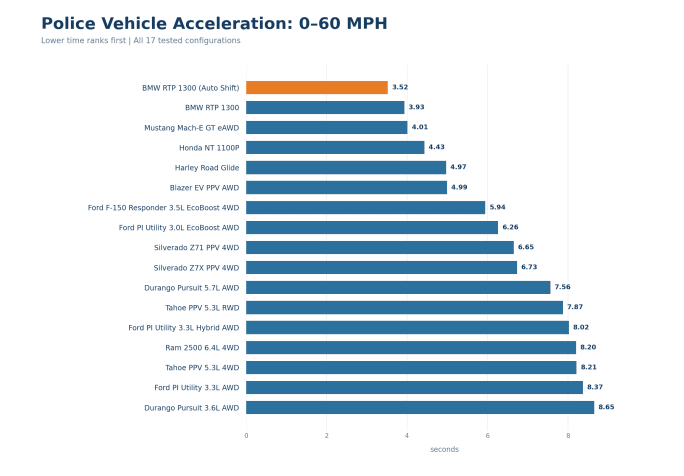
Police vehicle acceleration testing measures how quickly vehicles reach highway speeds, an important consideration for pursuit and emergency response duties.
Credit:
Government Fleet. This utilizes an AI-generated image. Refer to our Terms of Use.
Among the gas-powered vehicles, the F-150 Police Responder posted the quickest 0–100 mph time at 14.00 seconds, narrowly ahead of the 3.0L EcoBoost Police Interceptor Utility at 14.57 seconds.
The motorcycles recorded even quicker acceleration times, with the BMW RTP 1300 with Auto Shift reaching 60 mph in 3.52 seconds and 100 mph in 7.98 seconds. This makes the BMW the quickest configuration tested in both categories.
Top Speed
Although the EVs led the four-wheel field in acceleration, the Ford Police Interceptor Utility 3.0L EcoBoost AWD recorded the highest top speed at 148 mph.
The Dodge Durango Pursuit 5.7L AWD followed at 143 mph, while the Ford Police Interceptor Utility 3.3L Hybrid AWD and 3.3L AWD each reached 136 mph.
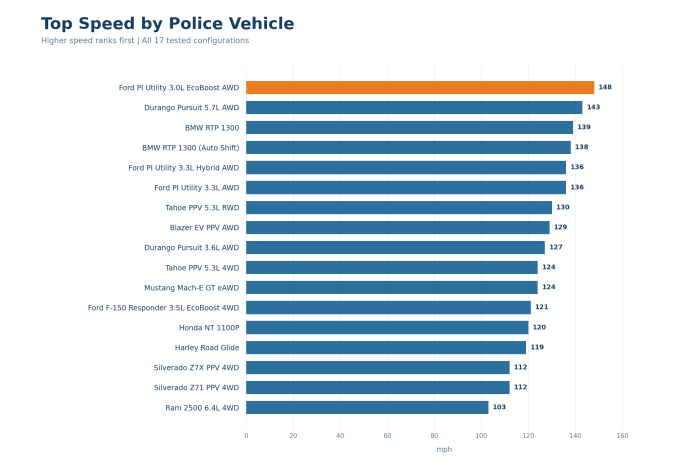
Top speeds varied across the tested vehicles, reflecting differences in powertrain configurations and intended applications.
Credit:
Government Fleet. This utilizes an AI-generated image. Refer to our Terms of Use.
The Chevrolet Tahoe PPV 5.3L RWD recorded 130 mph, followed by the Chevrolet Blazer EV PPV AWD at 129 mph. The Mustang Mach-E GT eAWD reached 124 mph.
Among motorcycles, the BMW RTP 1300 achieved the highest top speed at 139 mph, followed by the Auto Shift configuration at 138 mph. The Honda NT 1100P reached 120 mph, and the Harley Road Glide reached 119 mph.
Stopping Power
The preliminary braking results report overall average deceleration rates and projected stopping distances from 60 mph.
The Ford Mustang Mach-E GT eAWD recorded the shortest projected stopping distance at 123.12 feet. It also achieved the highest overall average deceleration rate at 31.45 feet per second squared.
The Ford Police Interceptor Utility 3.3L Hybrid AWD followed with a projected stopping distance of 129.60 feet, narrowly ahead of the 3.0L EcoBoost AWD version at 129.69 feet.
The Chevrolet Tahoe PPV 5.3L RWD recorded 129.74 feet, while the 4WD version recorded 130.00 feet.
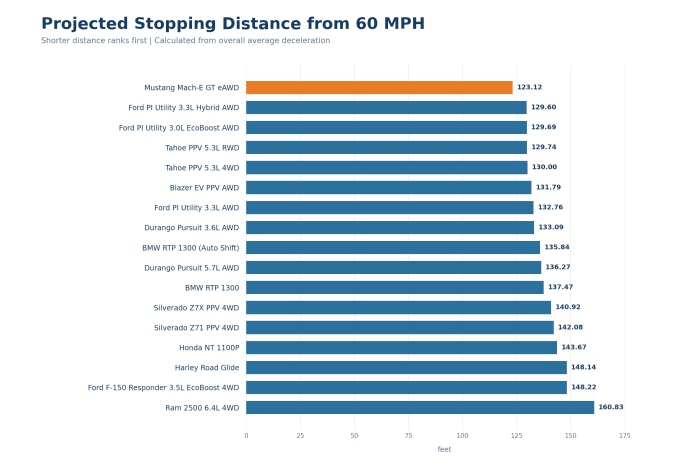
Shorter stopping distances can provide an important advantage during emergency braking situations.
Credit:
Government Fleet. This utilizes an AI-generated image. Refer to our Terms of Use.
The Chevrolet Blazer EV PPV AWD posted a projected stopping distance of 131.79 feet.
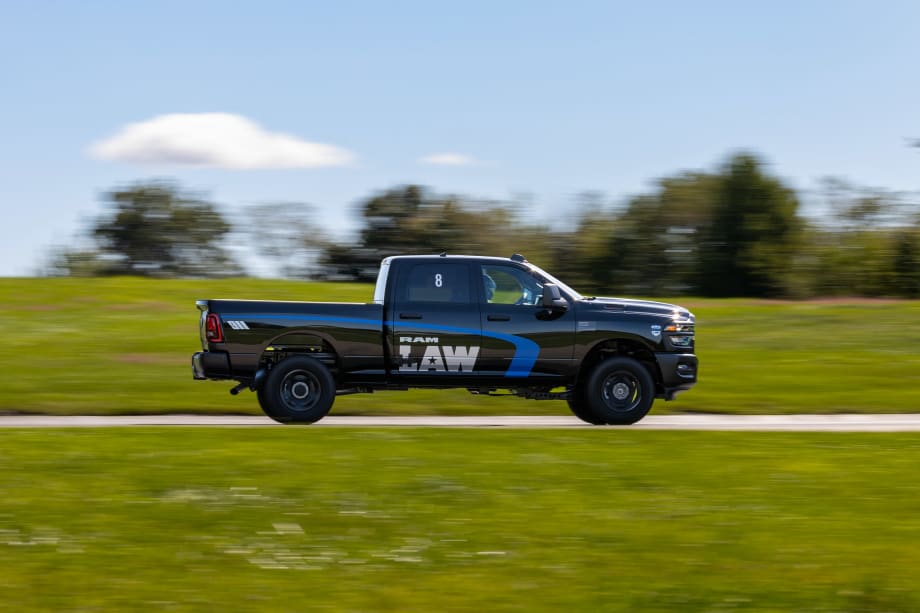
The Ram 2500 6.4L 4WD had the longest projected stopping distance among the tested vehicles at 160.83 feet, followed by the Ford F-150 Police Responder at 148.22 feet.
Among motorcycles, the BMW RTP 1300 Auto Shift recorded the shortest projected stopping distance at 135.84 feet, compared with 137.47 feet for the standard BMW configuration.
These distances are projected from overall average deceleration rates.
Dynamic Handling
MSP's vehicle dynamics testing provides another performance measure by recording five-lap average times and fastest individual laps for multiple test drivers.
The preliminary document includes vehicle dynamics results for 13 four-wheel configurations, with four drivers testing each model.
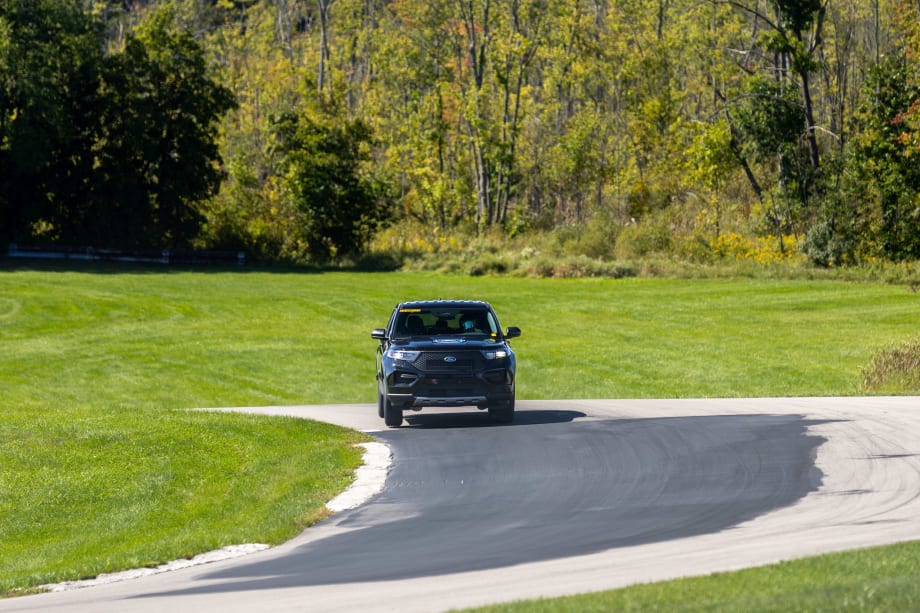
The Ford Police Interceptor Utility 3.0L EcoBoost AWD delivered the strongest overall performance based on the four drivers' reported five-lap averages, with a five-lap average of 1 minute, 34.69 seconds. Sergeant Edwards recorded the model's fastest individual lap at 1:33.91.
The Chevrolet Tahoe PPV 5.3L RWD also performed well, with a calculated five-lap average of approximately 1:37.88 and a fastest individual lap of 1:36.76.
The Dodge Durango Pursuit 5.7L AWD posted a calculated five-lap average of approximately 1:37.67, with a fastest individual lap of 1:36.49.
How Did the EVs Handle the Course?
The Ford Mustang Mach-E GT eAWD recorded a calculated five-lap average of approximately 1:38.11 across the four drivers. The fastest individual lap, however, was 1:33.11, recorded by Sergeant Edwards.
"The results highlight an important distinction between achieving the fastest individual lap and maintaining consistent performance over multiple laps,” said Sergeant Edwards. “The Ford Mustang Mach-E recorded the fastest single lap during vehicle dynamics testing, demonstrating its ability to deliver strong peak performance. However, the Ford Police Interceptor Utility 3. OL EcoBoost achieved the quickest calculated five-lap average, reflecting its ability to sustain competitive lap times throughout the evaluation."
For Sergeant Edwards, those results reinforce the importance of evaluating peak and sustained performance when assessing law enforcement vehicles.
Sgt. Edwards also noted that while EVs are very capable in acceleration, braking, and vehicle dynamics, their thermal management systems may reduce available power to protect electrical components, which can negatively affect performance consistency. ICE vehicles, for now, are more predictable.
Final results are expected over the next few weeks.
Subscribe to Our Newsletter
More Articles
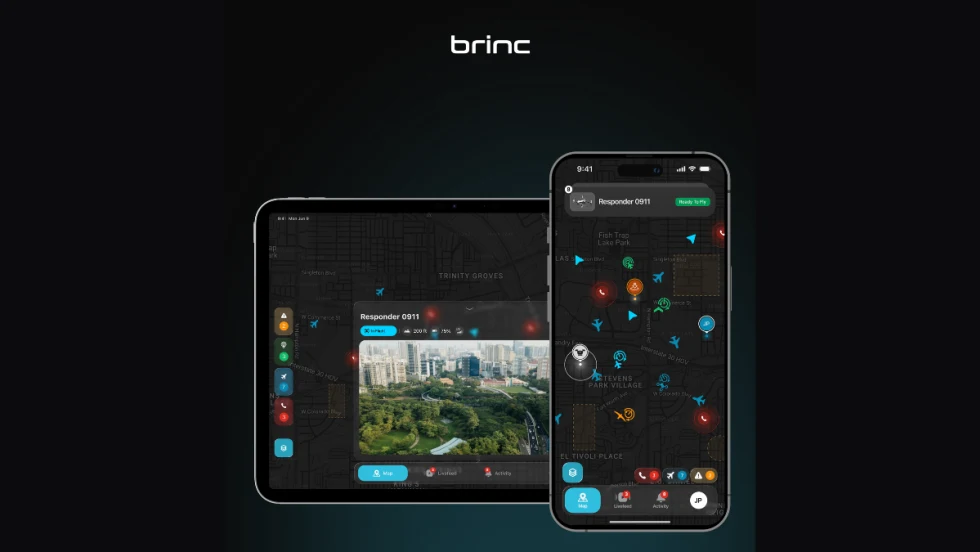
BRINC Launches Mobile App for Public Safety Drone Operations
As more public safety agencies incorporate drones into emergency response, access to aerial footage is expanding beyond drone operators and command centers. BRINC's new iOS app lets authorized personnel monitor live video, review flight information, and access agency drone operations on their mobile devices.
Read More →
Does Your Government Fleet Handle Refuse and Waste Operations? Take Our Poll
Government Fleet wants to hear from public-sector fleet professionals about their responsibilities for refuse collection and waste management equipment.
Read More →
What Public Fleets Should Document and Preserve After a Collision
Dashcam footage can be overwritten, witnesses can leave, and repairs can erase evidence. What should public fleets document and preserve before that information is lost?
Read More →
Fleet Replacement Decisions, Waste Fleet Technology and the GFX Deadline
Is your next vehicle the right fit, can your records settle a missed pickup dispute, and what could your fleet teach others at GFX 2027?
Read More →
Motive and Routeware Partner to Bring AI-Powered Visual Proof of Service to Waste and Public Works Fleets
The new integration uses Motive AI cameras and telematics to help municipalities and private haulers reduce manual work, settle disputes faster, and protect drivers without leaving the platform their team already works in.
Read More →
What Government Fleets Are Missing About Their True Costs
What are fleet budgets missing, and how can agencies use the data they already collect to make a stronger case for change?
Read More →
The Long-Term Cost of Delaying Fleet Replacement
Tony Yankovich, director of fleet consulting at RTA: The Fleet Success Company, discusses why replacement delays carry long-term costs and how fleets can prepare for changing operational demands.
Read More →
Sponsored•November 9, 2026
Enhanced Worker Safety Through UV Lighting Technology
An examination of how ultraviolet (UV) perimeter lighting can improve the visibility of workers wearing high-visibility apparel and safety equipment in low-light environments. When paired with durable optical materials and effective light distribution, UV illumination offers a complementary approach to reducing worker exposure risks near traffic and equipment.
Read More →
GFX 2027 Opens Registration for Its Move to the Southeast
Registration is open for the 2027 Government Fleet Expo & Conference, bringing public fleet professionals to Atlanta June 15–18. Early registrants can save $300.
Read More →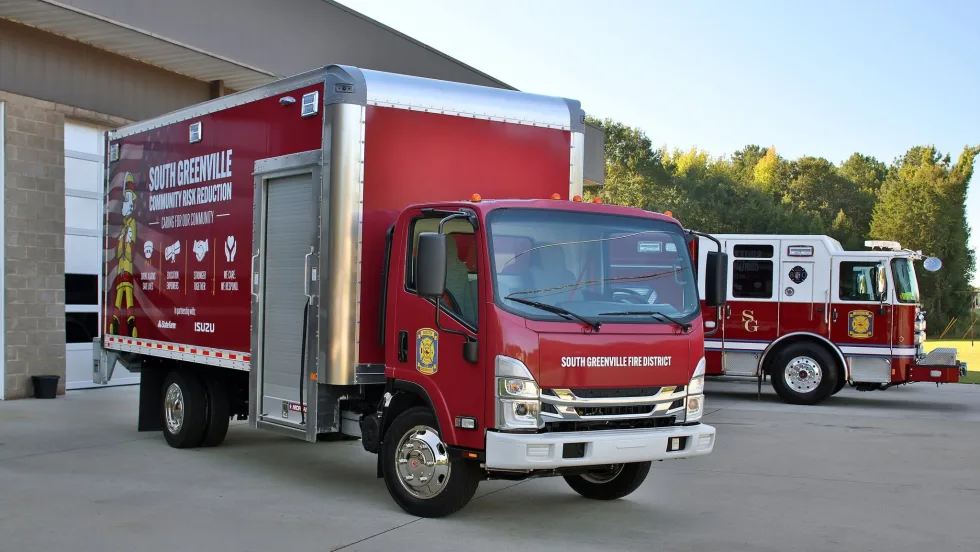
South Greenville Fire District Receives Truck for Community Outreach
A new medium-duty truck will help the South Carolina fire district transport equipment, educational materials, and displays to community events. The vehicle adds dedicated transportation capacity for fire prevention programs and public engagement outside the district's stations.
Read More →