


Weathering Storms,
Traffic & More:
 MENU
MENU SEARCH
How the Minnesota Department of Transportation successfully keeps its thousands of miles of roadways clear during the winters.

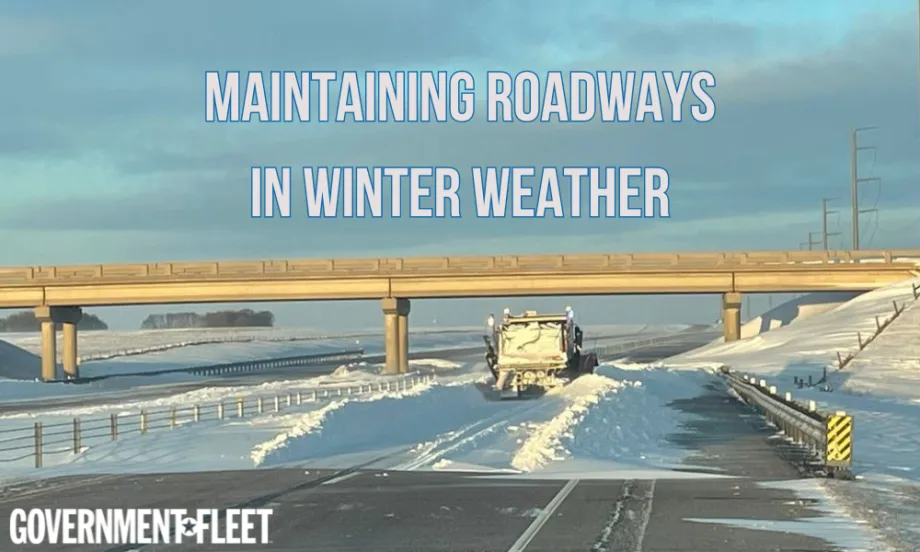
During the 2022-2023 winter season, the MnDOT fleet division put a lot more work into the equipment.
Photo: MnDOT/Canva/Government Fleet
The Minnesota Department of Transportation is tasked with preparing for unpredictable winter weather every year. Minnesota sees anywhere from 36 in. to 70 in. depending on where you are in the state.
This past winter, the state’s snowfall average was 90.2 in. One portion of the state, though, saw 112.7 in. Despite the high numbers, extreme winters are just something the state has to deal with, as the severity fluctuates year to year.
Government Fleet talked to the state DOT’s maintenance engineer about the agency's response to the extreme weather.
In addition to just over 800 snow plows, the state also has over 450 pieces of equipment that it uses to keep roadways clear. These include motor graders, self-propelled engine-driven blowers, just over 100 PTO mounted blowers, ice-breakers to break up compacted snow, and more. The agency also repurposes several tankers for winter activities to put down salt brine. Many of its trucks use both solids and liquids to help melt snow and make roadways safer for motorists.
In its 2022-23 winter maintenance report, the agency noted that it used more than 260,000 tons of salt and over 36,000 tons of sand.
Additionally, the fleet worked to clear just over 30,000 lane miles of rural roads, interstates, and highways.
The fleet division generally aims to turn over between 6-and 7% of its snow plow fleet every year. However, the pandemic and supply chain crisis have affected that. When the department is forced to work with old equipment, technicians work to maintain the equipment to keep it running.
This past winter, State Maintenance Engineer Jed Falgren said the division put a lot more work into the equipment. The cost to maintain equipment, expenditures for mechanics, and parts replacement was 33% higher this past winter than the previous year – around $20 million to almost $28 million in repair parts. That’s in addition to well over $20 million that the department put into building its new plow fleet, Falgren said. He assumed that normal cyclical replacements for equipment cost between $5- and $10 million alone.
Even with the higher snowfall amount, Falgren doesn’t expect to have to adjust the vehicle lifecycles.
“You're going to have heavy winters and you're going to have light winters. It kind of just balances out. Our desire is really to have a good cadence of replacement. We've been working on that for the last dozen years to have a much more proactive fleet management plan,” Falgren explained.
The severity of winter weather also fluctuates depending on where you are in the state. Where one winter might bring heavy snowfall to the northern part of the state, the following winter might only have light snowfall in that area but heavier snowfall in the southern portion of the state.
“We take a look at that regionally to try to best balance that throughout the season,” Falgren explained.
The most important pieces of equipment to maintain and keep on a regular lifecycle, Falgren said, are the snow plows. When seeking funding for replacements, snow plows are at the top of the list.
The maintenance department, which is over the fleet division, has worked to set a more sustainable fleet replacement cycle over the last 12 years. As the team began to assess its typical fleet replacement cycle, it noticed that the snow plow fleet’s average lifecycle varied, often going over the equipment’s 20-year lifecycles. MnDOT’s internal goal is to make sure the fleet is less than 10% out of lifecycle; it’s currently at 11%.
Part of the sustainable fleet replacement plan includes communicating better with the state legislature about the needs of the fleet. This past winter, MnDOT secured an additional $5 million to offset the higher costs associated with inflation.
The department has also streamlined the process of requesting extra funds when needed, so that they can be quickly approved to help keep things running.
“For snow and ice for example, we're going to move the snow even if we’re out of budget,” Falgren explained. “The snow is going to come off the roadway; Minnesota can't come to a standstill.”
This process has helped the department to avoid going over budget without having the money in place for additional costs.
Minnesota experienced two major winter weather storms during the 2022-23 winter season. Two days before Christmas, 2,000 miles of highway were shut down when a massive blizzard brought much of the country – Minnesota included – to a screeching halt. Then in February, almost 2 ft. of snow fell over a 48-hour period.
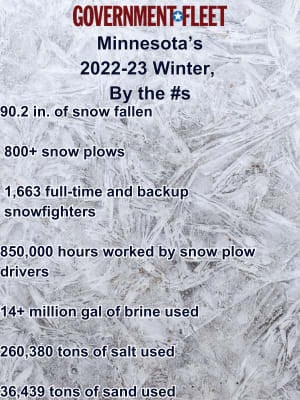
Part of what made this past winter so severe, Falgren said, was not so much that there was a lot of snowfall overall. It was more so that there happened to be multiple major storms throughout the season – from heavy snowfall to extremely cold temperatures.
“There are some things that become incredibly challenging, especially when we get into ultra cold situations. When you're looking at 20 and 30 and 40 degrees below, you're taking equipment out that now, the fluids are more challenging to keep moving. Equipment becomes more brittle. So you've got to be a little bit more careful when it gets into extreme cold, because you're worried about fuel. Gelling of fuel is a significant problem as it gets colder,” Falgren explained. “Our big focus is just to get a little bit better every time this happens.”
After the season was over, Falgren noted that one thing that helped keep things running smoothly with was an increase in communication.
Falgren not only oversees MnDOT’s fleet; he also oversees operations. One observation he has made between the two divisions is that the fleet operators and supervisors communicate well to keep operations running smoothly.
“How do we manage breakdowns? Are we going to do a significant repair on this piece of equipment?” he said. “Are we going to find a more simplified solution to just get a truck back on the road throughout the storm, and then do a more comprehensive repair? That dynamic is always occurring between our various shops and our operations group.”
One good result of the pandemic was the realization that remote communications between maintenance engineers, superintendents, shop supervisors, and other staff can be advantageous for MnDOT.
“It's that amount of communication and rapid sharing of best practices,” Falgren said. “I would say we're good at it, but we want to get a heck of a lot better. And so that's my role in the world is just to work on these systems to [figure out] how do we improve the communication internally?”
Communicating with the public is also crucial for MnDOT. The agency has several ways it conveys information on road conditions.
Through its 511 system, MnDOT notifies drivers of road conditions using snow plow trackers, which includes cameras that are mounted to the vehicles. Photos from the cameras are sent to the 511 website every 10 minutes or so, where the public can see them when clicking on a certain part of the state map.
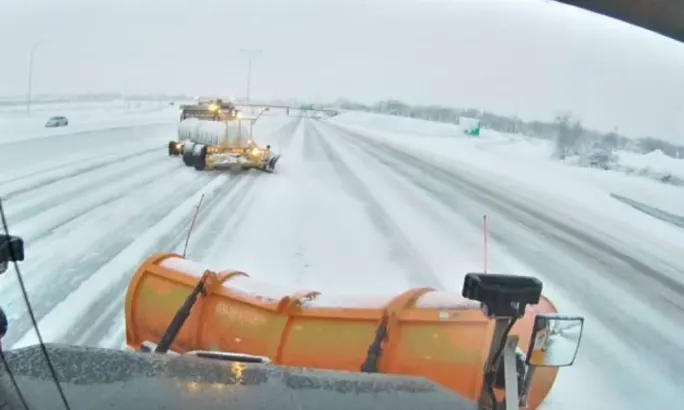
The agency used to have cameras on only about a third of its snow plows; this winter, there will be cameras on all of them. This allows the operations team to see what the conditions are like without having to bother the snow plow operators.
Photo: MnDOT
“It helps build some support and some credibility for what we're doing,” Falgren said. “It's one thing to tell somebody the roads are closed, but then when you send them a picture, they kind of go, ‘Okay, yeah, I understand why I'm not going to be able to get there with my car right now.’”
The agency used to have cameras on only about a third of its snow plows; this winter, there will be cameras on all of them. This also allows the operations team to see what the conditions are like without having to bother the snow plow operators.
With the new cameras, MnDOT is moving to a video-based system to provide more of a live feed of road conditions, instead of having photos uploaded in 10-minute increments. The agency is still figuring out the best way to extract the images to provide to the public.
Additionally, MnDOT also has cameras stationed on its roadways throughout the state, where people can see the road conditions on a live feed.
“[Photos and videos are] just another awesome tool to communicate with people. Sometimes it's actually the bigger storms where there's lots of buzz, especially if it's coming close to a metro area, that that will help,” Falgren said.
These feeds also allow people to get a better idea of what’s happening in other parts of the state.
“The February storm did not hit our metro areas hard. But…an extreme part of Western Minnesota got nailed. And so if you're if you're in that world, it was very difficult. And so, [it’s about] trying to be very open in those communications,” Falgren said.
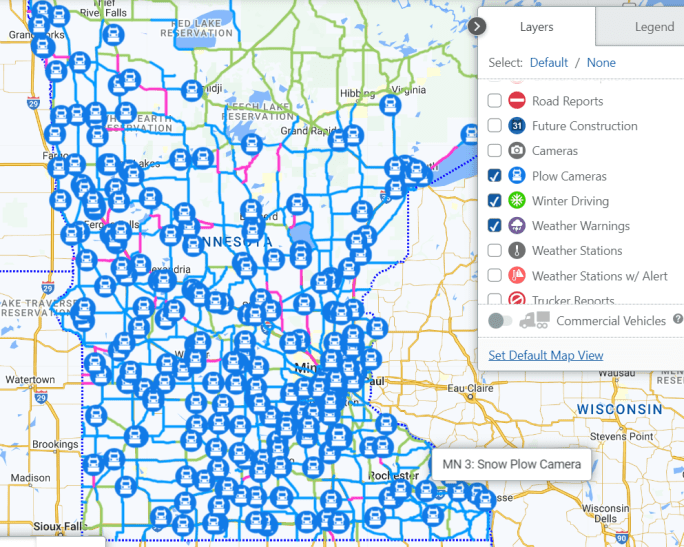
MnDOT's 511 website has a map that allows motorists to look at road conditions. The blue icons here represent plow cameras that motorists can view.
Photo: MnDOT
One thing that helped with the February storm – which actually ended up dumping less snow than expected – was heavy communication with the public, something MnDOT’s media relations team works hard to do ahead of every storm.
“The word got out early. And a lot of folks were off the road for that particular event,” MnDOT Media Relations Coordinator Anne Meyer said. “That really helped our crews get the job done even sooner. Every crash, every breakdown, anything that happens during an event slows down our operations to clear roads. So we're trying to convince and work with the public to be on our team to help us in those events so that we can get the job done faster.”
In addition to upgraded cameras on snow plows, MnDOT is also updating its automatic vehicle locator (AVL) systems, which it uses to track where material is put down on roadways, as well as track road conditions.
The agency is also improving the data feed from its trucks in order to feed better diagnostic information to fleet managers and shop supervisors around the state.
Falgren hopes changes like this will help MnDOT work more efficiently during the upcoming winter season.
“We try to learn from every year,” Falgren said.

Is keeping vehicles longer saving money, and what happens when a diagnostic test points to the wrong fix?
Read More →
Keeping a vehicle longer may ease this year’s budget, but what does it cost the next one? A closer look at fleet decisions can reveal opportunities to reduce spending while protecting essential services.
Read More →
From industry news and fleet management strategies to conversations with peers, Government Fleet's LinkedIn page offers public-sector fleet professionals another way to stay informed and connected.
Read More →
Five fleets were honored at RTA Connect 2026 in Chicago for excellence across resource efficiency, intentional culture, risk management, and stakeholder satisfaction.
Read More →
Buying fleet management software in 2027 means looking beyond features and price. As fleet operations, technology and expectations evolve, this guide explores what today’s fleet professionals should consider when choosing a system that can deliver value now and adapt to what comes next.
Read More →
Fleet car sales doubled, but the bigger picture tells a different story in this week’s roundup.
Read More →
St. Johns County, Florida, had fleet data, but turning it into reliable decision guidance was another matter. Instead of starting over with a new fleet management system, the county connected existing tools and built a scoring system that gives managers an objective look at fleet health.
Read More →
New one-day registration lets fleet professionals attend Tuesday, Wednesday, or Thursday, with passes available for $249.
Read More →
Two variants of the concept shuttles were revealed: a low-floor configuration and a high-floor configuration.
Read More →
What if your next technician hasn’t worked in a fleet shop yet? What fleets are doing to free up time.
Read More →