


A basic fleet replacement strategy can be chosen from among three approaches:
Optimize salvage value while minimizing downtime and maintenance costs.
Optimize salvage value while minimizing capital and maintenance costs.
Minimize capital costs.
 MENU
MENU SEARCH
The key to successfully managing lifecycle components is replacing a vehicle at the optimal time. One of three basic replacement strategies can be used to fit a particular fleet’s organization.
Key to successfully managing lifecycle components is replacing a vehicle at the optimal time.
Photo: Government Fleet
What is lifecycle management, what are the elements that need to be managed, and what are the basic strategies used to manage them?
In simple terms, lifecycle management is managing all the various expense (and revenue) components involved in providing and operating a vehicle — cradle to grave. Lifecycle cost elements include acquisition, license, insurance, fuel, maintenance, repair, salvage, debt expense, administration, accidents, inventory, and downtime.
The key to successfully managing lifecycle components is replacing a vehicle at the optimal time. While the entire fleet management process must be done correctly, if the “when to replace and when to retire” issue is sub-optimized, it’s likely that efforts focused in other areas will be sub-optimized as well.
The optimal replacement time is rarely a precise moment, but more closely resembles a window. Where that optimal window falls in a vehicle service life can vary between organizations. To determine the optimal window, age and use must be linked.
A basic replacement strategy can be chosen from three approaches:
Replacement policy: four years or less, 60,000 miles or less.
Organization characteristics:
Downtime is expensive and results in lost sales or lost customers. Productivity is seriously impaired.
Image is important.
A company vehicle likely is assigned to staff, used as an employee retention tool, and is a part of a compensation package.
These organizations typically very clearly view time as money. Production is vital, and production interruptions are not tolerated. Given the high cost of downtime, strategy 1 is often the most economical fleet management approach for these organizations.
Replacement policy: 4-8 years, 60,000-100,000 miles.
Organization characteristics:
Downtime is important, but production schedules can be adjusted or spares can be provided.
Image is a consideration, but selecting the latest model is not.
Optimization of all individual lifecycle cost components is a goal.
A company vehicle may be provided to staff and be included in compensation packages, but is not a vital employee retention strategy.
These organizations typically seek a balance by getting full-service value from vehicles, yet retiring them before significant cost or downtime problems occur. Strategy 2 can be the most economical approach to fleet management, if the balance is achieved.
Replacement policy: eight years or more, 100,000 miles or more.
Organization characteristics:
Downtime is tolerated. Either adequate spares are available (large inventory) or work production schedules easily manage disruptions.
Image is not particularly important.
Often, single focus is optimizing one cost component.
These organizations typically have more time than funding. Their “drive-’til-dead” approach results in carrying a large inventory (necessary as spares for breakdowns). While often perceived by customers as the most economical fleet management approach, in reality, strategy 3 is often the most costly approach.
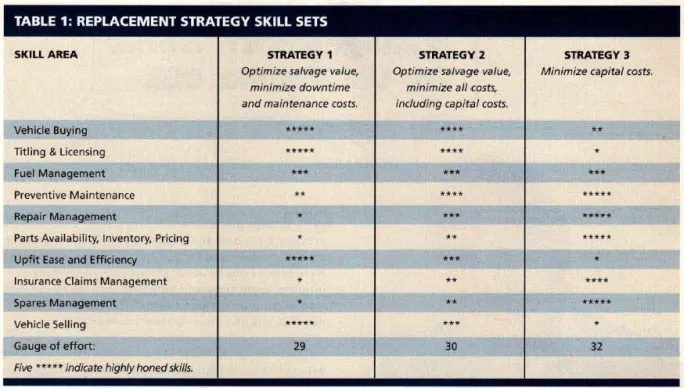
This table describes the relative emphasis (and skill) necessary in a particular area for each lifecycle strategy outlined.
Photo: David Schiller
Finding the right “when to replace, when to retire” lifecycle strategy for an organization requires two things:
Identification and consideration of all cradle-to-grave costs of operating a vehicle.
An assessment of downtime costs.
It is difficult for an organization to get the timing right if different managers (or budgets) bear responsibility for different facets of operating vehicles. An example of poor organizational alignment might be:
Manager A is responsible for maintenance and repair costs.
Manager B is responsible for the replacement budget (and when to replace).
Budget C receives proceeds from resale of used equipment (unrelated to budgets managed by manager A or manager B).
This scenario would be confused even further if another budget pays the equipment insurance or licensing costs (a cost problem associated with carrying a supply of spares).
Organization alignment and a “best practice” is one manager handling all costs associated with vehicle acquisition, operation, and sales.
This fleet manager is responsible (and accountable) for ensuring that the replacement timing strategy is right for the organization, given the usage requirements and customer downtime costs. Ideally, fleet services costs should be charged back to users via time period and usage charges.
How critical are strong skills successful with a particular strategy? Table 1 describes the relative emphasis (and skill) necessary in a particular area for each lifecycle strategy outlined previously.
For example, strategy 3, “Minimize Capital Costs” does not require skilled and capable vehicle acquisition specialists because inherent in this strategy is long replacement cycles, with relatively few annual replacements.
On the other hand, this strategy requires very skilled and capable repair management because dealing with breakdowns and effectively managing repairs is a frequent event.
While an argument could be made that one strategy or another “is easier,” in reality, all require effort (and costs) applied in different areas.
A second reality is that each basic lifecycle strategy can be appropriate, depending on the organization’s circumstances. A third reality is that each organization has an optimal lifecycle strategy, and finding the “optimal” lifecycle strategy for the organization depends on:
Identifying and considering cradle-to-grave costs.
Organizational and budgetary alignment.
While these are three basic lifecycle strategies, fleet managers should consider additional factors in assessing a particular strategy:
Organizations with a safety focus, and/or are perceived as having “deep pockets,” will orient towards strategy 1 or 2.
Replacement equipment is nearly always safer than equipment coming out of service.
Strategy 3 can result in failures at inopportune times, sometimes resulting in accidents, costly and time-consuming litigation, and/or organizational public relations issues.
Smaller organizations with limited ability to leverage the market with volume purchases for new equipment may orient toward strategy 3.
Strategy 2 success requires “hitting on all eight cylinders,” but likely will bring the lowest organizational costs if indeed the fleet is “hitting on all eight.”
Some organizations with highly variable usage require variable lifecycles to match an added challenge.
Seasonal peaks in vehicle demand can sometimes be met by “recycling” previously replaced units for a short temporary assignment, if timing issues can be resolved. Such secondary usage should be factored into “when-to-replace” decisions.
Finding the right strategy for an organization requires applying good science skills, particularly math. But to a certain extent, balancing all factors will require some art as well.
Editor's Note: This article was originally published in May of 2007 and has been updated for continued relevancy.

Is keeping vehicles longer saving money, and what happens when a diagnostic test points to the wrong fix?
Read More →
Keeping a vehicle longer may ease this year’s budget, but what does it cost the next one? A closer look at fleet decisions can reveal opportunities to reduce spending while protecting essential services.
Read More →
From industry news and fleet management strategies to conversations with peers, Government Fleet's LinkedIn page offers public-sector fleet professionals another way to stay informed and connected.
Read More →
Five fleets were honored at RTA Connect 2026 in Chicago for excellence across resource efficiency, intentional culture, risk management, and stakeholder satisfaction.
Read More →
Buying fleet management software in 2027 means looking beyond features and price. As fleet operations, technology and expectations evolve, this guide explores what today’s fleet professionals should consider when choosing a system that can deliver value now and adapt to what comes next.
Read More →
Fleet car sales doubled, but the bigger picture tells a different story in this week’s roundup.
Read More →
St. Johns County, Florida, had fleet data, but turning it into reliable decision guidance was another matter. Instead of starting over with a new fleet management system, the county connected existing tools and built a scoring system that gives managers an objective look at fleet health.
Read More →
New one-day registration lets fleet professionals attend Tuesday, Wednesday, or Thursday, with passes available for $249.
Read More →
Two variants of the concept shuttles were revealed: a low-floor configuration and a high-floor configuration.
Read More →
What if your next technician hasn’t worked in a fleet shop yet? What fleets are doing to free up time.
Read More →