





Want more? How Fleets Track Fuel Management in Uncertain Times
How to Track and Manage Emissions…Even If You’re a Small Fleet
Measuring and reducing your carbon footprint is possible even on a shoestring budget.
August 6, 2025

To track progress on emission reduction goals, it’s important to start by tracking current emissions.
Photo: Mikhail Nilov
3 min to read
If you manage a public sector fleet, you know your job is to be a good steward of your community’s tax dollars. Today, government fleets are also charged with being good stewards of the environment.
As fleets adopt cleaner-burning fuels or purchase zero-emission vehicles (ZEVs) to green their operations, data is essential to get the biggest sustainability gains. Even if you are just starting out, operate a small fleet, or have a small budget, these steps can help you measure and manage emissions and see your carbon footprint shrink.
Where to Start and Establishing a Baseline
To track progress on emission reduction goals, it’s critical to start by tracking current emissions.
“Smaller-sized fleets may not be focusing on collecting data and tracking their emissions, given other day-to-day business needs. However, beginning to measure your current emissions is a great start,” said Chase LeCroy, deputy director, Data Insights & Analytics, CALSTART. “The very first step would be to ensure you are tracking mileage and fuel consumption across all vehicles, and then using that data to calculate your baseline. This metric allows you to measure your progress as you phase-in ZEVs so you can be confident you are moving in the right direction.”
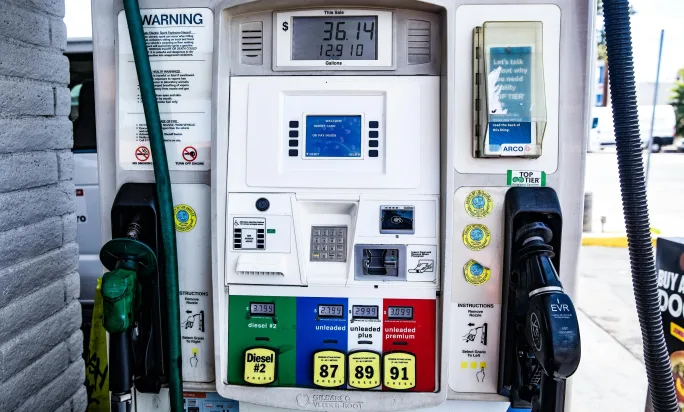
For traditional internal combustion engine (ICE) vehicles, tracking fuel consumption is usually the most reliable way to calculate emissions.
Photo by Ekaterina Belinskaya
Tim Venghaus, CEO of Darby Telematics, said establishing a baseline for the existing fleet can be as simple as tracking a single metric.
“For traditional internal combustion engine (ICE) vehicles, tracking their fuel consumption would be the most reliable way to calculate emissions. This information should be readily available if drivers use a fleet payment card or if they have a tank on-site for refueling (or a combination of both),” he explained. “Carbon can be calculated using total gallons and the type of fuel (gasoline, diesel, E-85, biodiesel blends, etc.) and the corresponding carbon coefficient available from sources like the EPA and EIA.”
Developing a Plan with Achievable Emissions-Reduction Goals
If tracking fuel consumption isn’t feasible, another approach is available: tracking mileage.
“There are reputable sources that one can use to calculate emissions as a function of vehicle miles traveled and specific vehicle type. CARB and EPA produce emissions inventories modeling what the emissions profile is likely to be coming from your vehicles; you can then multiply their values by the miles your fleet travels,” says LeCroy. “Many different factors can alter the exact emissions generated by any one vehicle, but barring the time and funding needed to do emissions testing, using these standardized metrics is a great approach.”

Any plan should establish processes to ensure data continues to be collected and progress is assessed at regular intervals.
Photo by Lukas | Pexels
The next step is to develop a plan with achievable emissions-reduction goals based on your baseline. If you’re not sure where to start, Jean Pilon-Bignell, SVP, Business Development at GEOTAB, suggested consulting fleet peers. “Compare your fleet against other similar fleets to benchmark and discover areas of improvement,” he advised.
Once goals are established, the next step is to put a data collection process in place.
“Any plan should establish processes to ensure data continues to be collected and progress is assessed at regular intervals as you transition your fleet,” LeCroy said. “Continuing to update your progress toward your goals over time is key so that you can see, share, and celebrate your achievements.”
Editor's Note: This article was originally published in August 2023 and reviewed for continued relevancy in August 2025.
Subscribe to Our Newsletter
More Operations

Is Keeping Older Fleet Vehicles Really Saving Money?
Is keeping vehicles longer saving money, and what happens when a diagnostic test points to the wrong fix?
Read More →
How Smart Fleet Strategy Can Help Local Government Agencies Do More with Less
Keeping a vehicle longer may ease this year’s budget, but what does it cost the next one? A closer look at fleet decisions can reveal opportunities to reduce spending while protecting essential services.
Read More →
Connect with Government Fleet on LinkedIn
From industry news and fleet management strategies to conversations with peers, Government Fleet's LinkedIn page offers public-sector fleet professionals another way to stay informed and connected.
Read More →
Town of Queen Creek Named Most Successful Fleet Award Winner of Inaugural RTA Fleet Success Awards
Five fleets were honored at RTA Connect 2026 in Chicago for excellence across resource efficiency, intentional culture, risk management, and stakeholder satisfaction.
Read More →
Sponsored•October 14, 2026
A buyer's guide to fleet management software in 2027
Buying fleet management software in 2027 means looking beyond features and price. As fleet operations, technology and expectations evolve, this guide explores what today’s fleet professionals should consider when choosing a system that can deliver value now and adapt to what comes next.
Read More →
Hazard Alerts, Fleet Car Sales Rise and a New Shuttle Concept
Fleet car sales doubled, but the bigger picture tells a different story in this week’s roundup.
Read More →
How St. Johns County Turned Fleet Data Into Better Replacement Decisions
St. Johns County, Florida, had fleet data, but turning it into reliable decision guidance was another matter. Instead of starting over with a new fleet management system, the county connected existing tools and built a scoring system that gives managers an objective look at fleet health.
Read More →
Fleet Forward Conference Introduces One-Day Passes for 2026
New one-day registration lets fleet professionals attend Tuesday, Wednesday, or Thursday, with passes available for $249.
Read More →
ENC Unveils its ZAVIR Medium-Duty Shuttle
Two variants of the concept shuttles were revealed: a low-floor configuration and a high-floor configuration.
Read More →
Could Your Next Fleet Technician Start as an Intern?
What if your next technician hasn’t worked in a fleet shop yet? What fleets are doing to free up time.
Read More →