




New Faces: Thinking Outside the Box as a New Acquisition Manager
Managing Recruitment & Maintenance as a New Fleet Manager
Alison Kerstetter, fleet manager of the Sacramento, California, Department of Public Works, shares the latest updates on her fleet and how she started her career in fleet.

Hillary Weiss・Senior Editor
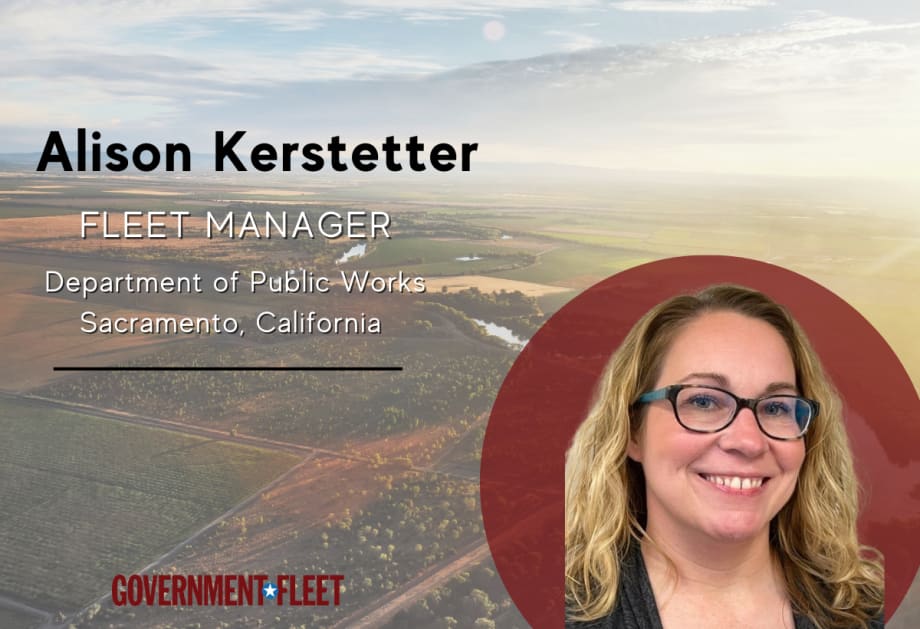
Alison Kerstetter, fleet manager of the city of Sacramento, California Department of Public Works.
Alison Kerstetter/Government Fleet
3 min to read
Alison Kerstetter joined the city of Sacramento, California Department of Public Works as fleet manager in July 2022.
Following the previous Fleet Manager Mark Stevens, she’s acquired a big undertaking. In her current role, she is responsible for Sacramento’s six maintenance shops, as well as 2,900 vehicles and equipment and roughly 160 contracts.
She leads the fleet management department, which has 60 employees. The department is responsible for the ins and outs of Sacramento’s fleet. This includes:
Vehicle procurement
Contracts management
Bid solicitation
Council reports
Motor pool management
Department of motor vehicle licensing and registering
Invoice payment
Budget generation
Vehicle replacement projections and repairs
Because of her large staff, there are always opportunities to learn and grow in her role with her employees. “The people I work with are great and are always providing information on the technical aspects of the job. I come from a business background and every day I learn something more about vehicle operation and mechanical workings,” Kerstetter says.
How it all Began
Kerstetter started her fleet career in logistics at Rite Aid Corporation specializing in Transportation and Supplier Compliance.
While she’s new to the fleet management role, she’s been working for the City of Sacramento since 2015.
She was able to use her skills and experience at Rite Aid Corporation when she moved to Sacramento and was hired as a program analyst with the City of Sacramento Department of Utilities Logistics Section.
She adds, “I was responsible for the department vehicle replacements and the budgets for the Utilities Fleet and Facilities. The department had 500 vehicles and equipment at that time.”
That role helped her grow in her career and she was soon promoted to program specialist for the Department of Public Works, Fleet Management Division.
“I oversaw purchasing all the city’s vehicles and equipment as the supervisor of the asset management team. At that time, there were 2,400 vehicles and equipment in the fleet. I was also responsible for bid solicitations, contracts and council reports for vehicles, equipment and services needed for the city fleet maintenance shops,” she says.
Looking Toward the Future
Like all fleet roles, the job has its good times and bad times.
One of Kerstetter’s biggest challenges as a fleet manager is recruitment and retention. Closing out 2022, Kerstetter stated the Fleet Management Division has over 20 positions vacant, including mechanics of all experience levels and equipment service workers.
“The experience level and time in the trade of the people that are applying for mechanic and service worker positions are less than what was seen 10 years ago. Also, as in most local municipalities, the ability to pay the same wages as private companies is not comparable.”
One of Kerstetter’s goals that will help improve retention and recruitment is to make changes within the organization that will make it a better place for employees to work.
Along with improving recruitment, she’s also excited to incorporate new vehicle and equipment technology.
“It will be interesting to see the types of vehicles we will be driving in the next 20 years,” she added.
As for her final advice to new fleet managers, she recommends learning as much from the staff and about the operations as much as possible.
“The best thing that I did to assist in understanding the divisional operation was spending time in the shops, talking to staff, and understanding what is needed to make their jobs easier and safer. The shop supervisors are very knowledgeable about ways to make the operation better as they are on the front lines of the shops every day. Also, understanding the budget and procurement methods are important to make decisions and understand the business from a financial perspective,” Kerstetter says.
Subscribe to Our Newsletter
More Operations

Is Keeping Older Fleet Vehicles Really Saving Money?
Is keeping vehicles longer saving money, and what happens when a diagnostic test points to the wrong fix?
Read More →
How Smart Fleet Strategy Can Help Local Government Agencies Do More with Less
Keeping a vehicle longer may ease this year’s budget, but what does it cost the next one? A closer look at fleet decisions can reveal opportunities to reduce spending while protecting essential services.
Read More →
Connect with Government Fleet on LinkedIn
From industry news and fleet management strategies to conversations with peers, Government Fleet's LinkedIn page offers public-sector fleet professionals another way to stay informed and connected.
Read More →
Town of Queen Creek Named Most Successful Fleet Award Winner of Inaugural RTA Fleet Success Awards
Five fleets were honored at RTA Connect 2026 in Chicago for excellence across resource efficiency, intentional culture, risk management, and stakeholder satisfaction.
Read More →
Sponsored•October 14, 2026
A buyer's guide to fleet management software in 2027
Buying fleet management software in 2027 means looking beyond features and price. As fleet operations, technology and expectations evolve, this guide explores what today’s fleet professionals should consider when choosing a system that can deliver value now and adapt to what comes next.
Read More →
Hazard Alerts, Fleet Car Sales Rise and a New Shuttle Concept
Fleet car sales doubled, but the bigger picture tells a different story in this week’s roundup.
Read More →
How St. Johns County Turned Fleet Data Into Better Replacement Decisions
St. Johns County, Florida, had fleet data, but turning it into reliable decision guidance was another matter. Instead of starting over with a new fleet management system, the county connected existing tools and built a scoring system that gives managers an objective look at fleet health.
Read More →
Fleet Forward Conference Introduces One-Day Passes for 2026
New one-day registration lets fleet professionals attend Tuesday, Wednesday, or Thursday, with passes available for $249.
Read More →
ENC Unveils its ZAVIR Medium-Duty Shuttle
Two variants of the concept shuttles were revealed: a low-floor configuration and a high-floor configuration.
Read More →
Could Your Next Fleet Technician Start as an Intern?
What if your next technician hasn’t worked in a fleet shop yet? What fleets are doing to free up time.
Read More →