




The formula:How to Calculate Technician-to-Vehicle Ratios
Expert Strategies for Fleet Staffing and Efficiency
A shortage of skilled technicians, and more fleet managers worried about budget cuts, efficient employee management is more important than ever.

Lexi Tucker・Senior Editor
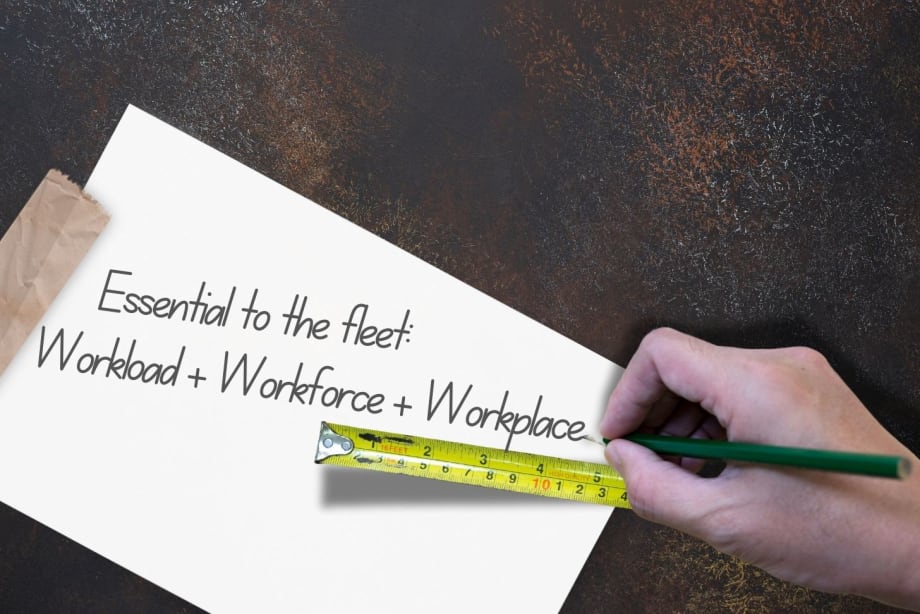
Every fleet operation has three essential elements: workload, workforce, and workplace.
Photo: Government Fleet
5 min to read
One of the biggest responsibilities of many public fleet managers is managing a staff of technicians and office employees. With the “aging” of the fleet industry, a shortage of skilled technicians, and more fleet managers worried about budget cuts, efficient employee management is more important than ever.
A webinar sponsored by Long Beach Clean Cities and presented by Government Fleet, MEMA, and Mercury Associates delved into how managers can make sure they have the right number of workers they need to care for a fleet.
Titled “Business Process Efficiency Improvement and Staffing Levels,” the webinar had Tony Yankovich, managing director at Mercury Associates and Marc Canton, senior client advisor at Mercury Associates, discussing processes managers can implement to ensure maximum productivity.
Calculating Staffing Requirements
Fleet service professionals know fleet cost and service effectiveness can be tied directly to the resources allocated to a fleet operation. These resources include vehicles and equipment, fleet maintenance facilities, tools and shop equipment, the people who work at the organization, technology, and information.
Every fleet operation has three essential elements:
Workload: What needs to be done
Workforce: The people required to get the work done
Workplace: Where the work will be accomplished
Fleet managers need to know the workload before they can determine workforce requirements, and they need to know the workforce numbers before they can determine the number of maintenance bays, size of the shop, and other space requirements for the workplace.
■ Calculate the workload
Convert every asset in the fleet into a vehicle equivalency unit (VEU). Then, based on the total VEU calculation for the entire fleet, you can identify the total direct labor hours, or demand hours, required to maintain the fleet.
■ Identify workload to be completed in-house versus sublet and adjust VEU analysis
The second step is to determine if all of the workload will be maintained by the in-house shop. In some cases, a portion of the work will be outsourced to commercial vendors, or to another shop. Identify the VEUs for what work your organization is not responsible for maintaining, and subtract that from the in-house workload demand.
■ Determine technician workload tolerance level
How much work can you expect your technicians to perform in a given year? How many VEUs can each technician support? How many direct labor hours can you expect technicians to achieve each year?
■ Do the math
The first step is to assign VEU values and calculate the workload. Every asset can be assigned a VEU value, which corresponds to the level of effort required to maintain that unit. For example, a standard passenger sedan would be rated at 1 VEU, while a law enforcement patrol sedan might be a 2.5. This means it would take two and a half times the effort to maintain it compared to a typical passenger sedan.
“It’s important your organization determines its own VEU values through analysis of your own data, such as the age of the fleet, utilization of the fleet assets, condition of the fleet, application of the unit, and the historical maintenance and repair experience for the organization,” Yankovich said.
Once you’ve assigned a VEU to every asset in the fleet, you can then calculate the total number of VEUs for your operation. When you know how many VEUs your shop is maintaining, you need to determine how many hours of direct labor are associated with each VEU. A general rule of thumb is each VEU represents about eight to 12 hours of labor each year.
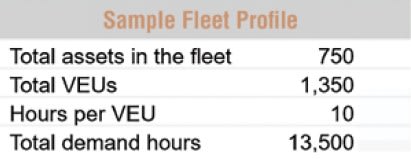
The next step includes determining if any of these assets are not going to be maintained by your operation. You would then decrease the total VEUs and hours by that amount to determine the remaining in-house workload demand.
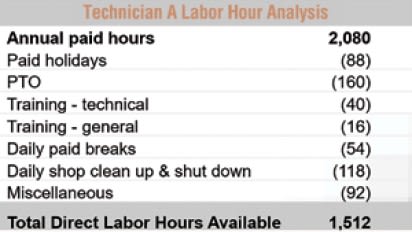
You must then determine how many hours technicians can account for each year. Assuming a full-time fleet technician with no other responsibilities, start with the standard number of available work hours and then subtract other activities.
Do the math: 13,500 hours of maintenance and repair required / 1,512 hours per technician = 8.93 technicians required.
Improving Business Processes
The goals of improving your business processes are to reduce waste, improve quality, reduce effort, decrease cost, and/or improve the customer experience.
“It’ll be fairly easy to pinpoint which of your business processes need improvement, as they’ll probably be items either your fleet customers or staff are regularly complaining about or dreading having to do, or there’ll be things you know yourself that are much more difficult than need to be or take too long,” explained Canton.
A few examples of areas ripe for improvement include procurement (having multi-year contracts with suppliers, piggy-backing existing contracts, blanket purchase orders or contracts); PM parts kits (prepared by a parts specialist based on PM schedule for the day); and PM checklists with detailed instructions (defines optimal order of operation).
Here are a few traditional process improvement approaches that may work for your operation:
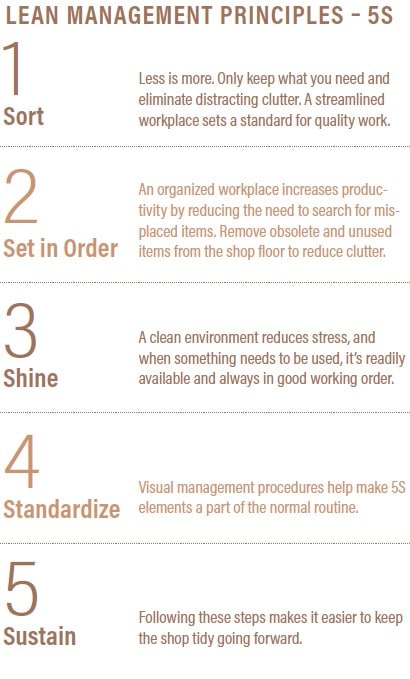
■ LEAN (also known as Lean Manufacturing or Lean Technology)
Originated with Toyota and implemented to streamline production. The key idea is to base improvement on the customer perspective, find out what they value, and make changes to reflect this focus.
■ Six Sigma
Focuses on the root cause of problems, defects, and variations that reduce the effectiveness of processes. Philosophy of constant improvement.
■ Total Quality Management
Focus is on the elimination of errors by holding everyone accountable for the overall quality of the product or service.
Using Technology to Drive Improvement
Integration can reduce the effort required for certain tasks and increases the visibility and accuracy of data and information by ensuring formerly disparate systems, applications, and devices “talk to each other.”
Automation involves programming one action to trigger a series of actions without additional user input. The goal is to simplify and streamline workflow.
Predictive analytics is the analysis of integrated data to calculate the probability of various future outcomes.
Editor's Note: This article was originally published in February 2021 but was updated for continued relevance and accuracy as of May 2024.
Subscribe to Our Newsletter
More Operations

Is Keeping Older Fleet Vehicles Really Saving Money?
Is keeping vehicles longer saving money, and what happens when a diagnostic test points to the wrong fix?
Read More →
How Smart Fleet Strategy Can Help Local Government Agencies Do More with Less
Keeping a vehicle longer may ease this year’s budget, but what does it cost the next one? A closer look at fleet decisions can reveal opportunities to reduce spending while protecting essential services.
Read More →
Connect with Government Fleet on LinkedIn
From industry news and fleet management strategies to conversations with peers, Government Fleet's LinkedIn page offers public-sector fleet professionals another way to stay informed and connected.
Read More →
Town of Queen Creek Named Most Successful Fleet Award Winner of Inaugural RTA Fleet Success Awards
Five fleets were honored at RTA Connect 2026 in Chicago for excellence across resource efficiency, intentional culture, risk management, and stakeholder satisfaction.
Read More →
Sponsored•October 14, 2026
A buyer's guide to fleet management software in 2027
Buying fleet management software in 2027 means looking beyond features and price. As fleet operations, technology and expectations evolve, this guide explores what today’s fleet professionals should consider when choosing a system that can deliver value now and adapt to what comes next.
Read More →
Hazard Alerts, Fleet Car Sales Rise and a New Shuttle Concept
Fleet car sales doubled, but the bigger picture tells a different story in this week’s roundup.
Read More →
How St. Johns County Turned Fleet Data Into Better Replacement Decisions
St. Johns County, Florida, had fleet data, but turning it into reliable decision guidance was another matter. Instead of starting over with a new fleet management system, the county connected existing tools and built a scoring system that gives managers an objective look at fleet health.
Read More →
Fleet Forward Conference Introduces One-Day Passes for 2026
New one-day registration lets fleet professionals attend Tuesday, Wednesday, or Thursday, with passes available for $249.
Read More →
ENC Unveils its ZAVIR Medium-Duty Shuttle
Two variants of the concept shuttles were revealed: a low-floor configuration and a high-floor configuration.
Read More →
Could Your Next Fleet Technician Start as an Intern?
What if your next technician hasn’t worked in a fleet shop yet? What fleets are doing to free up time.
Read More →