



At a Glance
Robert Martinez earned the Legendary Lifetime Achievement Award for:
Helping transform police light bar use
Creating an internship program for high school students
Teaching at conferences and sharing with the industry.
 MENU
MENU SEARCH
Robert Martinez was named 2015 Legendary Lifetime Achievement Award recipient. Determination, a vision for a better work environment, and advanced calculus allowed the former NYPD auto service worker surpass his career goals.
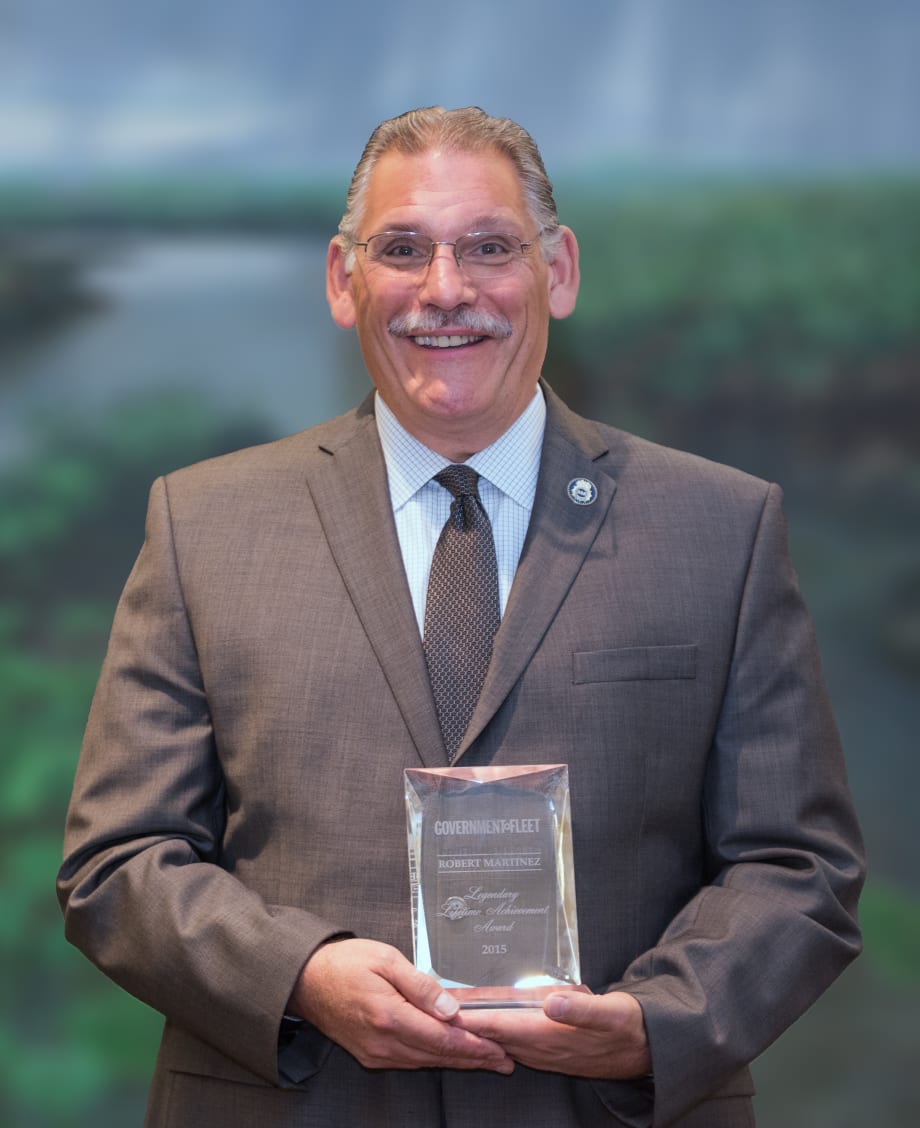
Robert Martinez received the Legendary Lifetime Achievement Award at the Government Fleet Expo & Conference (GFX) on June 10. Photo by Gene Tewksbury
Robert Martinez received the Legendary Lifetime Achievement Award at the Government Fleet Expo & Conference (GFX) on June 10. Photo by Gene Tewksbury
In many ways, the Robert Martinez of 1986 would have been the ideal candidate for a fleet technician position today — a technician with a few years of experience, hard-working, determined to better himself and to become a leader, and willing to take a pay cut for the benefits.
Back in 1986, Martinez took his first fleet job as a temporary auto service worker for the New York Police Department (NYPD), earning about $15,000 annually. Today, he is deputy commissioner of the NYPD’s Support Services Bureau, overseeing more than 400 fleet employees and three other divisions.
On June 10, Government Fleet honored Martinez not just for being inducted into the Public Fleet Hall of Fame, but also with a Legendary Lifetime Achievement award. The annual award, sponsored by the National Joint Powers Alliance (NJPA), recognizes one individual among the Hall of Fame inductees and candidates who has contributed significantly to the industry.
The former motorcycle technician rose to a three-star position within the NYPD through vision, hard work, and education.
Driving Factors
Martinez had worked on motorcycles since he was a teenager, and after graduating from a vocational high school in its automotive program, he continued to work on motorcycles before opening his own shop.
“I got a city job because I started to have kids and needed benefits. I had to grow up,” Martinez recalled.
Eight years out of school, he joined the NYPD. Martinez knew within a year at the fleet that he wanted to rise above the technician position. He wanted to become the fleet director, and a series of driving factors got him to his current position and beyond.
The first was that need for benefits. The second was the need to earn more money — he knew a promotion to the auto mechanic position would more than double his salary, and he took the required steps (and civil service test) to get there.
The third was a concern for his working environment.
“What I noticed right away was that the supervisor kind of controlled the environment in which people worked. And there were certain people I didn’t want to work for, and they were taking the supervisor’s test at the same time,” Martinez said. “It was either take the test or end up working for them.”
He said his ideal work environment was one where technicians were respected and everyone could work to identify and resolve inefficiencies.
Martinez passed the test on the second try, and became a fleet supervisor in 1996.
The last driving factor came as a result of a frustrating experience:
“We had a seat on a Harley Davidson motorcycle that we had a problem with. I was a mechanic at the time, and I was talking to an engineer from Harley. I was explaining to him what the problem was, and basically he just discarded whatever I said because he was an engineer and I wasn’t,” he said.
Martinez wanted to be able to talk to engineers as an equal, so he went back to school. After not being in school for more than a decade, he struggled through the advanced calculus classes, but he succeeded, getting his bachelors of technology degree in electromechanical engineering in 2000.
After that, he rose in the hierarchy within the department. After a couple of promotions, in 2006, Martinez, to his surprise, was named the fleet director. Four years later, he was named executive director of the Support Services Bureau, overseeing fleet, the property clerk, central records, and printing. In 2014, he became deputy commissioner of the bureau, his current position.
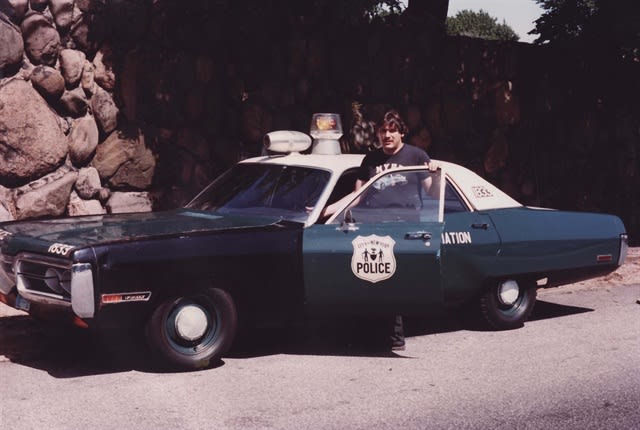
Robert Martinez is pictured here in the late ’80s, shortly after joining the NYPD fleet as a technician. Photo courtesy of Martinez
Shaping the Industry
Martinez is well known in the public fleet industry. He is a longtime member of the NAFA Fleet Management Association, on his third year of serving as chairperson of the association’s Law Enforcement group. NAFA has awarded him the Larry Goill prize and the Flexy award for Leadership in the past few years. He has been nominated various times for Government Fleet’s Public Sector Fleet Manager of the Year award, and the NYPD fleet has been named a Leading Fleet for the past two years.
One of his proudest accomplishments, and perhaps making the biggest impact to the industry, was back in 1996, when he converted a conventional halogen police vehicle light bar to an LED light bar, reducing amperage draw from 100 to 10 amps.
“We were able to talk to Federal Signal and Whelen and other manufacturers and have them look into getting into the LED market on overhead lighting,” he said. “Within five years, it was the standard.”
Another accomplishment, although not so well known, is his involvement in the creation of an internship program with vocational high school students. The Board of Education pays the students to work at an assigned fleet facility, and technicians become mentors to these students.
“Some of them now, we’re actually hiring as mechanics,” Martinez said.
At a time when many fleet managers are having problems with recruitment, this program allows the NYPD to train future technicians. And Martinez takes particular interest with it because he came from a vocational school.
He also teaches at fleet conferences and seminars and is happy to share his experiences with others.
“One thing that’s great about fleet managers is everyone is happy to share and likes to share, and it’s this great environment,” he said. “People [are] doing the same thing but in different communities, but at the end of the day everyone is willing to share and volunteer their time to help other people out.”
Passing Along Advice
Throughout his 30 years in fleet, Martinez has learned a few things. The first is that education has been the key to his success. After earning his bachelor’s degree, he went on to study executive management, earning a master’s degree in 2010.
“There are always people who want to knock you down or say bad things about you, but education people can’t take away. You get that degree or you get that certification, no matter what they say, they can’t take that away from you, and you have it for life,” he said. “And the other thing you do is you set a good example for your children and your other workers.”
Another is to let people learn from their own mistakes, allowing them to take a path or make a decision he wouldn’t have made. If the employee finds he has made a mistake, that’s one lesson he won’t forget. And if it works out, Martinez learns from the experience.
As fleet management becomes more data-centric, Martinez said fleet managers need to be more conscious about being transparent. The information available to elected officials and the public will increase, which means anyone who can access the data (that is, everyone) can hold a fleet manager accountable for his decisions.
“Everything from telematics to your labor rates, everything will be there and as people are getting smarter and able to digest this data, you need to be up on your game,” he said. “The information will be readily available to people who never even thought about this before.”

Is keeping vehicles longer saving money, and what happens when a diagnostic test points to the wrong fix?
Read More →
Keeping a vehicle longer may ease this year’s budget, but what does it cost the next one? A closer look at fleet decisions can reveal opportunities to reduce spending while protecting essential services.
Read More →
From industry news and fleet management strategies to conversations with peers, Government Fleet's LinkedIn page offers public-sector fleet professionals another way to stay informed and connected.
Read More →
Five fleets were honored at RTA Connect 2026 in Chicago for excellence across resource efficiency, intentional culture, risk management, and stakeholder satisfaction.
Read More →
Buying fleet management software in 2027 means looking beyond features and price. As fleet operations, technology and expectations evolve, this guide explores what today’s fleet professionals should consider when choosing a system that can deliver value now and adapt to what comes next.
Read More →
Fleet car sales doubled, but the bigger picture tells a different story in this week’s roundup.
Read More →
St. Johns County, Florida, had fleet data, but turning it into reliable decision guidance was another matter. Instead of starting over with a new fleet management system, the county connected existing tools and built a scoring system that gives managers an objective look at fleet health.
Read More →
New one-day registration lets fleet professionals attend Tuesday, Wednesday, or Thursday, with passes available for $249.
Read More →
Two variants of the concept shuttles were revealed: a low-floor configuration and a high-floor configuration.
Read More →
What if your next technician hasn’t worked in a fleet shop yet? What fleets are doing to free up time.
Read More →