




Research Yields New Ambulance Design Standard
New vehicle safety guidelines promise improved protection for first responders and patients in ambulance patient compartments.

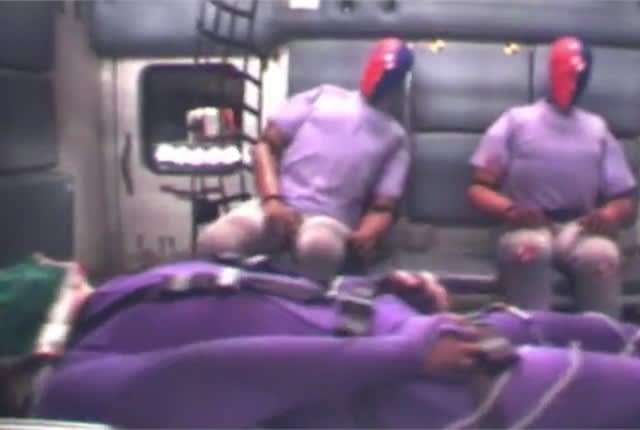
VIDEO: Ambulance Crash Tests Highlight Risks
A research and development project, involving three federal government agencies, has produced an updated ambulance design standard that promises to better protect emergency medical service workers and patients.
The project has involved the National Institute of Standards and Technology (NIST), the National Institute for Occupational Safety and Health (NIOSH, which is under the Centers for Disease Control and Prevention), and the Department of Homeland Security (DHS) Science and Technology Directorate.
Emergency medical service (EMS) providers riding in the back of ambulances are currently at a high risk of injury during a crash or an evasive traffic maneuver if they’re not using restraints, NIST said. (To view a video featuring NIOSH crash tests on ambulances with traditional safety features, click on the photo or link below the headline.) However, EMS workers often complain that restraints make it difficult to access and treat patients in transit.
Trading off protection for function often comes at a price. Between 1992 and 2011, the National Highway Traffic Safety Administration (NHTSA) estimates there was an average of 4,500 vehicle crashes involving ambulances annually, a third of which resulted in injuries. The crash statistics also show that 84 percent of EMS providers riding in the patient compartment were not restrained and only 33 percent of patients were secured with both shoulder and lap restraints.
To better balance safety and efficiency, researchers developed new design guidelines for ambulance patient compartments. The National Fire Protection Association this summer adopted the guidelines, integrating them into a voluntary consensus standard used by ambulance component and vehicle manufacturers.
“With the new design standards, emergency personnel should be able to do nearly 95 percent of their tasks while properly restrained,” said Jennifer Marshall, homeland security program manager in NIST’s Special Programs Office.
Marshall added that the updated NFPA standard details safety, efficiency and ergonomic improvements for compartment configuration. It also includes recommended specifications for seating and restraints, equipment mounting, patient cot retention, communications equipment, controls and switches, interior surfaces and storage, ventilation, illumination, and medical waste disposal.
“For the first time, we now have a voluntary consensus standard that includes testing and performance requirements from a crash perspective,” Marshall said. “Those requirements range from ‘soft’ recommendations, such as countertops and work surfaces designed to keep items from falling off, to ‘hard’ directives such as how the patient cot and caregiver seat are positioned.”
Submitted to NFPA by NIST and NIOSH, the new ambulance design guidelines were developed following a four-year R&D effort. Data were gathered through many methods, including surveys, focus groups, EMS worker interviews, visits to equipment manufacturers and EMS stations, computer simulations and crash tests.
The new standard (NFPA 1917, 2016 Edition) will go into effect on Jan. 1 of 2016. NIST and its partners are now working with ambulance component and vehicle manufacturers, the National Association of State EMS Officials, trade organizations, and state and federal government entities to increase awareness and foster understanding of how to improve ambulance safety using voluntary consensus standards.
Additionally, the agencies are also collaborating with NHTSA’s Office of Emergency Medical Services and the General Services Administration on a project aimed at creating 10 new ambulance crash safety test methods. The project, which began in 2009 and extends into 2016, has already produced six recommended practices published by the Society of Automotive Engineers (SAE) and referenced by other national standards. Also involved in this project is the ambulance manufacturer’s division of the National Truck Equipment Association.
These recommended practices cover ambulance crash response in frontal impact, side impact, rear impacts, seating and restraints, gurney and patient restraint, equipment mounting, patient compartment integrity, cabinet mounting and content retention, occupant excursion when restrained, and interior surface safety (“delethalization” in crashworthiness design jargon).
More Safety
New Partnership Aims to Expand Public Digital Hazard Alert System Statewide
The Hawai’i Department of Transportation (HDOT) is expanding advance digital hazard alerts for the public statewide.
Read More →
New York City Expands Safety Technologies Across Municipal Fleet
Executive Order 19 moves intelligent speed assistance and pedestrian alerts from pilot programs toward standard fleet equipment, offering other public fleets a look at how safety technology can be tested, measured, and scaled.
Read More →
Hidden in Plain Sight: Fleet Compliance Risks
Fleet compliance isn't just about having policies — it's about consistently enforcing them. This practical guide reveals six hidden compliance risks common in public sector and shared fleet operations and outlines proven strategies to improve visibility, accountability, and audit readiness.
Read More →
5 Days Left to Submit Your 2026 Fleet Safety Award Nomination
Know a government fleet, safety, or risk manager who deserves recognition for making fleet operations safer? Nominations are open through Aug. 15.
Read More →
How the First 24 Hours Can Shape a Fleet Crash Response
How a strong accident response process helps government fleets move from the initial report to recovery while building a clearer record for what needs to change next.
Read More →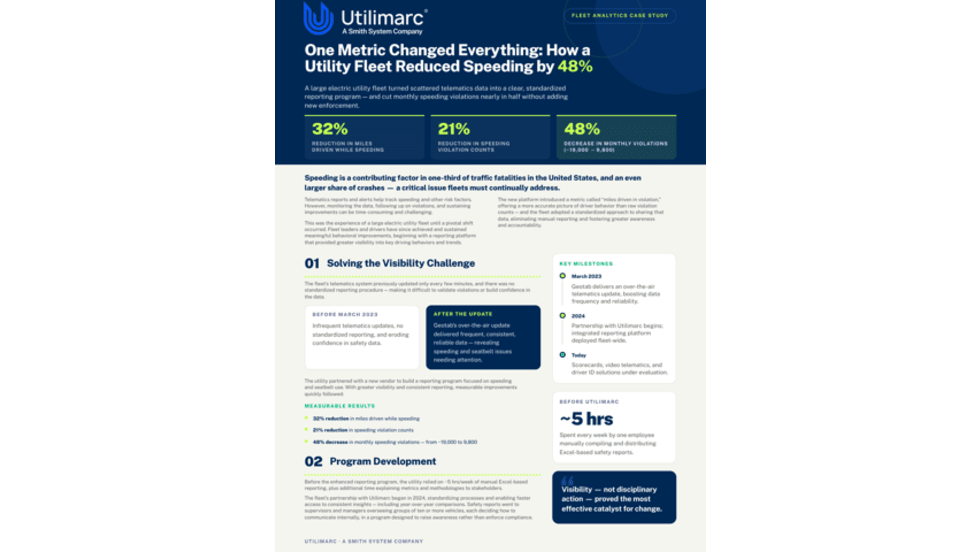
How Better Visibility Cut Speeding Violations by 48%
Fleet leaders don't need more data, they need clearer visibility into what the data is saying. This case study explores how one utility replaced speeding-event counts with a single metric — miles driven in violation — to strengthen safety and significantly reduce speeding violations.
Read More →
e-con Systems Expands AI Camera Tools for Traffic Monitoring
The systems support license plate recognition, traffic analytics, and video management for transportation agencies.
Read More →
King Township Pilot Links Driver Feedback to Reduced Speeding
How King Township, a best-in-class municipal fleet, reduced speeding by 10.9% and demonstrated a projected 349% ROI by putting safety ownership directly in drivers' hands.
Read More →
Beyond the Fireline: The Critical Role of Public Fleets in Wildfire Response
Behind every wildfire response is a complex network of vehicles, data, and decisions that must work in sync under extreme pressure. Global heating trends require strong fleet coordination and reliable communications to keep crews safe and operations running smoothly.
Read More →
How AI Is Transforming Public Fleet Safety - Part 1
AI-powered safety systems are helping public fleets tackle distracted driving by delivering real-time coaching and measurable behavior change behind the wheel. In part one of our Q&A, Nauto CEO Stefan Heck explains how agencies can improve safety, reduce costs, and navigate implementation challenges with AI-driven technology.
Read More →