





Ready to join the Leading Fleets ranks? APPLY NOW
Blueprints for Success from Leading Fleet Winners
Are you submitting for Leading Fleets? Check out some past interviews with previous Leading Fleets and how they overcame key challenges.
January 12, 2026
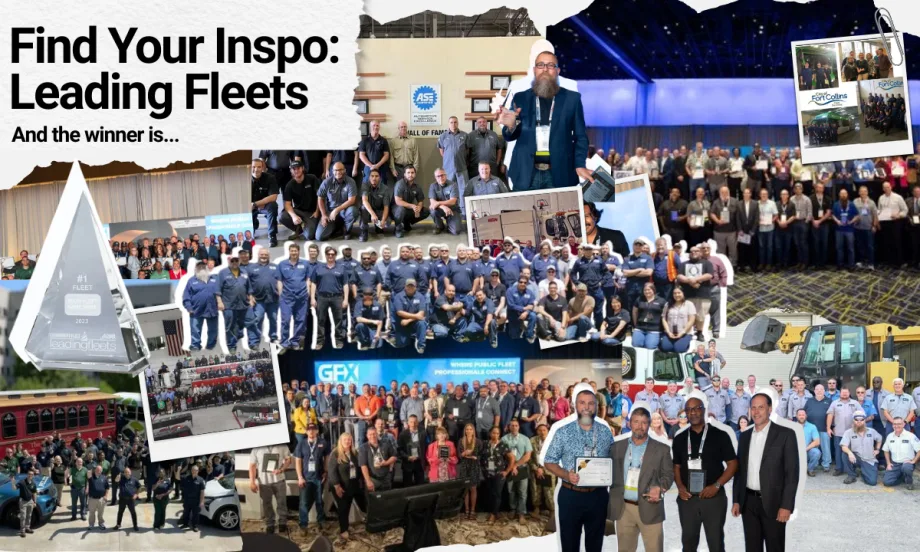
Are you submitting for Leading Fleets? Check out some past interviews with previous Leading Fleets and how they overcame key challenges.
Photo: Government Fleet
4 min to read
Every year, Government Fleet asks the question, "What makes a Leading Fleet?" And each year, that answer is unique to the fleet and its challenges.
As Larry Campbell said at GFX 2025, "success is as unique as your fingerprint," so it makes sense that each year's winners have stood apart for their innovative approaches to
But what will that look like this year? You may be reading this right now and not realize that your fleet will be receiving a Leading Fleet award. To provide insight into the award application, let's take a look at some of the takeaways from a few of the past Leading Fleet winners.
Technician Recruitment Pressure and ZEV Demands Shaped the Strategy
Long Beach’s No. 1 finish reflected a management approach built on empowerment rather than micromanagement, paired with a culture that treated KPIs as a tool for improvement instead of punishment.
The fleet addressed technician recruitment and retention with significant wage and incentive changes and expanded hiring pathways by making trade school graduates eligible for immediate hire. At the same time, leadership continuity benefited from long-standing succession planning, while predictive maintenance and a commitment to 40 hours of annual training per employee supported readiness for zero-emission vehicles.
Keep readingfor more details on how these moves came together and what other public sector fleets can take from Long Beach’s approach.
Managing a Diverse Fleet While Scaling Electrification and Storm Readiness
Tallahassee’s Leading Fleet profile centered on managing a diverse municipal operation, from transit buses to utilities and airport equipment, while pushing electrification at scale. The team paired aggressive light-duty hybrid and EV targets with a growing transit partnership that included roughly 100 chargers and major grant-funded bus and overhead-charger expansion.
Operationally, the fleet emphasized storm response readiness, facility upgrades, and a utilization strategy designed to reduce underused assets by 10% each year, backed by consistent internal customer communication and data-sharing.
Keep reading for the full playbook on how Tallahassee balanced electrification, resiliency, and day-to-day fleet complexity.
Rebuilding Culture, Fixing Procurement Bottlenecks, and Strengthening Hiring Pipelines
The Raleigh fleet paired a “people before projects” culture with process changes intended to improve speed, consistency, and accountability across the shop. Procurement was a major constraint, with parts delays and requisition-heavy purchasing keeping bays tied up and vehicles off the road; the team moved to a single parts-distribution contract to reduce administrative load and improve fill times.
Post-COVID hiring was another pressure point, prompting clearer job descriptions, broader outreach through schools, job fairs, and professional networks, and a stronger internal promotion path that helped bring vacancies down.
Keep reading for more details on the operational changes, workforce moves, and technology upgrades that supported Raleigh’s climb to No. 1.
Turning Growth Into Uptime With Shop Expansion and Data-Driven Maintenance
Buckeye’s rise as the 2024 No. 1 small fleet tracked directly to growth pressures and the operational changes made to keep pace. Shop capacity was a limiting factor as the fleet expanded across light-, medium-, and heavy-duty units and fire apparatus, prompting a facility expansion that improved throughput and created room to add technicians.
On the staffing and process side, positions were upgraded to stay competitive, a service writer role was added to tighten scheduling, and preventive maintenance was strengthened with longer oil intervals and monitoring tied to idle hours.
Technology adoption also moved faster, including GPS-based fault code and oil-life monitoring, fuel and fleet software upgrades, and tools that reduced paper while improving readiness for 24/7 assets like fire apparatus.
Keep reading for more details on the specific steps Buckeye used to modernize operations while scaling service capacity.
Turning Constant Change Into Resilience and Trust
Sarasota County linked operational resilience to tighter customer communication and stronger performance visibility, while navigating growth and cost inflation under a flat-budget mandate. Quarterly replacement and planning meetings replaced annual check-ins, improving alignment with departments on equipment needs and issues as they surfaced.
Reporting also shifted from legacy fleet reports to nightly refreshed Power BI dashboards that blended FMIS, telematics, and other data sources to track KPIs and provide customers direct transparency. The operation’s Hurricane Ian response remained a defining proof point, including an eight-day, 24-hour fueling effort that delivered more than 43,000 gallons.
Keep reading for more details on the facility expansion planning, telematics rollout, and the leadership practices supporting a 24-hour operation.
Subscribe to Our Newsletter
More Operations
Is Keeping Older Fleet Vehicles Really Saving Money?
Is keeping vehicles longer saving money, and what happens when a diagnostic test points to the wrong fix?
Read More →
How Smart Fleet Strategy Can Help Local Government Agencies Do More with Less
Keeping a vehicle longer may ease this year’s budget, but what does it cost the next one? A closer look at fleet decisions can reveal opportunities to reduce spending while protecting essential services.
Read More →
Connect with Government Fleet on LinkedIn
From industry news and fleet management strategies to conversations with peers, Government Fleet's LinkedIn page offers public-sector fleet professionals another way to stay informed and connected.
Read More →
Town of Queen Creek Named Most Successful Fleet Award Winner of Inaugural RTA Fleet Success Awards
Five fleets were honored at RTA Connect 2026 in Chicago for excellence across resource efficiency, intentional culture, risk management, and stakeholder satisfaction.
Read More →
Sponsored•October 14, 2026
A buyer's guide to fleet management software in 2027
Buying fleet management software in 2027 means looking beyond features and price. As fleet operations, technology and expectations evolve, this guide explores what today’s fleet professionals should consider when choosing a system that can deliver value now and adapt to what comes next.
Read More →
Hazard Alerts, Fleet Car Sales Rise and a New Shuttle Concept
Fleet car sales doubled, but the bigger picture tells a different story in this week’s roundup.
Read More →
How St. Johns County Turned Fleet Data Into Better Replacement Decisions
St. Johns County, Florida, had fleet data, but turning it into reliable decision guidance was another matter. Instead of starting over with a new fleet management system, the county connected existing tools and built a scoring system that gives managers an objective look at fleet health.
Read More →
Fleet Forward Conference Introduces One-Day Passes for 2026
New one-day registration lets fleet professionals attend Tuesday, Wednesday, or Thursday, with passes available for $249.
Read More →
ENC Unveils its ZAVIR Medium-Duty Shuttle
Two variants of the concept shuttles were revealed: a low-floor configuration and a high-floor configuration.
Read More →
Could Your Next Fleet Technician Start as an Intern?
What if your next technician hasn’t worked in a fleet shop yet? What fleets are doing to free up time.
Read More →