





Learn more about the largest annual conference for public fleets in the nation.
Climbing the Communication Ladder: Fairfax County's Rise to Police Fleet Innovation
2025 Police Fleet Innovators Award recipient, Fairfax County, shares how open communication helped them achieve innovation greatness.
August 8, 2025
We spoke to Sheldon Harley of Fairfax County, Virginia, to learn more about how they achieved a top spot as one of the 2025 Government Fleet's Police Fleet Innovators Award recipients.
Photo: Government Fleet
3 min to read
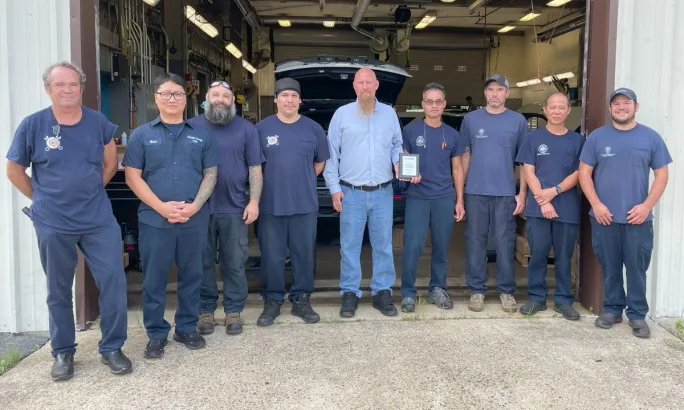
We spoke to Sheldon Harley of Fairfax County, Virginia, to learn more about how they achieved a top spot as one of the 2025 Government Fleet's Police Fleet Innovators Award recipients.
Photo: Fairfax County Department of Vehicle Services
Communication is said to be the key to everything. In Fairfax County, Virginia, it is central to their efficiency and operations. In such a large-scale, high-demand environment, constant communication keeps innovation continuous and dynamic.
We spoke with Sheldon Harley, Superintendent at Fairfax County Department of Vehicle Services, to discover how this large-scale operation earned a 2025 Police Fleet Innovators award at this year’s Government Fleet Conference and Expo.
Leadership through Communication
Fairfax County’s communication-first approach has been paramount to successful operations. With its facilities tasked with upfitting over 200 vehicles a year, maintaining open lines of communication with manufacturers, dealerships, and end-users makes all the difference in streamlining processes.
“For example, after the vehicle purchases are confirmed, I conduct meetings with our major equipment manufacturers to procure the appropriate quantities of parts and supplies and streamline delivery to coincide with critical stages of the build process. Given the size of our facility, “just in time” deliveries are paramount to maintain the upfitting program while allowing space for preventative and repair maintenance functions,” explained Harley.
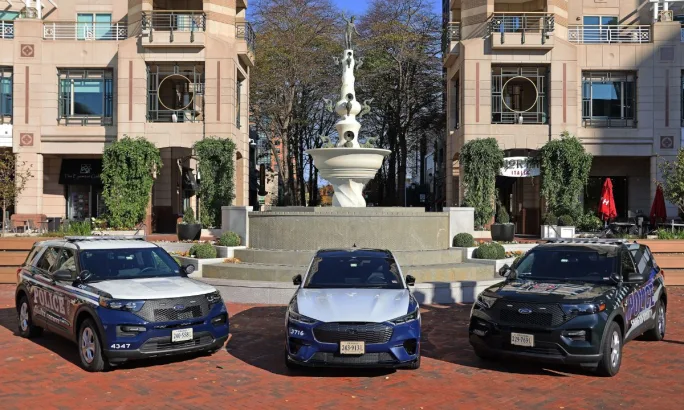
"Keeping units on the road and out of the repair facility is paramount for increasing public safety." -Sheldon Harley
Photo: Fairfax County Department of Vehicle Services
As new technology arises, the Fairfax team conducts additional meetings to validate the technology and schedule testing and evaluation (T&E) to allow for field testing and ensure the equipment meets its standards.
In keeping with his push for transparency and openness, Harley conducts several meetings before vehicles are produced to validate the need, equipment capabilities, and cost benefit of implementations. Fairfax has received enthusiastic feedback from their law enforcement partners.
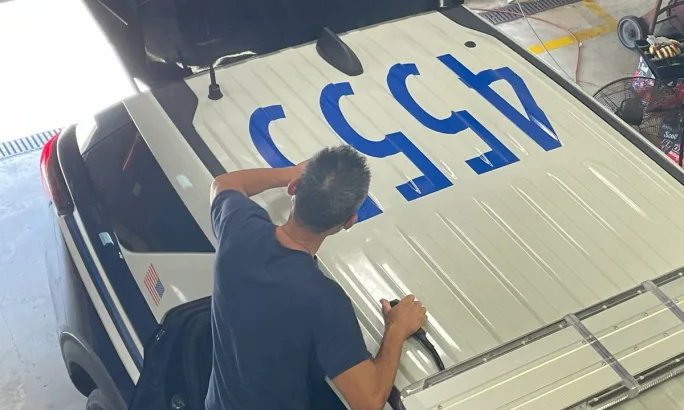
Danny Vo, Fleet Technician, completes the installation of police vehicle roof numbers.
Photo: Fairfax County Department of Vehicle Services
Harley further explained the process: “A key portion of our implementation is testing and understanding how the equipment works, how long will the equipment last, and most importantly, whether the equipment improve officer safety. This ties back to the T&E vehicles and how important it is to make accurate decisions on a global scale without creating unforeseen long-term issues.”
Lights On for Technology
Fairfax County’s embrace of technology leaves its end users excited about the vehicles it produces. Working diligently to streamline production with little to no impact on product quality, Harley is constantly searching for new avenues to reduce costs without sacrificing safety and innovation.
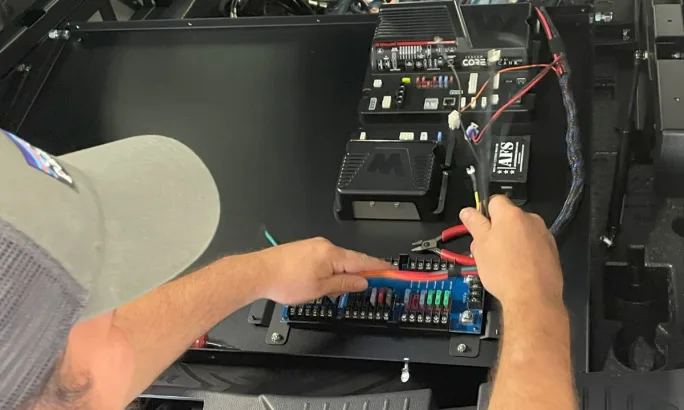
James Lynch, Fleet technician, lays electronics on the rear electronics tray.
Photo: Fairfax County Department of Vehicle Services
One such innovation involves making light bars reusable. In 2024, Fairfax County began using MIL-SPEC connectors, eliminating the need for hardwiring and allowing them to be removed without pulling the vehicle’s interior apart. Though there is a cost, Harley says the price is offset when comparing the purchase price of new light bars for future builds.
“Creating a standardized upfitting process has guaranteed that all vehicles produced during specified time periods are exactly the same, which in turn means that during emergencies, operators will know how to locate and use the equipment on a vehicle,” Harley expanded.
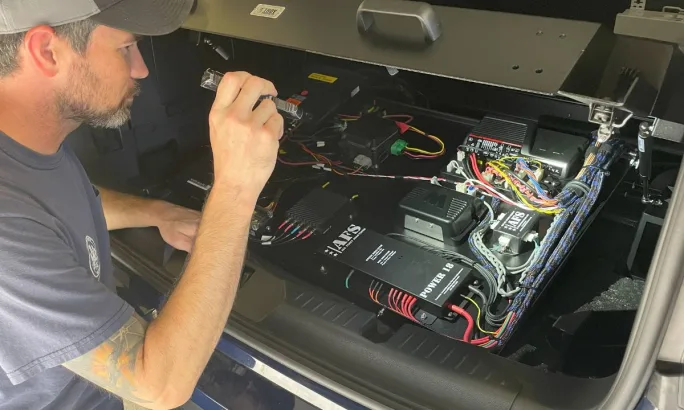
Scott Fleming, Fleet Technician, performs a final inspection before getting the vehicle on the road.
Photo: Fairfax County Department of Vehicle Services
Additionally, their 2025 fleet has integrated sync modules into light bars that decrease production time and increase driver safety through improved visibility. They are currently considering the Whelen Cloud Platform (WCP) for comprehensive fleet management. It would improve traffic control, provide accident avoidance, geofencing firmware or configuration updates, and real-time fleet management.
When asked what advice he would offer to other large-scale departments looking to optimize their operations, Harley had this to say:
“The first would be to balance improvements versus cost. If we can do a process faster, but it will entail an extra cost, we need to understand the ultimate outcome of execution. It is basic mathematics; if we spend an extra $1,000 per unit and it will improve production by 10% as well as improve safety, the extra expense is worthwhile. If we spend an extra $1,000 and it hampers production and there is no improvement to safety, then we must look at other avenues to implement an improvement without undue fiscal burden.”
Fairfax County is focused on its current plans and continuing to offer the service quality its users are used to. We are excited to see what the future will hold.
Subscribe to Our Newsletter
More Operations

Is Keeping Older Fleet Vehicles Really Saving Money?
Is keeping vehicles longer saving money, and what happens when a diagnostic test points to the wrong fix?
Read More →
How Smart Fleet Strategy Can Help Local Government Agencies Do More with Less
Keeping a vehicle longer may ease this year’s budget, but what does it cost the next one? A closer look at fleet decisions can reveal opportunities to reduce spending while protecting essential services.
Read More →
Connect with Government Fleet on LinkedIn
From industry news and fleet management strategies to conversations with peers, Government Fleet's LinkedIn page offers public-sector fleet professionals another way to stay informed and connected.
Read More →
Town of Queen Creek Named Most Successful Fleet Award Winner of Inaugural RTA Fleet Success Awards
Five fleets were honored at RTA Connect 2026 in Chicago for excellence across resource efficiency, intentional culture, risk management, and stakeholder satisfaction.
Read More →
Sponsored•October 14, 2026
A buyer's guide to fleet management software in 2027
Buying fleet management software in 2027 means looking beyond features and price. As fleet operations, technology and expectations evolve, this guide explores what today’s fleet professionals should consider when choosing a system that can deliver value now and adapt to what comes next.
Read More →
Hazard Alerts, Fleet Car Sales Rise and a New Shuttle Concept
Fleet car sales doubled, but the bigger picture tells a different story in this week’s roundup.
Read More →
How St. Johns County Turned Fleet Data Into Better Replacement Decisions
St. Johns County, Florida, had fleet data, but turning it into reliable decision guidance was another matter. Instead of starting over with a new fleet management system, the county connected existing tools and built a scoring system that gives managers an objective look at fleet health.
Read More →
Fleet Forward Conference Introduces One-Day Passes for 2026
New one-day registration lets fleet professionals attend Tuesday, Wednesday, or Thursday, with passes available for $249.
Read More →
ENC Unveils its ZAVIR Medium-Duty Shuttle
Two variants of the concept shuttles were revealed: a low-floor configuration and a high-floor configuration.
Read More →
Could Your Next Fleet Technician Start as an Intern?
What if your next technician hasn’t worked in a fleet shop yet? What fleets are doing to free up time.
Read More →