




About the Author: Norman Barrientos is a registered architect with 42 years of design experience, and he is the president of Barrientos Design & Consulting, Inc., based in Milwaukee. His architectural work is focused on field operations and equipment maintenance facilities, and he has been involved in the planning and design of over 130 O&M-type facilities. Over the last 10 years, he has delivered numerous seminars on the design of fleet maintenance facilities to national organizations. He is the author of "Fleet Facilities Design & Standards," a technical book covering the design of fleet maintenance garages.
Upgrading Your Fleet Garage for the Future
The opportunity to upgrade, expand or rebuild your fleet garage is a once in a generation opportunity with many fleet professionals’ only experiencing this process once or twice in their careers.
by Norman Barrientos, AIA, Principal Architect, Barrientos Design & Consulting, Inc.
May 30, 2025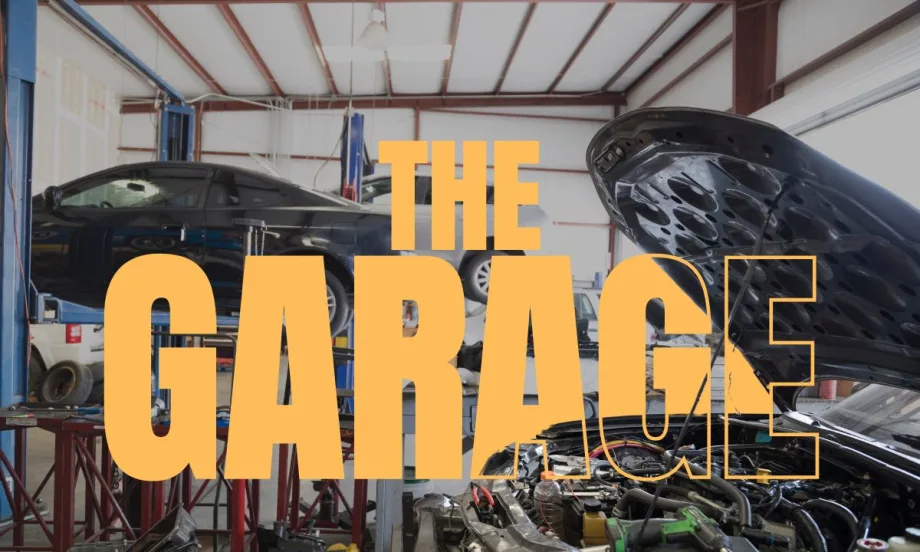
The first step of a facility upgrade is to document the key building, site and equipment components.
Photo: Government Fleet
8 min to read
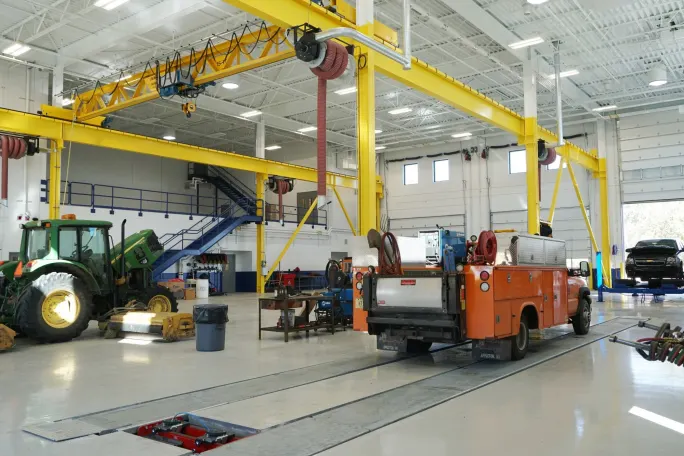
Capital projects, such as constructing a new repair bay as an addition to the existing garage, will support your fleet operational objectives.
Photo: Barrientos Design & Consulting, Inc.
The opportunity to upgrade, expand or rebuild your fleet garage is a once in a generation opportunity with many fleet professionals’ only experiencing this process once or twice in their careers. Moreover, most fleet facilities are budgeted to last 50 years and the design assumptions made back then often do not line up with current shop practices, regulations and technology.
The fleet industry and its associated buildings are unique in their facility needs but there is no organization documenting what best practices should be for shop design. It is a dynamic industry with changes in fleet types, fueling methods, truck sizes, equipment complexity, regulations and technology changes occurring continuously over the decades.
As fleet professionals and their facility management members establish design criteria for their new upgrades and expansions, it becomes important to identify your functional requirements, incorporate industry best practices, and capture future trends so your building will be relevant and adaptable for many decades to come.
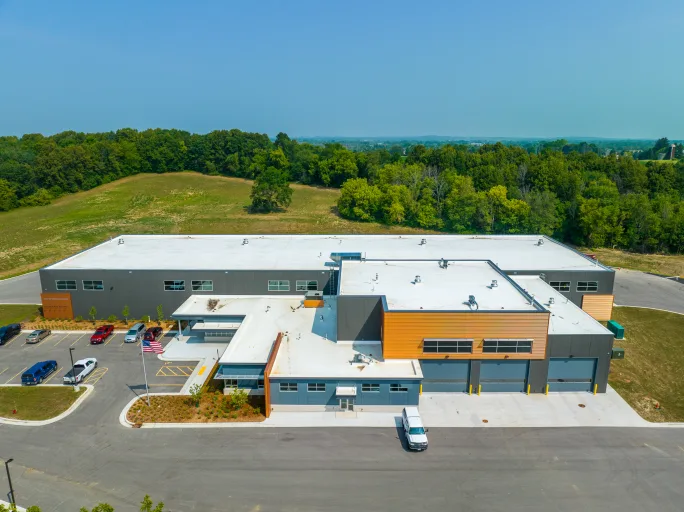
The city of Pewaukee, Wisconsin, Public Works Department.
Photo: Barrientos Design & Consulting, Inc.
Fleet Garage Facility Components
The first step of a facility upgrade is to document the key building, site and equipment components. A typical fleet shop of around 1,000 units under maintenance will have these facility components:
Service Write-Up Counter, or Canopy
Repair Bays: Small Engine Light, Medium, Heavy, Public Safety
Preventative Maintenance Bays
Upfitting & Communications Shop
Fabrication Shop
Tire Shop and Inventory
Hydraulic Hose Shop
Vehicle Parts Storage
Bulk Fluid Storage
Technician offices and support
Fleet Administration
Dead line/Read Line Parking
Vehicle Wash
Fueling and Charging Stations
Each of these facility functions have an essential role in providing effective maintenance turn around times, just-in-time parts distribution, vehicle preservation, technician safety and support, and supervisory lines of communication.
What to Know: Organization and Workflow
Enhancing workflow requires analyzing the sequence of maintenance events that occur throughout the day for each functional group. There are many loops of activity that occur in the garage and these need to diagrammed out for a logical network of vehicles and parts.
One primary circulation loop is when a customer drives on site for a service write-up and then meet with a customer service representative. After initial diagnostics, the service rep moves the vehicle into a repair or dead line stall until a repair bay and tech are assigned.
The second loop is when the technician takes the repair vehicle through a power wash, then moves it into a distinct bay type. From there the technician conducts diagnostics, selects and picks up parts, lifts up the vehicle and start disassembling the components needing replacement.
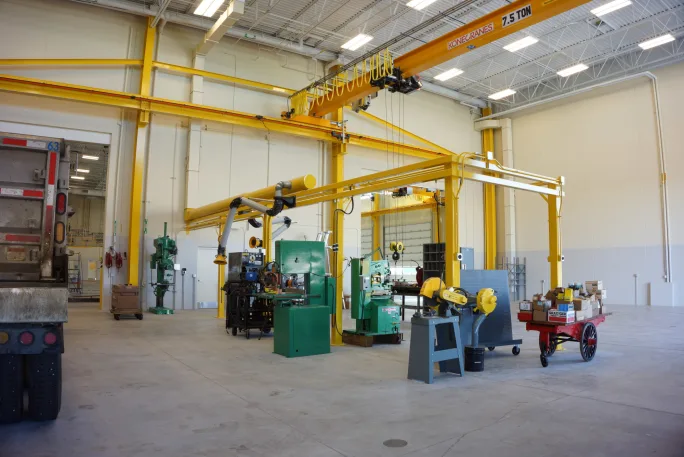
Enhancing workflow requires analyzing the sequence of maintenance events that occur throughout the day for each functional group.
Photo: Barrientos Design & Consulting, Inc.
Throughout this maintenance activity, the technician may access a wide variety of equipment and tools such as:
Mechanics’ tools, privately owned and agency provided
Bulk Fluid Reeds
Tool Box
Welder
Air Conditioning Unit
Reels, wires and hoses
Parts Washers
Filter crusher
Workbenches
PC for diagnostics, ordering and work order documentation
Jack stands
Each of these equipment pieces should be mapped out on the floor plans so the technician's spatial movements can me minimized and allow them to stay focused on the maintenance activity. This also includes minimizing the amount of time that the technician needs to walk over the parts or to access specialty tools and inventory.
Along with the use and location of equipment, the activities of technicians and clerks need to be mapped on the floor so their tools and workbenches are lined up in sequence with their repair activities.
Once this level of functional and relationship analysis is completed for all of fleet’s maintenance functions, an overall relationship diagram can be completed showing these functional interrelationships.
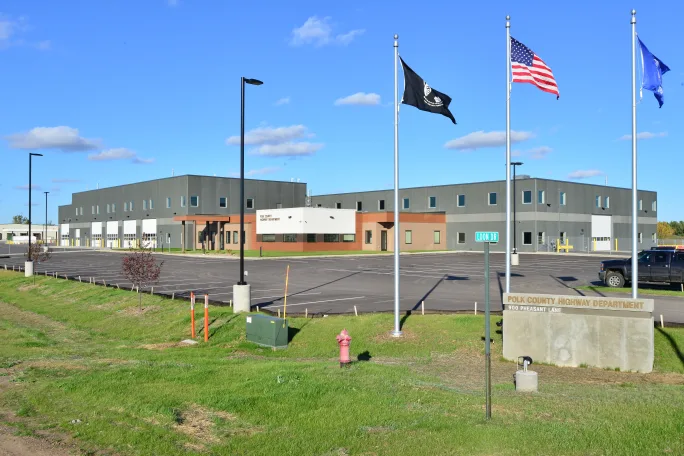
Wisconsin's Polk County Highway Department fleet facilities.
Photo: Barrientos Design & Consulting, Inc.
Garage Facility Upgrade Objectives
The most common issue that initiates an upgrade project is an insufficient number of repair bays, the sizing and clearances around the bay, lack of inventory storage space, lack of specialty shop space, (tires, fabrication, communications), and parking stalls for the different lines of vehicles under maintenance.
While a fleet facility may to be too small to provide the maintenance repair units needed, it may also be a matter of the functions being too far from each other, out of sequence from logical work flows, not enough maintenance equipment on the floor, non-supportive environments for technician lighting, air quality, walkway safety, privacy, and classroom learning, and finally, insufficient power, water, air and lighting levels for repair activities.
Another facility deficiency can be the building’s lack of environmental sustainability, hazard event resiliency, and electric vehicle servicing equipment. These issues are usually driven by your leadership’s values and the geographic environment of the site location. Once prioritized by these two factors though, these issues can be a top priority for an upgrade project.
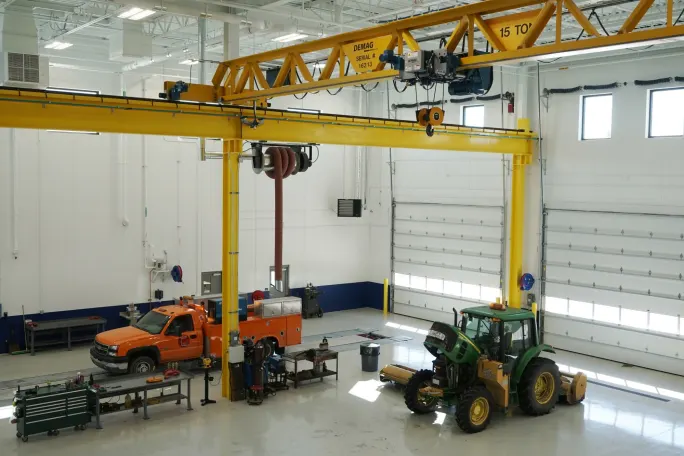
The first step of a facility upgrade is to document the key building, site and equipment components.
Photo: Barrientos Design & Consulting, Inc.
With these facility needs pressing your organization, building and yard upgrade and expansion projects should meet these objectives:
Provide more physical space in terms of bays, parking, storage and crew support.
Enhance workflow relationships and maintenance efficiency.
Increase productivity with supportive equipment.
Create a quality and healthy work environment.
Align with Agency sustainability, resiliency and EV infrastructure goals.
Adapt to new shop practices, technology and HR policies.
As fleet management is performance metrics based, these facility upgrades will enhance your technician utilization rates, allow your organization to process more Maintenance Repair Units, extend vehicle life, provide greater control over inventory, and attract and retain more skilled staff.
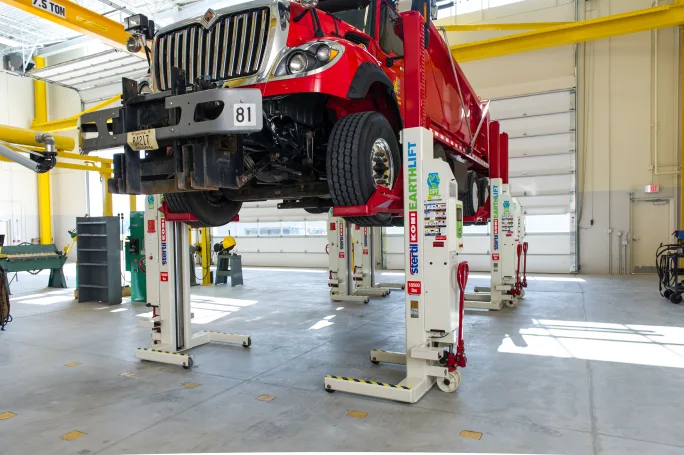
With your fleet facility performance goals identified, justifying and scoping out various upgrades will follow in a rational process.
Photo: Barrientos Design & Consulting, Inc.
Future Trends Affecting Fleet Garage Facilities
Looking ahead at how the fleet industry is evolving there are these technological, environmental, demographic and marketing issues shaping the fleet facility of the future.
Electric vehicles, charging equipment and power infrastructure both inside the building and in the yard.
EV workplace safety to minimize arc flash hazard.
Continued vehicle complexity, attached equipment types, power draw, vehicle size and IT components all resulting in greater cost, more proprietary maintenance stock and specialty maintenance equipment.
Increasing demand to maintain more costly truck in higher condition for a longer period of time.
Higher demands on asset protection, longevity, tracking and security.
More Agency demand for a quality customer service experience.
Asset management software integration providing greater levels of maintenance metrics.
Greater push for proactive preventative maintenance hours.
Finer tracking of technician utilization and time to repair.
More diverse workforce, including women and populations not traditionally represented in the fleet industry.
Greater competition to attract and retain technician workforce.
Continuous workforce training for technicians and fleet admin staff.
Health and fitness of technicians and operators.
Privacy of workers and respecting their break time.
Generational differences in what is an acceptable work environment.
Health and safe work environments for shop staff.
Security and prevention of violence upon staff.
Making the building green and renewable.
Fortifying the building to withstand major hazard events.
All of the future trend issues are placing more design demands on the fleet facility and these trends will continue to affect shop operations for the next decade. Fleet facilities built over 20 years ago are already behind the times with these emerging trends and will require significant upgrade reinvestment.
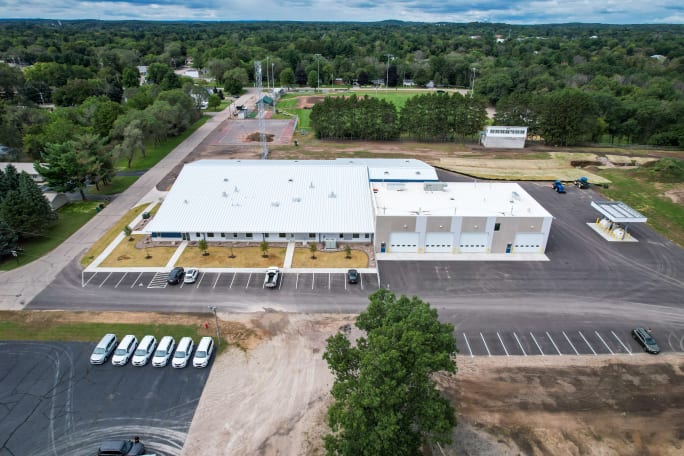
The city of Waupaca, Wisconsin, fleet facilities.
Photo: Barrientos Design & Consulting, Inc.
Facility Upgrade Opportunities
With your fleet facility performance goals identified, justifying and scoping out various upgrades will follow in a rational process. Based on our experience in planning fleet garages, these types of capital projects will support your fleet operational objectives:
Construct new Repair Bay as an addition to the existing Garage.
Construct new Repair Bays as a stand-alone structure within existing yard.
Construct a whole new Fleet Facility, building and yard, at a new site.
Construct a new Truck Wash Bay, either as an addition or stand-alone structure.
Build a new canopy for Service Write-Up, add a driver’s waiting lounge.
Install new vehicle lifts, either in-ground, surface mounted, or as mobile columns.
Add floor drains near overhead doors to allow easy cleaning of truck debris
Repair concrete slabs where there is settlement and pitting of the surface. Same with exterior concrete aprons.
Resurface concrete slab with a cementitious coating.
Paint interior walls, and if feasible ceiling structure.
Build new overhead crane along with supporting column structure
Add a fixed mono-rail with crane attachment, when there is no room for the double rows of crane columns.
Install new fixed jib-cranes at bays lifting items over 100 lbs.
Install additional bulk fluid reels structured from the ceilings or columns.
Install a rotary air compressor along with more lines for air bibs
Install more lines of water and hose bibs. Add high-volume water hoses at main overhead doors.
Install large diameter destratification fans in the ceiling to move heated air downward.
Repair or replace make-up air units in the ceiling for effective heated and fresh air supply.
Change lighting fixtures to high-bay LED lights. Add automotive shop lights at 8’ above the floor in areas with workbenches.
Add hand-wash sink in shops. Add ice machine in lunchroom. Add washer and dryer off lunch room. Create stretching and fitness room.
Add technician bathroom for bays that are further than 150’ from lockers.
Change overhead doors with translucent, narrowed paneled ones that can roll up quickly.
Replace steel plates over trench drains with high-strength plastic ones.
In Parts Storage, add high-bay automated carousels for vehicles parts and tires
Remove non-code compliant occupant uses from repair bays. This include lunch rooms, tables, chairs, microwaves, coffee makers, and informal kitchenettes.
Install piped-in audio system for announcements and background music.
Install TV monitors linked to fleet management software for updates on vehicle status and work assignments.
Designate and clear a walking path for technician movement. Apply safety yellow paint to walkway.
Provide adequate and equal restrooms and lockers for women employees.
Install photovoltaics on roof deck
Install electric vehicle chargers inside building and in distinct area of yard.
Size up emergency generator to handle all the building’s demands for continuous service during hazard events.
Add signage throughout yard and building to guide and separate out technicians, vendors, and other agency members. Add large number signs for each repair bays door for numbering the bays.
Install service write-up canopy off access drive.
Build dedicated wash bay, either manual wash or automatic wash. As stand alone structure or an addition.
Install lighting poles and cameras throughout the yard for supervision and security.
Install perimeter security fence with motorized gate around fleet facility. If possible fence off other internal Agency users so no other group’s vehicles circulate through Fleet’s Yard.
Relocate fuel station toward main entry drive and just outside the secured gate.
Install new transformer, distribute power lines to new EV chargers, install EVSE pedestals.
These objectives, approaches and capital improvements will guide your fleet organization to higher performance, a well defined building plan, and a return on investment that justifies the capital outlay required.
Subscribe to Our Newsletter
More Operations
Is Keeping Older Fleet Vehicles Really Saving Money?
Is keeping vehicles longer saving money, and what happens when a diagnostic test points to the wrong fix?
Read More →
How Smart Fleet Strategy Can Help Local Government Agencies Do More with Less
Keeping a vehicle longer may ease this year’s budget, but what does it cost the next one? A closer look at fleet decisions can reveal opportunities to reduce spending while protecting essential services.
Read More →
Connect with Government Fleet on LinkedIn
From industry news and fleet management strategies to conversations with peers, Government Fleet's LinkedIn page offers public-sector fleet professionals another way to stay informed and connected.
Read More →
Town of Queen Creek Named Most Successful Fleet Award Winner of Inaugural RTA Fleet Success Awards
Five fleets were honored at RTA Connect 2026 in Chicago for excellence across resource efficiency, intentional culture, risk management, and stakeholder satisfaction.
Read More →
Sponsored•October 14, 2026
A buyer's guide to fleet management software in 2027
Buying fleet management software in 2027 means looking beyond features and price. As fleet operations, technology and expectations evolve, this guide explores what today’s fleet professionals should consider when choosing a system that can deliver value now and adapt to what comes next.
Read More →
Hazard Alerts, Fleet Car Sales Rise and a New Shuttle Concept
Fleet car sales doubled, but the bigger picture tells a different story in this week’s roundup.
Read More →
How St. Johns County Turned Fleet Data Into Better Replacement Decisions
St. Johns County, Florida, had fleet data, but turning it into reliable decision guidance was another matter. Instead of starting over with a new fleet management system, the county connected existing tools and built a scoring system that gives managers an objective look at fleet health.
Read More →
Fleet Forward Conference Introduces One-Day Passes for 2026
New one-day registration lets fleet professionals attend Tuesday, Wednesday, or Thursday, with passes available for $249.
Read More →
ENC Unveils its ZAVIR Medium-Duty Shuttle
Two variants of the concept shuttles were revealed: a low-floor configuration and a high-floor configuration.
Read More →
Could Your Next Fleet Technician Start as an Intern?
What if your next technician hasn’t worked in a fleet shop yet? What fleets are doing to free up time.
Read More →