




Florida Fleets Send Aid for Florence Recovery
Fleets in Florida joined public agencies around the country in responding to calls for assistance during Hurricane Florence.

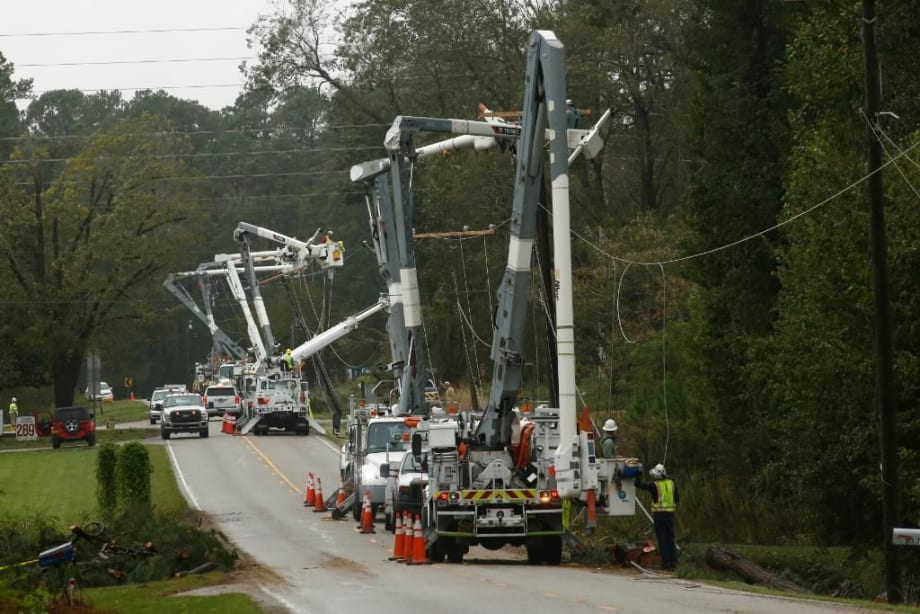
Photo via FPL/Twitter
Our crews have been deployed in Columbus County, NC, getting the lights back on for communities impacted by #Florence. B-roll: FPL crews working in Whiteville, NC - https://t.co/LcJyBPOZiIpic.twitter.com/KtWEEg4NsT
— FPL Newsroom (@FPL_Newsroom) September 17, 2018
Hurricane Florence hit North and South Carolina on Friday, making landfall near Wrightsville Beach, N.C., at 7:15 a.m. As fleets in the Carolinas and nearby states scrambled to prepare, fleets in Florida — which had been hit by the devastating Hurricane Irma last year — joined public agencies around the country in responding to calls for assistance. Fleet professionals attending the Florida Association of Governmental Fleet Administrators' conference in St. Pete Beach this week spoke to Government Fleet about their contributions.
On Friday afternoon, with the hurricane — re-categorized as a tropical storm — well under way just a state away, technicians at Sarasota County, Fla., were preparing vehicles to be sent up north.
The county has already sent three ambulances to a military base in the Carolinas and are getting more vehicles ready, said Ron Kennedy, CEM, CPFP, Sarasota County fleet manager.
”We have three technicians ready to deploy. They did a unit resource request for inventory that we could give up, so we had three more fire trucks and three more ambulances that are prepped. If they throw out a resource request through the state, we’re ready to roll,” he said.
Orange County sent three rescue vehicles as well as a battalion chief vehicle. The Fire Department sent the vehicles over to fleet, where they got new tires and a quick check-up before they were on their way.
“They literally had hours before they had to leave,” said Inshan Edoo, assistant manager for the Orange County fleet management.
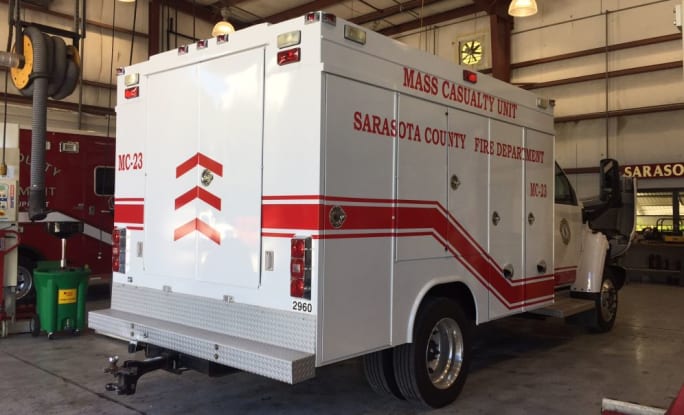
Sarasota County, Fla., fleet technicians prepped vehicles for potential deployment to the Carolinas for hurricane and storm recovery efforts, including this vehicle.
Photo by Thi Dao
Further north, the City of Gainesville prepared to send 15 vehicles, including 55-foot aerial trucks, derricks, pole trailers, and smaller equipment for backyards, said Jason Foster, CAFM, fleet operations supervisor for the city.
“We had a list of vehicles that we were going to inspect. We made sure they were safe and performed any maintenance or repairs that needed to be done prior to leaving,” he said.
Gainesville had a few days to prepare, as the vehicles were scheduled to leave the city on Saturday morning.
Manatee County pre-staged three ambulances for potential deployment to the Carolinas. The vehicles are equipped with tires, spare parts, and wear items, said Matthew Case, EMS, fleet division manager for the county.
“We usually pick out the newest ambulances that are under warranty. We pull them in for a safety inspection and [perform preventive maintenance on] them. That way, they’re ready to go. Our reserve trucks go on the road so we don’t lose our effectiveness in the community,” he said.
Palm Beach County Fire Rescue is also preparing two units to be sent for after-storm recovery, Tim Calhoun, CAFM, fleet management director, reported.
And it’s not just municipal fleets providing assistance. Florida Power & Light Company, a publicly-traded energy company, sent about 150 company-owned vehicles and 930 employees and contractors to the Charlotte, N.C., area.
“We received a request for mutual assistance on Monday, so we had the crews on the road on Tuesday,” said Patti Earley, CAFM, fleet and fuel operations specialist. The vehicles consist of mostly bucket trucks and some digger derricks, and the staff members are mostly tree crews and construction crews, as well as some technicians to make sure the vehicles keep running.
[Updated 9/17] Florida Power & Light’s vehicles and crew stayed in Charlotte until the storm passed, and were deployed to Whiteville, N.C., to help restore power.
More Operations

Is Keeping Older Fleet Vehicles Really Saving Money?
Is keeping vehicles longer saving money, and what happens when a diagnostic test points to the wrong fix?
Read More →
How Smart Fleet Strategy Can Help Local Government Agencies Do More with Less
Keeping a vehicle longer may ease this year’s budget, but what does it cost the next one? A closer look at fleet decisions can reveal opportunities to reduce spending while protecting essential services.
Read More →
Connect with Government Fleet on LinkedIn
From industry news and fleet management strategies to conversations with peers, Government Fleet's LinkedIn page offers public-sector fleet professionals another way to stay informed and connected.
Read More →
Town of Queen Creek Named Most Successful Fleet Award Winner of Inaugural RTA Fleet Success Awards
Five fleets were honored at RTA Connect 2026 in Chicago for excellence across resource efficiency, intentional culture, risk management, and stakeholder satisfaction.
Read More →
A buyer's guide to fleet management software in 2027
Buying fleet management software in 2027 means looking beyond features and price. As fleet operations, technology and expectations evolve, this guide explores what today’s fleet professionals should consider when choosing a system that can deliver value now and adapt to what comes next.
Read More →
Hazard Alerts, Fleet Car Sales Rise and a New Shuttle Concept
Fleet car sales doubled, but the bigger picture tells a different story in this week’s roundup.
Read More →
How St. Johns County Turned Fleet Data Into Better Replacement Decisions
St. Johns County, Florida, had fleet data, but turning it into reliable decision guidance was another matter. Instead of starting over with a new fleet management system, the county connected existing tools and built a scoring system that gives managers an objective look at fleet health.
Read More →
Fleet Forward Conference Introduces One-Day Passes for 2026
New one-day registration lets fleet professionals attend Tuesday, Wednesday, or Thursday, with passes available for $249.
Read More →
ENC Unveils its ZAVIR Medium-Duty Shuttle
Two variants of the concept shuttles were revealed: a low-floor configuration and a high-floor configuration.
Read More →
Could Your Next Fleet Technician Start as an Intern?
What if your next technician hasn’t worked in a fleet shop yet? What fleets are doing to free up time.
Read More →