




ALI Lift Safety Course Goes Online
The Automotive Lift Institute (ALI) adapted its Lifting It Right DVD into an interactive, Web-based format. A narrator guides trainees through curriculum covering lift types, the lifting and lowering process, and lift maintenance.
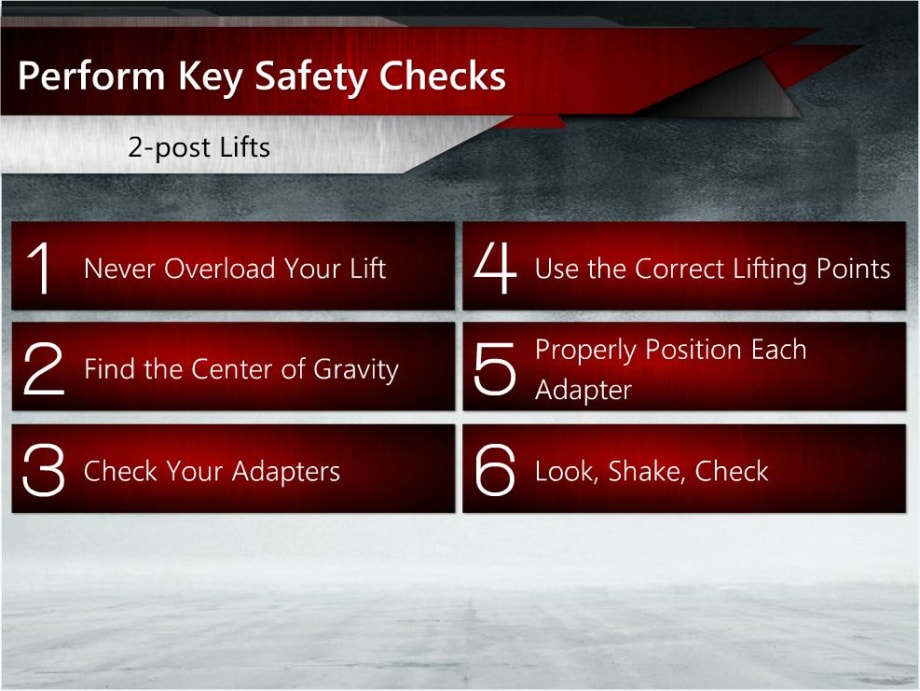
Screencapture via ALI.
Screencapture via ALI.
The new online version of Automotive Lift Institute's (ALI) "Lifting It Right" vehicle lift safety training course is now live.
The course is produced by ALI and hosted by racing legends Richard and Kyle Petty. ALI partnered with KPA, a dealer services provider, to adapt material from the Lifting It Right DVD into an interactive, Web-based format. The information presented applies to lift operators at dealerships, independent shops, government agencies, vocational schools, and other facilities.
"With health and safety officials increasing their focus on vehicle service providers throughout North America, it is crucial that members of the service and repair industry take ownership of safety issues and embrace a proactive approach to accident prevention," said R.W. "Bob" O'Gorman, ALI president.
In "Lifting It Right: 2014 Online Edition," a narrator guides trainees through curriculum covering lift types, the lifting and lowering process, and lift maintenance. Throughout the presentation, real-world scenarios with corresponding questions are presented to engage participants, who interact with the content and receive immediate feedback when answering the questions.
The interactive elements provide a positive learning environment and reinforce the trainee’s understanding of each topic presented before moving forward. At the conclusion of the program, a certificate of completion is generated and stored online. It can also be printed if desired.
"The ability to manage training records online is probably the biggest benefit to shop operators, beyond minimizing the slowdown of productivity associated with traditional workforce-style classroom training," says O'Gorman. "With online records, there is no need to print and score a written test and then store a certificate. When training compliance needs to be demonstrated, the manager can just pull up each employee's record on the computer."
The training program costs $29 per trainee. Once registered, the user can take up to 90 days to successfully complete the course. If the participant fails the question-and-answer portion on the first try, he or she may study and review the course as needed before re-taking the online test a second time within the allotted 90 days.
Upon completion of the program, each participant will receive a copy of ALI's "Automotive Lift Safety Tips" card and the "Lifting It Right" safety manual via mail.
ALI's "Lifting It Right" DVDs are still available for purchase. "Lifting It Right: 2014 Online Edition" can be accessed here.
More Safety

New York City Expands Safety Technologies Across Municipal Fleet
Executive Order 19 moves intelligent speed assistance and pedestrian alerts from pilot programs toward standard fleet equipment, offering other public fleets a look at how safety technology can be tested, measured, and scaled.
Read More →
Hidden in Plain Sight: Fleet Compliance Risks
Fleet compliance isn't just about having policies — it's about consistently enforcing them. This practical guide reveals six hidden compliance risks common in public sector and shared fleet operations and outlines proven strategies to improve visibility, accountability, and audit readiness.
Read More →
5 Days Left to Submit Your 2026 Fleet Safety Award Nomination
Know a government fleet, safety, or risk manager who deserves recognition for making fleet operations safer? Nominations are open through Aug. 15.
Read More →
How the First 24 Hours Can Shape a Fleet Crash Response
How a strong accident response process helps government fleets move from the initial report to recovery while building a clearer record for what needs to change next.
Read More →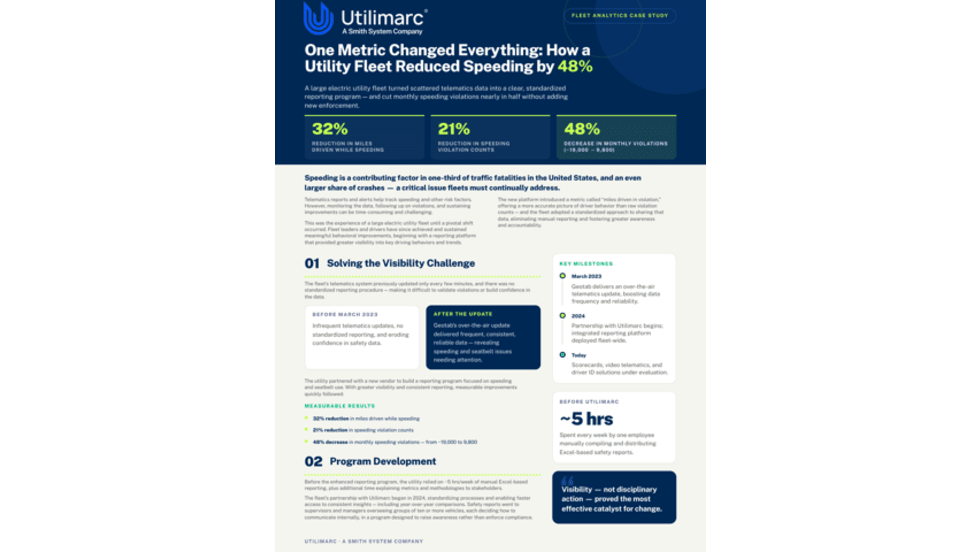
How Better Visibility Cut Speeding Violations by 48%
Fleet leaders don't need more data, they need clearer visibility into what the data is saying. This case study explores how one utility replaced speeding-event counts with a single metric — miles driven in violation — to strengthen safety and significantly reduce speeding violations.
Read More →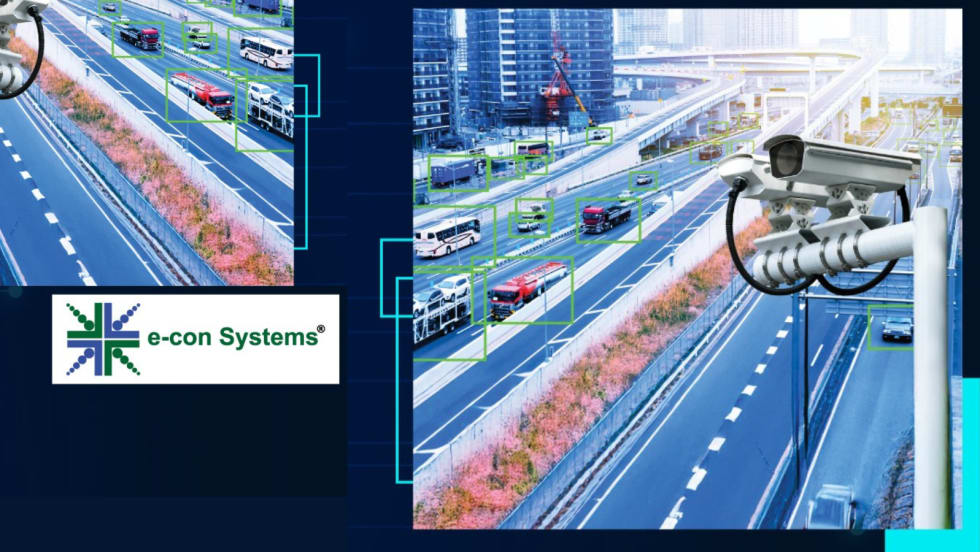
e-con Systems Expands AI Camera Tools for Traffic Monitoring
The systems support license plate recognition, traffic analytics, and video management for transportation agencies.
Read More →
King Township Pilot Links Driver Feedback to Reduced Speeding
How King Township, a best-in-class municipal fleet, reduced speeding by 10.9% and demonstrated a projected 349% ROI by putting safety ownership directly in drivers' hands.
Read More →
Beyond the Fireline: The Critical Role of Public Fleets in Wildfire Response
Behind every wildfire response is a complex network of vehicles, data, and decisions that must work in sync under extreme pressure. Global heating trends require strong fleet coordination and reliable communications to keep crews safe and operations running smoothly.
Read More →
How AI Is Transforming Public Fleet Safety - Part 1
AI-powered safety systems are helping public fleets tackle distracted driving by delivering real-time coaching and measurable behavior change behind the wheel. In part one of our Q&A, Nauto CEO Stefan Heck explains how agencies can improve safety, reduce costs, and navigate implementation challenges with AI-driven technology.
Read More →
Reducing Risk and Improving Safety in Public Sector Fleets with Advanced Driver-Assist Technology
Public sector fleets face increasing pressure to improve safety, reduce liability, and operate efficiently. See how advanced vehicle technologies are helping agencies protect drivers, the public, and their budgets.
Read More →