





Related: Honda Shows Clarity Fuel Cell Sedan
First Look at Honda’s Fuel Cell Car
Honda's Steve Ellis discusses the new Clarity fuel cell sedan, fueling infrastructure in California, and whether the vehicle will be available to fleets.
November 21, 2015
2 min to read
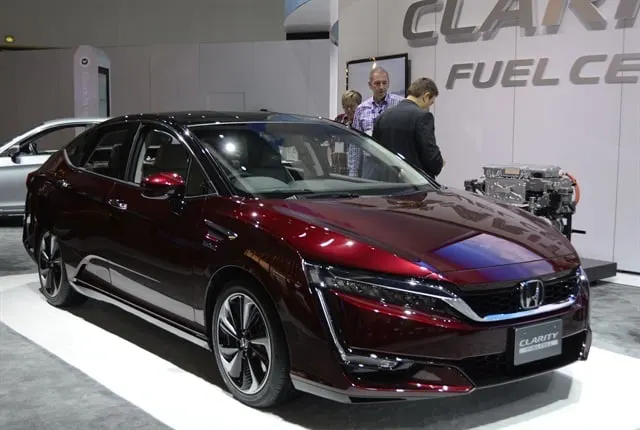
Photo by Thi Dao
Back in 2013, Steve Ellis, manager of fuel cell marketing at Honda, nervously allowed me to test drive the Honda FCX Clarity fuel cell vehicle. With Honda’s unveiling of the all-new Clarity Fuel Cell vehicle at the Los Angeles Auto Show this week, he spoke to me again about this new car, hydrogen fueling stations, and the company’s plans.
The Clarity Fuel Cell, most likely a 2017 model-year, will have a range of more than 300 miles, up from the FCX Clarity’s range of 240 miles. The lighter and smaller powertrain, with weight and size similar to a V-6 powertrain, is now entirely under the hood. Pricing will be likely “competitive with similar vehicles.” Ellis believes fuel will initially cost more ($8-10 per kilogram), but drivers can expect more than 60 miles per kg and pricing could come down in the future. Honda hasn’t yet announced whether it would offer free fuel for a limited time.
The vehicle will be available in Northern and Southern California in fall 2016. As for fueling stations, Ellis said he expects California will have 40-50 stations up and running by fall of next year. There's already one in Harris Ranch, halfway between Los Angeles and San Francisco, allowing drrivers to travel between northern and southern California today.
Electric vehicle (EV) range is increasing, which could pose a challenge for the expansion of fuel cell vehicles. But Ellis doesn’t see it that way.
“These are non-competing; these are collaborative technologies. They’re both all-electric cars,” Ellis said. “But the key difference will still be longer range and three- to five-minute fueling for hydrogen fuel cell vehicles.” That’s in comparison to the hours it normally takes to charge a battery EV.
He added that while EV batteries are improving, so is fuel cell technology. The power density improvement on the Clarity Fuel Cell is 60% over the last model.
The big question for fleet managers: Will it be available to them? While the vehicle is targeted to retail customers, “that doesn’t mean we won’t consider a few early interested fleets,” Ellis said. He added that while the details aren’t finalized yet, “we would like to hear from customers where stations are developing that have an interest in the car for their fleet.”
I didn’t get a chance to test drive the Clarity Fuel Cell at the auto show, which with its right-side steering wheel, came directly from Japan. But I have heard of fleet interest in fuel cell vehicles, including 2016 Toyota Mirai, and I’m excited to see how fleets (and retail customers) respond to these new vehicles.
Subscribe to Our Newsletter
More Blog Posts

Understanding the Road to Improved Operations
Every fleet has goals, but meaningful progress depends on knowing where the operation stands and continuing forward when the path changes.
Read More →
Navigating the Crossroads of Data and New Technologies
As data volumes increase and emerging technologies advance, where do government fleets stand? Takeaways from Samasara Go Beyond Public Sector 2026.
Read More →
When the Roadblocks Hit, Where is Your Inspiration?
It can be easy to get caught up in the busy day-to-day of fleet, but when the problems pile up, that's when it's time to find the motivation to keep going.
Read More →
Is it Time for Change or Consistency?
Consistency can be good, but there comes a time when you have to step back and ask whether what you’re doing is the best approach.
Read More →
Blink and You’ll Miss It: Fleet Reflections from 2025
A note as we leave behind 2025 and plan for new ventures heading into 2026.
Read More →
It’s Far Worse Than a Technician Shortage…
A letter to government fleet leaders on the technician gap and how to rebuild the pipeline that keeps public services running.
Read More →
Public Perception of Your Fleet Changes
How fleet transitions shape public perception and how a well-managed rollout can influence your fleet's narrative.
Read More →
The Balancing Act: Stability vs. Shifting Leadership Priorities
With the revolving door of government leadership bringing new priorities fleets are expected to pivot, even if those pivots undermine long-term planning.
Read More →
How Technology is Driving Upgrades in the City of Columbus Fleet Operations
How the city of Columbus fleet has embraced change as a strategic driver, using technology to revolutionize how the fleet fuels, tracks, and measures performance across a 260-square-mile service area.
Read More →
At the End of the Day, Be Good to Yourself
When the stresses of your work life become too much, don't forget to prioritize yourself and find balance in each day.
Read More →