





Keep Reading: How Cloud-Based Tech Creates Safer Incident Responses
Understanding the Human, Technical, and Strategic Factors Behind Smarter Fleets
Fleet professionals at Geotab Connect 2025 shared how data, driver psychology, and emerging technologies are redefining the foundations of effective fleet management.
March 29, 2025
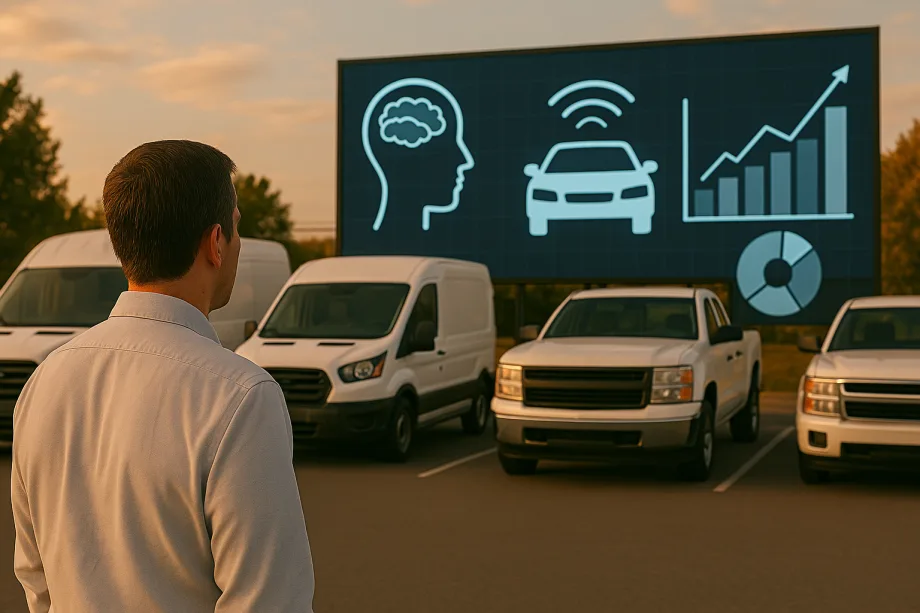
Data, driver psychology, and emerging technologies are redefining the foundations of effective fleet management.
Photo: his utilizes an AI-generated image. Refer to our Terms of Use.
6 min to read
As anyone in fleet can attest to, the industry spans much further than the vehicles operations use on a day-to-day basis.
Within the various fleet departments and operational spaces, the challenges and achievements revolve around big issues dealing with what exactly makes a fleet, and the people who keep it running, successful.
At Geotab Connect 2025 Government Fleet was able to get a broad pool of insights into how professionals are looking at the future of fleet and what other operations can be focusing on to better prepare for their operation's tomorrow.
The Psychology of Humans and Driving Behaviors
With the numerous advancements taking place throughout the fleet world, safety, especially when it comes to driving behavior, has become a focal point for many fleets. With more vehicles and more distractions than ever, fleets now have to find the best solution to keep drivers focused and aware of their environment.
According to Ari Zadikov, Head of Marketing and Technical Marketing at Vitality Global, one way to approach safety is through human psychology.
"For example, we'll eat something that's unhealthy, even though it's unhealthy. We'll sit on the couch when we perhaps know we should be going for a run. And the same applies for driving behaviors," Zadikov said. We know we shouldn't speed, we know we shouldn't drive dangerously. We know we shouldn't be on our phones...sometimes also have this belief that we're safer than we are, and we're better than we are."
One way to address those behavioral challenges is by rewarding good driving behaviors so that there is a desire to stick to these behaviors. Zadikov said he has seen the impact in something as small as improved acceleration and braking. Ultimately, this is meant to benefit drivers themselves with rewards equating to safety and boosted productivity.
The incentive could be based around a weekly goal, with a reward such as a gift certificate or voucher.
“People like to be rewarded,” they like to feel the incentive directly,” Zadikov noted. “It’s all about driving well towards that goal and getting a personalized reward can be exceptionally powerful.”
Everyone wants safety in addition to efficient routing to get people from point A to B. Daniel Morton, Sales Engineer at Trimble MAPS, explained that the challenge is trying to find a balance between keeping the driver and the company safe, as well as making the process intuitive and something that drivers want to use.
Fleets are trying to bridge that gap between what an operation needs and what the drivers need.
In order to find that balance, fleets first need to focus on adoption and onboarding. Second, the technology drivers are using is solving for the use case that they desire. For some people, it might be finding the lowest miles between origin and destination, for others it might be leveraging higher classes and streets.
Telematics, Starting Small, and Public Education
As any fleet knows, technology is evolving, and at a rapid pace. But what does this mean for telematics technology? For many fleets, it means a greater integration of various working parts that can not only help fleets have a better understanding of vehicles but give the public a better idea of what the public sector does.
Take the state of Minnesota, for example, where Northern Business Intelligence has been supporting the fleet with the integration of cameras so that citizens are able to see footage from the windshield of snow plows and know the status of their road.
“That’s driven by this amazing telematics technology and the integration of multiple platforms to make that happen,” said Dwayne Primeau, President at Northern Business Intelligence.
Primeau explained that the switch from telematics devices being largely driven by either a WiFi connection of data or USB. Now, cellular is ubiquitous, and 5G is allowing fleets to use data collection from sensors that weren't available 10 years ago.

AI is transforming fleet operations and changing how data is used to support decision-making, safety, and efficiency.
Photo: his utilizes an AI-generated image. Refer to our Terms of Use.
Advancements such as cameras in the vehicle running AI to detect data from various moving parts that were not detectable previously open up a number of applications for the technology. This could be anything from the safe operation of the vehicles to confirmation that services are being delivered, such as sanitation work, if garbage is collected, or even pothole detection.
“I see a huge amount of potential for that application of AI machine learning,” Primeau said. “It’s important to focus on the opportunities that are most impactful and prioritize those opportunities.”
For a fleet that's just getting started with this technology, it can be as simple as starting by picking two or three areas to focus on, such as idling or safety, areas that can be measured and that support the fleet.
“There is a lot of data, and a lot of tools, and not all are suitable for every client, that's the beauty of the flexibility, this technology, but I would say start with the key priorities. Start small and you know, crawl, walk, run, and build on that.”
Making the Connection Between Data, AI, and the Unknown
At Waylens, an AI video camera platform, there has been a focus on better understanding driver distraction in relation to driver risk and collision frequency.
One key has been identifying and analyzing that driver behavior which Waylens has been doing through a partner, Greater Than, which in turn looks at ways to not only improve but why there needs to be improvement.
The challenge, according to Waylen's Jim Davis, Vice President of insurance and risk management, is the large amounts of data and knowing what data is needed. This is where AI predictions come into the picture.
“The key is automation; you need a process where AI can identify the risk, make it seamless and also effortless,” Davis explained. “The customer or the driver has very little to do other than when they get the information on the back end as to why they're safe or unsafe in that case.”
Building Upon a Continual Learning Model
And as Johanna Forseke, Chief Business Officer and Deputy CEO at Greater Than, pointed out, fleets are now shifting biases toward AI from seeing it as something that wasn’t always trusted to something that is now desirable. But the question remains, what is the best way to implement AI and see the benefits?
The consensus seems to be that implementation varies case by case but that the benefits can range from speeding up processes to wrangling all the data that is coming in and making that data actionable by providing it at the right time.
“From our standpoint, we're continually improving the model, getting information, learning new things, and feeding that back to the algorithm,” Davis said, adding that AI only becomes smarter with fewer false positives. “I think the future is bright.”
It’s obvious that fleets now have more tools than ever to capture information quickly and use that information to get a better understanding of the fleet as a whole.
However, as Davis pointed out, there may still be a need for a coaching process for automated learning training. This means the fleet manager is able to monitor the educational portion to see the learning process and make sure those metrics are improving.
An example Davis used was safety and how it needs to be effortless and seamless, but also, something that can have high visibility throughout the whole organization, through that data.
“I think everyone is right now talking about, what should I invest in? What should I be using? Forseke said. “But I think … this is the new digital seat belt.”
Subscribe to Our Newsletter
More Operations
Is Keeping Older Fleet Vehicles Really Saving Money?
Is keeping vehicles longer saving money, and what happens when a diagnostic test points to the wrong fix?
Read More →
How Smart Fleet Strategy Can Help Local Government Agencies Do More with Less
Keeping a vehicle longer may ease this year’s budget, but what does it cost the next one? A closer look at fleet decisions can reveal opportunities to reduce spending while protecting essential services.
Read More →
Connect with Government Fleet on LinkedIn
From industry news and fleet management strategies to conversations with peers, Government Fleet's LinkedIn page offers public-sector fleet professionals another way to stay informed and connected.
Read More →
Town of Queen Creek Named Most Successful Fleet Award Winner of Inaugural RTA Fleet Success Awards
Five fleets were honored at RTA Connect 2026 in Chicago for excellence across resource efficiency, intentional culture, risk management, and stakeholder satisfaction.
Read More →
Sponsored•October 14, 2026
A buyer's guide to fleet management software in 2027
Buying fleet management software in 2027 means looking beyond features and price. As fleet operations, technology and expectations evolve, this guide explores what today’s fleet professionals should consider when choosing a system that can deliver value now and adapt to what comes next.
Read More →
Hazard Alerts, Fleet Car Sales Rise and a New Shuttle Concept
Fleet car sales doubled, but the bigger picture tells a different story in this week’s roundup.
Read More →
How St. Johns County Turned Fleet Data Into Better Replacement Decisions
St. Johns County, Florida, had fleet data, but turning it into reliable decision guidance was another matter. Instead of starting over with a new fleet management system, the county connected existing tools and built a scoring system that gives managers an objective look at fleet health.
Read More →
Fleet Forward Conference Introduces One-Day Passes for 2026
New one-day registration lets fleet professionals attend Tuesday, Wednesday, or Thursday, with passes available for $249.
Read More →
ENC Unveils its ZAVIR Medium-Duty Shuttle
Two variants of the concept shuttles were revealed: a low-floor configuration and a high-floor configuration.
Read More →
Could Your Next Fleet Technician Start as an Intern?
What if your next technician hasn’t worked in a fleet shop yet? What fleets are doing to free up time.
Read More →