




Keeping the Grass and Your Budgets Greener
Caring for large landscaped grounds, be they lawns, golf courses, parks, or cemeteries, requires sophisticated equipment and techniques.Here’s a look at some ideas for maximizing the use of your equipment.

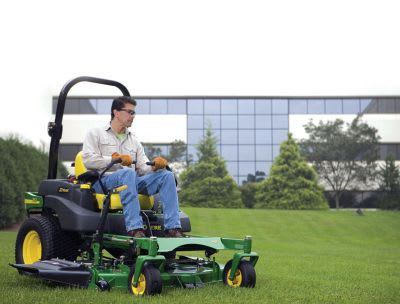
Caring for lawns and grounds, particularly large open spaces such as municipal parks and golf courses, has become much more than just having a crew of workers pushing mowers around. Grounds care is now a science, and it requires specialized equipment and techniques to get the best job done with the least expenditure of time and money.
With modern grounds-care equipment, more area can be covered by relatively fewer workers and often, in significantly less time. The acquisition, operation, and maintenance of that machinery while balancing the lowest cost with maximum efficiency, is the job of the fleet manager.
Keeping Expenses Down
According to Gilbert Peña, business-to-business strategy manager for John Deere, the most significant fleet management considerations are keeping expenses down and maximizing staff use.
“First,” he said, “I would look for equipment with fuel capacity to last the day.” Peña explained that to refuel equipment in the middle of the day is a waste of time. Grounds managers who care for large expanses of grass do not want to return equipment to the yard for refueling or send a truck out for refueling mid-day.
Many new mowers are equipped with diesel engines, which provide greater fuel efficiency and increased power.
Peña also noted the availability of dual-stage air filters.“Keeping the particles stirred up by the machinery out of the machinery extends the engine life and maintenance intervals,” he said. These are all time savings, which translate to money savings.
Peña added that the fleet’s equipment supplier should guarantee maintenance parts availability. “You don’t want to waste time waiting for parts,” he said. In addition, he noted, because maintenance parts are basic, fleet managers should ask suppliers if they can guarantee the availability of maintenance parts. Request the supplier guarantee that both repair parts and maintenance parts will always be available.
As a final thought on parts, Peña suggested asking if suppliers could stock maintenance parts in their shops. Some suppliers allow this, and it is a considerable timesaver.
On the maintenance side, Peña recommended investigating the ease of performing routine maintenance on any equipment before acquiring it. Check to determine if blades, belts, and filters are within easy reach, he advised. “When we look at different suppliers,” he said, “we look at, for example, if you want to grease the mower deck, are the grease fittings on top or on the bottom? Or, does replacing the blade require two wrenches, one on top and one on the bottom?”He explained these are some of the most basic issues in ease of maintenance. If these factors are reviewed up-front, he said, maintenance will be performed because it is easy. “You want to raise the probability that the maintenance will get done.”
Scheduling Maintenance
Once the equipment is evaluated and acquired, the next stage in saving money and maximizing time is informing staff that daily,weekly, monthly, and per-hour maintenance is expected, that routine maintenance includes greasing, checking the belts, and changing the oil.
The equipment operator’s manual offers maintenance schedule recommendations. Staff is responsibile to perform maintenance at the intervals set out in the manual. These recommendations, if followed and performed properly, lead to cost savings.
For some equipment, the manufacturer recommends preseason or postseason maintenance. These advisories are important because when a piece of equipment returns to service after some months in storage, certain maintenance tasks must be performed to keep it operating optimally.
Peña added that a critical factor is staff awareness of maintenance requirements. “Does my staff know this is expected, that they’re being graded on it, so to speak?” He advised ensuring that maintenance information is available in bilingual format, if needed.
Conducting Visual Inspections
Peña advocated the “daily visual,” noting that employees should be expected to perform certain tasks before they begin operating the machines each morning. These tasks include checking for loose hardware, tire air pressure, safety shield placement, etc.
“The reason I mention it is that it can cause loss of time later on,” Peña said. He noted that if shields aren’t in place, they are disregarded; if later on, somebody gets hit, gets a rock in an eye, or some other problem, it causes downtime, loss of efficiency, and lawsuits. So it is expected that on a daily basis, staff look for any safety item, not only from the maintenance standpoint, but also from a safety perspective.
With a daily visual inspection of the machinery, Peña includes what he called “prepping the area.” Sometimes, he noted, employees get on a machine and go, regardless of nearby objects.When mowing close to trees, there may be branches on the ground. Mowers operated close to streets may encounter bottles or cans. Often, operators don’t take the time to prep the area, which can cause a loss of time later. Neglecting to prep a work area risks damaging tires or belts, or even bigger issues, such as hitting a concrete block. Determining how much prep to perform depends on the day’s work assignment.
Explore On-Site Maintenance
Peña recommended that large fleets explore on-site maintenance. Suppliers increasingly offer this opportunity. Depending on staff technician expertise, it may be more economical for a supplier to perform on-site maintenance on a periodic basis. For example, on the first Tuesday or first Saturday of the month, supplier staff can perform a list of maintenance services to all machines in the fleet. It might be more efficient for a local dealer to perform periodic maintenance on a schedule determined by the fleet manager. For example, service mowers once a week, tractors once a month in season, etc. Maintenance is, by default, preventive; it lowers the risk of downtime.
Is Leasing an Option?
Finally, Peña concluded, the older the equipment, the more likely it will incur downtime. Leasing equipment on a two-year basis is one consideration in avoiding this issue. He explained that owning the equipment might not be the most economical way to do business.
“You only need to use the equipment,” Peña said, “and if that is the case, large fleets should consider leasing from the perspective that leasing usually includes a contract for maintenance. In addition, the equipment is always under warranty. If you have a two-year lease, you replace old equipment with new models every two years. The time when they start to need repairs is always in the future."
More Operations

Is Keeping Older Fleet Vehicles Really Saving Money?
Is keeping vehicles longer saving money, and what happens when a diagnostic test points to the wrong fix?
Read More →
How Smart Fleet Strategy Can Help Local Government Agencies Do More with Less
Keeping a vehicle longer may ease this year’s budget, but what does it cost the next one? A closer look at fleet decisions can reveal opportunities to reduce spending while protecting essential services.
Read More →
Connect with Government Fleet on LinkedIn
From industry news and fleet management strategies to conversations with peers, Government Fleet's LinkedIn page offers public-sector fleet professionals another way to stay informed and connected.
Read More →
Town of Queen Creek Named Most Successful Fleet Award Winner of Inaugural RTA Fleet Success Awards
Five fleets were honored at RTA Connect 2026 in Chicago for excellence across resource efficiency, intentional culture, risk management, and stakeholder satisfaction.
Read More →
A buyer's guide to fleet management software in 2027
Buying fleet management software in 2027 means looking beyond features and price. As fleet operations, technology and expectations evolve, this guide explores what today’s fleet professionals should consider when choosing a system that can deliver value now and adapt to what comes next.
Read More →
Hazard Alerts, Fleet Car Sales Rise and a New Shuttle Concept
Fleet car sales doubled, but the bigger picture tells a different story in this week’s roundup.
Read More →
How St. Johns County Turned Fleet Data Into Better Replacement Decisions
St. Johns County, Florida, had fleet data, but turning it into reliable decision guidance was another matter. Instead of starting over with a new fleet management system, the county connected existing tools and built a scoring system that gives managers an objective look at fleet health.
Read More →
Fleet Forward Conference Introduces One-Day Passes for 2026
New one-day registration lets fleet professionals attend Tuesday, Wednesday, or Thursday, with passes available for $249.
Read More →
ENC Unveils its ZAVIR Medium-Duty Shuttle
Two variants of the concept shuttles were revealed: a low-floor configuration and a high-floor configuration.
Read More →
Could Your Next Fleet Technician Start as an Intern?
What if your next technician hasn’t worked in a fleet shop yet? What fleets are doing to free up time.
Read More →