




How Phoenix Is Building Its Next Generation of Fleet Technicians
With more than 8,000 vehicles and pieces of equipment to maintain, the City of Phoenix could not afford to wait for fully trained technicians to walk through the door. Instead, they revamped their entire workforce strategy and showed how public fleets can create their own talent pipeline while preparing existing employees for increasingly complex vehicles.

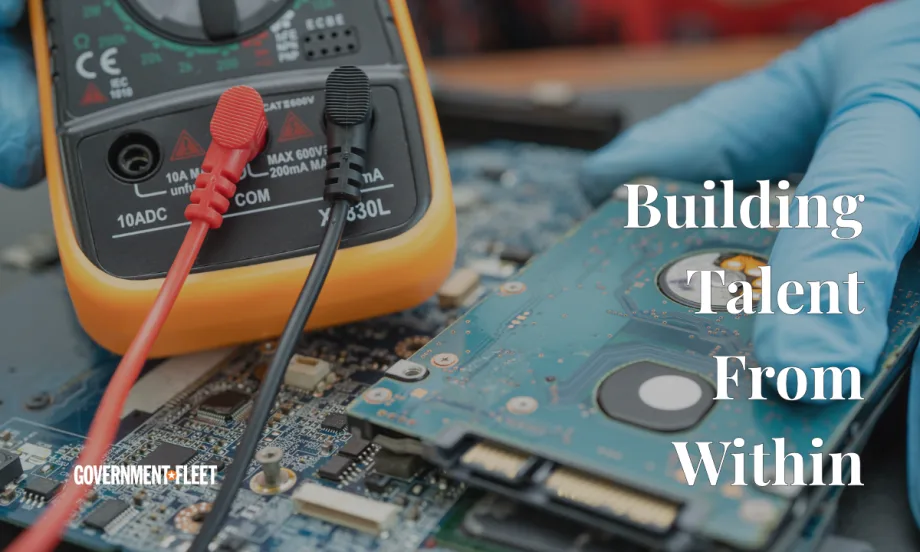
Rather than waiting for experienced technicians to come through the door, Phoenix is creating pathways for employees to learn, gain hands-on experience, and grow into long-term fleet careers.
Government Fleet
Finding technicians is one challenge. Finding technicians equipped to work on everything a modern government fleet throws at them is another.
The City of Phoenix has roughly 190 fleet technicians supporting more than 8,000 vehicles and pieces of equipment across 20 municipal departments. That includes light-duty vehicles, heavy equipment, off-road machinery, and refuse collection vehicles.
At the 2026 Government Fleet Expo & Conference, Phoenix Public Works' Joseph Coleman and Weijia Xie shared how the city has approached technician development by transforming its workforce and attracting, empowering, and retaining talent.
Phoenix is tackling the technician shortage not as a recruiting problem, but a workforce-development opportunity.
Create A Pathway for New Technicians
One of the biggest limitations of traditional fleet recruiting is the assumption that applicants should arrive with most of the necessary technical skills already in place.
Phoenix has created another entry point.
The city's Fleet Technician/Equipment Service Worker II apprenticeship lets applicants enter without prior fleet experience and build their skills while working for the city.
Instead of competing only for experienced technicians already being pursued by dealerships, private fleets, repair facilities, and neighboring governments, a fleet can start looking at candidates based on their ability and willingness to learn.
For Phoenix, that means creating an actual pathway from beginner to technician.
Participants complete 4,000 hours of on-the-job training and at least 288 hours of related instruction. Their training includes classroom automotive technology alongside hands-on experience with city equipment.
The work goes beyond basic terminology and preventive maintenance into hydraulics, electrical systems, brakes, mechanical repairs, troubleshooting, and larger repair assignments.
After successfully completing the apprenticeship requirements, participants can move into the Equipment Service Worker II classification.
Pay increases are tied to program milestones.
Without that pathway, an entry-level position risks becoming just that: an entry-level position with no obvious destination.
Train for What You Need
While developing beginners addresses one side of the issue, it doesn't tell the whole story.
The vehicles already entering government fleets are also changing what experienced technicians need to know.
Phoenix's fleet has been preparing for a growing mix of vehicle technologies as the city modernizes its operation. Its broader electrification planning, for example, includes training fleet technicians on new vehicle technology and maintenance requirements.
Modern refuse trucks, heavy-duty equipment, electronic controls, diagnostics, alternative-fuel systems, and increasingly software-dependent vehicles can all push technicians beyond the systems they learned earlier in their careers.
That means workforce development cannot end once a technician reaches the journey level. Phoenix has supplemented internal development with specialized manufacturer training.
When technicians encounter increasingly specialized equipment, sending difficult repairs outside the organization may solve the immediate problem, but it does not build the fleet's capabilities.
Phoenix has invested in manufacturer training intended to give technicians the skills to diagnose and repair equipment internally.
In 2024, the city approved a contract of up to $200,000 over five years for Cummins systems training. The hands-on courses were intended to teach technicians how to troubleshoot engine components, perform fault analysis, repair equipment, and work with the natural gas engines used in the city's refuse fleet.
The city specifically connected that knowledge to reducing vehicle downtime and returning equipment to service more quickly.
Training budgets can be hard to protect when the operational impact is unclear. Connecting a course directly to recurring diagnostic problems, outsourced repairs, downtime, or incoming vehicle technology gives a fleet a much stronger reason to invest.
Build Training Around Your Operation
Phoenix's situation highlights the limits of a “one-size-fits-all” technician training program.
For one fleet, the immediate need might be advanced diesel diagnostics. Another may be introducing hybrid or battery-electric vehicles. A fleet with refuse equipment may need technicians who understand hydraulics, natural gas engines, and complex electronic systems.
Start with the operation's own equipment and recurring repair needs.
From there, managers can identify where technicians already have sufficient expertise, where outside support is being used repeatedly, and which upcoming vehicle purchases will introduce skills the shop does not currently possess.
Training becomes much easier to prioritize when it is connected to those gaps.
The Phoenix initiative presented at GFX also focused on employee empowerment and retention.
Recruiting another technician does little to solve a workforce shortage if an experienced employee leaves at the same time. A visible development path gives technicians an opportunity to keep advancing instead of looking elsewhere for their next career step.
It can also change how employees view training. Instead of a class being something management requires, development becomes part of a longer career path.
What Your Fleet Can Do To Start
A public fleet does not need 8,000 vehicles or nearly 200 technicians to borrow from Phoenix's approach.
Start by looking at the technician pipeline as a system.
- Create an entry point. Determine whether every opening truly requires an experienced technician or whether some positions can be developed through apprenticeships or trainee classifications.
- Define the path. Give employees measurable milestones showing how they can progress from foundational work into increasingly complex assignments.
- Identify skill gaps. Look at recurring outsourced work, difficult diagnoses, upcoming vehicle purchases, and technologies entering the fleet.
- Use outside expertise strategically. OEM and specialized training can help transfer knowledge into the operation instead of continuously outsourcing repairs.
- Keep developing experienced technicians. Workforce development should continue long after employees have mastered basic maintenance.
Rather than depending entirely on the labor market to produce technicians with exactly the skills its operation needs, the city is working to create those skills itself.
More Operations

Is Keeping Older Fleet Vehicles Really Saving Money?
Is keeping vehicles longer saving money, and what happens when a diagnostic test points to the wrong fix?
Read More →
How Smart Fleet Strategy Can Help Local Government Agencies Do More with Less
Keeping a vehicle longer may ease this year’s budget, but what does it cost the next one? A closer look at fleet decisions can reveal opportunities to reduce spending while protecting essential services.
Read More →
Connect with Government Fleet on LinkedIn
From industry news and fleet management strategies to conversations with peers, Government Fleet's LinkedIn page offers public-sector fleet professionals another way to stay informed and connected.
Read More →
Town of Queen Creek Named Most Successful Fleet Award Winner of Inaugural RTA Fleet Success Awards
Five fleets were honored at RTA Connect 2026 in Chicago for excellence across resource efficiency, intentional culture, risk management, and stakeholder satisfaction.
Read More →
A buyer's guide to fleet management software in 2027
Buying fleet management software in 2027 means looking beyond features and price. As fleet operations, technology and expectations evolve, this guide explores what today’s fleet professionals should consider when choosing a system that can deliver value now and adapt to what comes next.
Read More →
Hazard Alerts, Fleet Car Sales Rise and a New Shuttle Concept
Fleet car sales doubled, but the bigger picture tells a different story in this week’s roundup.
Read More →
How St. Johns County Turned Fleet Data Into Better Replacement Decisions
St. Johns County, Florida, had fleet data, but turning it into reliable decision guidance was another matter. Instead of starting over with a new fleet management system, the county connected existing tools and built a scoring system that gives managers an objective look at fleet health.
Read More →
Fleet Forward Conference Introduces One-Day Passes for 2026
New one-day registration lets fleet professionals attend Tuesday, Wednesday, or Thursday, with passes available for $249.
Read More →
ENC Unveils its ZAVIR Medium-Duty Shuttle
Two variants of the concept shuttles were revealed: a low-floor configuration and a high-floor configuration.
Read More →
Could Your Next Fleet Technician Start as an Intern?
What if your next technician hasn’t worked in a fleet shop yet? What fleets are doing to free up time.
Read More →