




How Fleet Leaders Are Adjusting to Constant Change
At FLAGFA’s spring conference, fleet leaders shared the challenges shaping their operations, how they are responding, and the perspective they would offer others in the industry.
March 26, 2026


At FLAGFA’s spring conference, fleet leaders shared the challenges shaping their operations, how they are responding, and the perspective they would offer others in the industry.
Credit:
Government Fleet
8 min to read
- Fleet leaders at FLAGFA’s spring conference shared the challenges currently affecting their operations.
- Participants explored various strategies to adapt to the rapid changes in fleet management.
- The discussions aimed to offer insights and perspectives beneficial to others in the industry facing similar issues.
*Summarized by AI
Ask a room full of fleet leaders what is making the job harder, and the answer is usually bigger than any one problem.
That was the impression during several discussions at the Florida Association of Governmental Fleet Administrators' spring conference.
In speaking with fleet leaders, the conversation kept circling back to a reality that feels bigger than any one policy change or budget decision. The industry has seen plenty of change, and those shifts are forcing fleet managers to plan in an environment that feels harder to predict.
Collectively, the responses showed just how much fleet leaders are being asked to navigate right now.
Several fleet leaders described an environment in which planning has become more difficult as costs rise and budgets are stretched further. For some, that has meant taking a harder look at fuel use and internal efficiency. For others, it means rethinking replacement strategies altogether.
Financial Pressure Keeps Reshaping Fleet Decisions
Budgeting is often discussed in conversations with fleet leaders, but not always in the same way. In some cases, the pressure is immediate; in others, it shapes longer-term decisions about purchasing, replacement, and how far existing dollars can be stretched. The challenge is not only rising costs, but the difficulty of planning around them when so much feels uncertain.
For Tim Coxwell, CAFM, CPFP, CEM, fleet director for the Leon County Sheriff's Office, the primary challenge is legislative. He pointed to uncertainty in Florida over whether property taxes could eventually be eliminated and what that could mean for county funding.
“Property taxes are the primary source of income for county governments, and the Sheriff's Office is funded by that revenue from the Board of County Commissioners,” said Coxwell.
Because the Sheriff’s Office is a line item in the county budget, he explained that any reduction in that revenue would put added pressure on capital outlay.
“If it’s less and our county is possibly going to be short $90 million, that is putting constraints on capital outlay because the primary interest when there are reductions in revenue is making sure all our people are paid,” Coxwell said. “That means my pool for replacement planning shrinks. So how do we maintain our average age fleet with less money?”
For Justin Hightower, fleet services manager at JEA, fuel, specifically fuel prices, is the most immediate concern.
“There’s a lot of uncertainty right now,” he said, noting that his team has focused on the areas it can control, including meeting with operators, to try to make sure they are cutting down on idling.
That includes cutting unnecessary driving by planning routes more carefully.
“We’re just trying to stay ahead of everything…we don’t know how much longer this is going to last,” he added.
Manatee County Government Fleet Division Manager Matt Case, CEM, pointed to a similar strain from the purchasing side.
“One of the biggest challenges is the instability of the government right now,” he said. That, in turn, has created problems with equipment pricing, especially as “aluminum steel prices continue to increase.”
Fuel costs, he added, “have really thrown a wrench into an already expensive program.”
Dave Persad, CAFM, CEM, CPFP, director of fleet management and mobility for the City of Boynton Beach, also pointed to shrinking budgets and the pressure to do more with less. Rather than stopping at what cannot be afforded, he argued that fleet professionals have to come forward with options.
“As subject matter experts, we can’t just be saying, ‘we cannot get you these vehicles because we don’t have money to do it,’” Persad said. “We have to find ways as a subject matter expert to come up with solutions.”
For Persad, one of those options is leasing. Instead of taking the full hit of a vehicle purchase in one budget cycle, he said leasing can spread the cost out over time. “We are looking at leasing options rather than the capital outlay to purchase vehicles outright,” he said.
Adaptation Has Become Part of the Job
If financial pressure was one recurring theme, adaptation was another. Fleet leaders did not describe a single playbook for working through today’s challenges. Instead, they pointed to the small and large adjustments they are making to keep operations moving, whether that means tightening communication with vendors, reworking shop processes, finding new ways to fund vehicle purchases, or learning how to work through leadership changes without losing momentum.
Case said part of the response comes down to communication and budgeting discipline.
“One of the most important things is that you’ve just got to be upfront with the vendors,” he said. “A contract’s a contract when we cut a purchase order. So when we do it, it’s going to be a done deal.” He also emphasized the importance of working closely with senior administration and financial leadership while carefully planning for fuel costs. “Luckily, we budgeted correctly for fuel, so we’re going to be okay,” he said.
For Orange County Fleet Manager Bryan Lucas, the focus has been on improving efficiency without expecting additional resources. Technician vacancies remain a concern, he said, but so does the pressure to get more work done with the same staffing, space, and mix of vehicles.
“We have no more space, have no more people, we still have an old fleet, we still have a diverse fleet,” Lucas said. That has pushed his team to focus on smaller operational changes that can still make a measurable difference. He pointed to stronger reporting in AssetWorks, along with tweaks to daily shop operations, as one way to improve efficiency.
One recent change has been shifting communication between the shop and parts room to Teams. “We’re using Teams because it just seems to work a little bit better,” he said. The goal, he explained, is to lower downtime, raise PM rates, and speed up repairs in an environment where the workload does not let up.
Coxwell described a strategy built around flexibility in funding and replacement timing. As vehicle prices continue to rise, he said his team has had to be more competitive for available funding and more deliberate about how purchases are structured.
This past year, he said, the goal was to buy 120 vehicles, but only 67 were funded, leaving the rest to be made up over time through excess funds and other strategies. One approach has been using finance agreements to acquire more vehicles earlier, while pricing is still lower than it may be in the future. Another has been remarketing used units directly to other agencies instead of sending them to auction. “You just have to roll with the punches and adjust to the economy as it happens,” he said.
Brian Carroll, CAFM, fleet manager for the Canaveral Port Authority, pointed to a different kind of adjustment. With new management bringing a different perspective, he said he has learned to be candid when offering input, while also recognizing when it is time to carry out the direction that has been set and move on to the next project.
Fleet Insight for the Road Ahead
Despite the hurdles, the silver lining is that with a variety of challenges there is now more advice for a variety of problems. It’s less about trying to find a single big fix and more about habits that help organizations stay ready.
For some fleets, it’s about bringing the focus back to workflow. In Hightower’s view, fleet operations run better when managers take the time to review how work moves internally and remove steps that no longer add value. “Make sure all of your internal processes flow well,” he said. “Make sure you go through and update those to make sure that all your processes flow, everything clicks, and you don’t have any unnecessary steps in your procedures.”
Others emphasized the importance of staying connected to the broader fleet community. Lucas noted that some of the best solutions come from other fleet leaders who are often dealing with the same kinds of problems, even if their operations look different on paper.
“Learn from your peers, especially in your area,” he said. He encouraged fleet professionals to get involved with local associations and industry events, adding that sometimes the quickest way to solve a problem is simply to call someone who has already dealt with that issue.
Still, there are other ways fleet managers can stay prepared in regards to education. Carroll recommended certifications, particularly CAFM, as a way to build long-term career value. “It’s a big program that will help careers a long way,” he said, stressing the importance of planning ahead while watching costs closely and being realistic about the challenge of hiring experienced technicians.
Carroll also noted that fleets still need to find good technicians, though experienced candidates are hard to come by. He added that hiring often comes down to instinct. “I like to interview and get to know somebody and I think I have a good feel for getting to know somebody pretty quick,” Carroll said.
For Coxwell, the key is to be “as flexible as you can.” He suggested taking advantage of trade-in opportunities when policy allows, especially on vehicles that don't require a significant amount of upfit. For the Leon County Sheriff’s Office, that would typically be large vehicles and administrative sedans. He also noted that no fleet is working through these constraints alone, which creates opportunities for agencies to help one another in practical ways.
“It's just a different strategy,” he explained. “As the market changes, we'll have to come up with a new one to meet whatever the demands are then.”
Persad returned to a theme that came up throughout the interviews: fleet leaders have to think creatively. “Things are changing, think outside the box,” he said. For Persad, that means more than finding short-term budget solutions. It also means building stronger ties with local schools and associations so fleets can help create their own pipeline of future technicians.
He encouraged managers to get involved with tech schools, high schools, and colleges that offer automotive programs, and to serve on advisory committees when possible. That kind of early involvement, he suggested, can help fleets shape talent before it ever enters the workforce.
And for Manatee County Government Fleet Division Manager Matt Case, the advice was to the point: “Be ready so you don’t have to get ready.”
Subscribe to Our Newsletter
More Articles

New Partnership Aims to Expand Public Digital Hazard Alert System Statewide
The Hawai’i Department of Transportation (HDOT) is expanding advance digital hazard alerts for the public statewide.
Read More →
How St. Johns County Turned Fleet Data Into Better Replacement Decisions
St. Johns County, Florida, had fleet data, but turning it into reliable decision guidance was another matter. Instead of starting over with a new fleet management system, the county connected existing tools and built a scoring system that gives managers an objective look at fleet health.
Read More →
The Missing Link in Fleet Safety: Turning Data into Behaviour Change
Every municipal vehicle tells residents something about how their fleet is being managed. For King Township, Ontario, that visibility made speeding more than a driver performance issue.
Read More →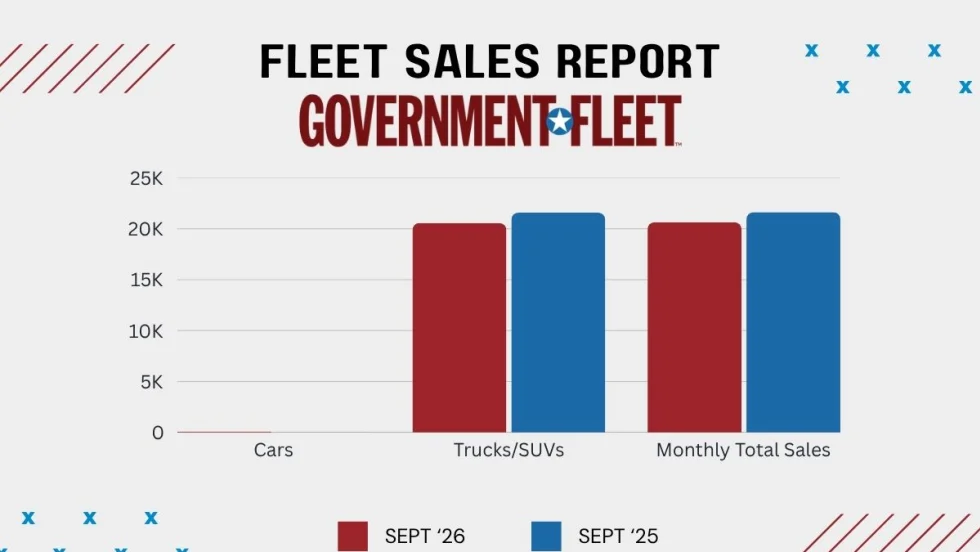
Government Fleet Car Sales More Than Double in September
Government fleet car sales rose 112.8% year over year in September, climbing from 39 to 83 units even as total monthly sales declined 4.5%.
Read More →
John Deere Adds SmartGrade Box Blades, Fire Suppression Option
John Deere is expanding the capabilities of its compact track loaders with new grading attachments and an equipment protection option. The additions include two SmartGrade box blades for the 333 and 335 P-Tier models and an integrated fire suppression system for large-frame machines.
Read More →
Fleet Forward Conference Introduces One-Day Passes for 2026
New one-day registration lets fleet professionals attend Tuesday, Wednesday, or Thursday, with passes available for $249.
Read More →
ENC Unveils its ZAVIR Medium-Duty Shuttle
Two variants of the concept shuttles were revealed: a low-floor configuration and a high-floor configuration.
Read More →
Could Your Next Fleet Technician Start as an Intern?
What if your next technician hasn’t worked in a fleet shop yet? What fleets are doing to free up time.
Read More →
How Phoenix Is Building Its Next Generation of Fleet Technicians
With more than 8,000 vehicles and pieces of equipment to maintain, the City of Phoenix could not afford to wait for fully trained technicians to walk through the door. Instead, they revamped their entire workforce strategy and showed how public fleets can create their own talent pipeline while preparing existing employees for increasingly complex vehicles.
Read More →
What’s Slowing Your Fleet Down?
Could a change in how work gets done help your fleet return vehicles to service sooner?
Read More →