




Clearing the Air
When Jerry Nabhan took over as fleet manager for the City of Sunnyvale, Calif. — with 136,000 residents and 3,000 businesses in the heart of the Silicon Valley — he located his garbage trucks by looking for black smoke in the air.
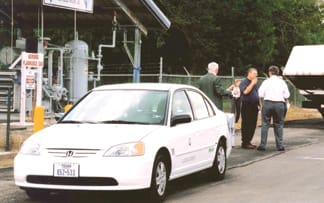
Jerry Nabhan was touched personally by two cancers in his family. He intuitively knew the connection between cancer and living in an area of seven million people, with five million cars producing 550 tons of hydrocarbons a day, a precursor of ozone and the main ingredient in smog. Nabhan, Sunnyvale, Calif.’s fleet manager, felt it was imperative to take action on the local level to slow the progression of environmental impacts, pollution, disease, and global warming. Noted as a progressive city, Sunnyvale has been named the 10th safest city in America. All officers train and work in both police and fire services. Assignment rotation provides employees with mental stimulation and a variety of experiences critical to maintaining high job performance. The Energy Policy Act of 1992 requires local governments to convert fleets to alternative fuel-powered vehicles. Local laws also encouraged the fleet department to use alternative fuels. And, Nabhan knew it was the right thing to do. He converted 19 residential waste-collection trucks from diesel to compressed natural gas (CNG). These trucks reduce smog-forming and particulate pollution by 56 tons throughout the course of their operation. A proactive city, Sunnyvale hired Global Research and Analysis to survey citizens on their perceptions of city services. Global Research asked Nabhan to heighten awareness of the city’s reduction of pollution and noise (citizens used to wake up to the sound of trash trucks). Nabhan and his staff came up with the idea of showcasing their zero-emissions CNG trucks. Global Resources hosted a “Dinner at the Dump” for 340 residents, featuring oysters, steaks, salmon, and chili cooked by public safety officers. Nabhan’s wife and mother made more than 340 strawberry shortcakes. The event raised $15,600 for the needy in Sunnyvale. Since the “Dinner at the Dump” event, and the resulting publicity, the city’s fueling station sells more CNG fuel to the public than used by the entire fleet.
More Operations

Is Keeping Older Fleet Vehicles Really Saving Money?
Is keeping vehicles longer saving money, and what happens when a diagnostic test points to the wrong fix?
Read More →
How Smart Fleet Strategy Can Help Local Government Agencies Do More with Less
Keeping a vehicle longer may ease this year’s budget, but what does it cost the next one? A closer look at fleet decisions can reveal opportunities to reduce spending while protecting essential services.
Read More →
Connect with Government Fleet on LinkedIn
From industry news and fleet management strategies to conversations with peers, Government Fleet's LinkedIn page offers public-sector fleet professionals another way to stay informed and connected.
Read More →
Town of Queen Creek Named Most Successful Fleet Award Winner of Inaugural RTA Fleet Success Awards
Five fleets were honored at RTA Connect 2026 in Chicago for excellence across resource efficiency, intentional culture, risk management, and stakeholder satisfaction.
Read More →
A buyer's guide to fleet management software in 2027
Buying fleet management software in 2027 means looking beyond features and price. As fleet operations, technology and expectations evolve, this guide explores what today’s fleet professionals should consider when choosing a system that can deliver value now and adapt to what comes next.
Read More →
Hazard Alerts, Fleet Car Sales Rise and a New Shuttle Concept
Fleet car sales doubled, but the bigger picture tells a different story in this week’s roundup.
Read More →
How St. Johns County Turned Fleet Data Into Better Replacement Decisions
St. Johns County, Florida, had fleet data, but turning it into reliable decision guidance was another matter. Instead of starting over with a new fleet management system, the county connected existing tools and built a scoring system that gives managers an objective look at fleet health.
Read More →
Fleet Forward Conference Introduces One-Day Passes for 2026
New one-day registration lets fleet professionals attend Tuesday, Wednesday, or Thursday, with passes available for $249.
Read More →
ENC Unveils its ZAVIR Medium-Duty Shuttle
Two variants of the concept shuttles were revealed: a low-floor configuration and a high-floor configuration.
Read More →
Could Your Next Fleet Technician Start as an Intern?
What if your next technician hasn’t worked in a fleet shop yet? What fleets are doing to free up time.
Read More →