




RoadFlex Brings Fuel Tax Compliance and Audit-Ready Reporting to Government, Public Works Fleets
New capabilities aim to help public-sector and public works fleets streamline fuel tax exemptions, reclamation, reconciliation, and audit-ready reporting.
June 16, 2026

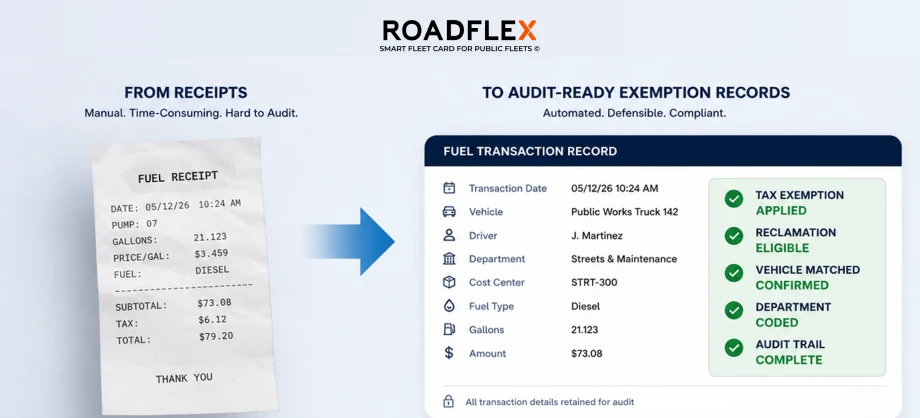
New capabilities aim to help public-sector and public works fleets streamline fuel tax exemptions, reclamation, reconciliation, and audit-ready reporting.
Credit:
RoadFlex
3 min to read
RoadFlex, a solution provider of fuel risk management, is expanding its fuel tax compliance capabilities for government and public works fleets.
The capabilities are built to help eligible public-sector agencies reduce the administrative burden of managing fuel tax exemptions, reimbursements, and reclamation, giving them a more automated and auditable way to manage fuel transactions, flag eligible purchases, and produce clean records for finance and audit teams, according to a press release.
Pulling Workflows Into a Single Platform
That matters most for the agencies running the widest range of vehicles and equipment. Public works, transportation, and municipal fleets spread fuel spend across departments, cost centers, and field sites, which makes exemption tracking and audit prep harder the moment it leaves a single fuel island.
“Government fleets need more than a payment card. They need a platform that manages spend, enforces controls, and documents compliance in a way auditors can follow,” said Rush Akin, Chief Revenue Officer of RoadFlex. “These capabilities cut the administrative work behind fuel tax compliance and give agencies cleaner, more defensible records of every fuel purchase.”
RoadFlex’s fuel tax compliance capabilities is designed to help agencies:
- Identify eligible fuel purchases automatically using enhanced transaction data, instead of sorting them by hand.
- Distinguish exempt or reclamation-eligible spend from purchases that require standard tax treatment.
- Support exemption handling at the point of sale where available, and streamline reclamation where tax is paid upfront.
- Tie each transaction to the relevant vehicle, driver, department, and cost center, cutting spreadsheet and receipt reconciliation.
- Retain transaction-level evidence, including merchant, date, amount, fuel data, cardholder, vehicle, and department, for audits and reimbursement reviews.
- Manage exemptions, controls, and compliance reporting for multi-department, multi-location fleets in one platform.
The capabilities run on RoadFlex’s open-loop Visa platform and use enhanced transaction data and card-level controls to identify eligible fuel purchases. Where an exemption can be applied at the point of sale, it is.
Where tax is paid upfront, which is common when crews fuel at retail stations, the same transaction-level detail supports exemption handling where available and streamlines reclamation. That gives fleet and finance teams a clearer view of which purchases may be eligible for exemption or recovery and which require standard tax treatment.
Because the platform is open-loop, drivers can fuel wherever Visa is accepted rather than inside a limited fuel network. For fleets working across districts, depots, and field sites, that means fewer out-of-network workarounds and a more complete record for compliance reporting to draw from.
The capabilities are built to support both savings and compliance. Recovering eligible taxes is part of it, but so is giving agencies a more controlled, transparent, and auditable fuel spend process overall.
A Modern Alternative to Legacy Fuel Card Programs
The platform combines open-loop Visa acceptance, configurable spend controls, audit-ready reporting, cooperative purchasing readiness, and integrations across fleet and financial systems.
For agencies that procure through cooperative purchasing channels, fuel tax compliance adds another public-sector-specific capability tied to fuel savings, compliance, and administrative efficiency.
They also extend RoadFlex’s work with Visa to modernize fleet payments for government and enterprise fleets. RoadFlex recently collaborated with Visa on a public-sector fleet payments whitepaper on how modern card technology, transaction controls, data visibility, and compliance workflows can help agencies reduce administrative burden and improve oversight of fleet spend.
RoadFlex will discussed its public-sector fleet payment and compliance capabilities at the Government Fleet Expo & Conference (GFX), the largest annual conference for public fleets, held June 9 to 12, 2026 in Long Beach, California.
More Operations

Fleet Forward Conference Introduces One-Day Passes for 2026
New one-day registration lets fleet professionals attend Tuesday, Wednesday, or Thursday, with passes available for $249.
Read More →
ENC Unveils its ZAVIR Medium-Duty Shuttle
Two variants of the concept shuttles were revealed: a low-floor configuration and a high-floor configuration.
Read More →
Could Your Next Fleet Technician Start as an Intern?
What if your next technician hasn’t worked in a fleet shop yet? What fleets are doing to free up time.
Read More →
How Phoenix Is Building Its Next Generation of Fleet Technicians
With more than 8,000 vehicles and pieces of equipment to maintain, the City of Phoenix could not afford to wait for fully trained technicians to walk through the door. Instead, they revamped their entire workforce strategy and showed how public fleets can create their own talent pipeline while preparing existing employees for increasingly complex vehicles.
Read More →
What’s Slowing Your Fleet Down?
Could a change in how work gets done help your fleet return vehicles to service sooner?
Read More →
Can Public Fleets Trust the Data Driving Their Decisions?
Public fleets have more data than ever, but inconsistent records and missing information can still undermine maintenance, replacement, and cost decisions.
Read More →
John Deere Introduces 40 P-Tier Compact Excavator
John Deere is adding a compact excavator designed for crews that need to move equipment between jobsites and handle multiple types of work with one machine. The 40 P-Tier weighs less than 10,000 pounds and offers configurable hydraulics, attachment options, and connected fleet-management capabilities.
Read More →
How Leading Fleets Improve and Why Business Plans Matter
This week, we look at what past Leading Fleet winners can teach us about making progress, plus how to build a business plan your fleet will actually use.
Read More →
Nominate a Fleet Leader for the 2027 Public Fleet Hall of Fame
Do you know a fleet leader who has made a lasting impact on the industry? Nominate this fleet professional for the 2027 Public Fleet Hall of Fame.
Read More →
Why Fleet Business Plans Need Three Perspectives
A fleet business plan should help agency leaders understand the fleet’s value, give the organization a clear direction, and establish shared expectations with customer departments.
Read More →