




Certifications Promote Industry Professionalism
Fleet industry credentials, such as NAFA’s CAFM and the American Public Works Association’s CPFP, showcase the specialized skill sets required of technicians who work on today’s complex automobiles and equipment.

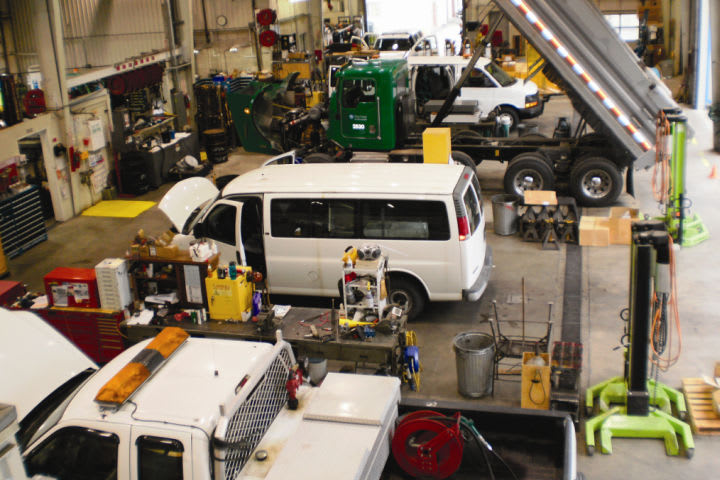
With a 500-unit fleet, Pierce County’s 25-member fleet team serves several county agencies, including public works & utilities, emergency management, and facilities management.
"A professional fleet manager works here." That's the validation industry certifications bring a fleet operation, believes Alan Kies, equipment services division manager for Pierce County, Wash.
Achieved after often-rigorous courses of study, experience, and testing, certifications counter mechanics' long-held image as "grease monkeys." Today, says Kies, National Institute for Automotive Service Excellence (ASE) certifications "showcase" modern technicians who need "special skill sets to work on the increasingly complex automobiles and equipment."
Industry credentials such as NAFA Fleet Management Association's (NAFA) Certified Automotive Fleet Manager (CAFM) and the American Public Works Association's (APWA) Certified Public Fleet Professional (CPFP) signify advanced experience and knowledge in all areas of fleet management.
Kies speaks with authority on the value of industry certifications. A certified ASE master automobile technician and master medium-/heavy-duty truck technician, he also holds CAFM and CPFP distinctions.
"Certification has given me the tools to perform my job in a professional manner," Kies says. "Whether managing fleet assets, maintaining the fleet, fuel management, or any of the many other functions required to keep a large fleet operating in top condition, certification programs challenge you to be your best. They also challenge me to stay up-to-date in my profession for my re-certification process every five years."
Paving a Career Path
His ASE certifications, first earned while working in the private sector and for Monterey County, Calif., "served me very well, not only in securing gainful employment, but also in consideration for advancement to supervisory positions and eventually the fleet supervisor position," in 1996, Kies recalls.
Achieving a CAFM credential led to a fleet post with Pierce County in 1997 and promotion to Kies' current position in 2002.
Located at the southern end of Puget Sound and including the City of Tacoma, Wash., Pierce County operates a 500-unit fleet, primarily vans, pickups, SUVs, medium- and heavy-duty trucks, and off-road and construction vehicles. Kies' 25-member fleet team serves several county agencies, including public works and utilities, emergency management, facilities management, and parks & recreation, in addition to the county's telecommunications commission and three county fire districts.
Making Time for Achievement
Kies admits achieving and maintaining industry certifications "takes a lot of dedication. Like anything else, if you decide it is valuable, you will make the time."
While each certification program is a "self-paced" process, completion and testing generally takes 2-3 years, says Kies.
A mentor recommended NAFA's CAFM program when Kies determined he wanted to "move it up a notch" to the fleet management level. His progress toward CAFM certification began with a "rude awakening," Kies recalls.
"When I first signed up for the NAFA exam, I wondered, 'How hard could this really be?' So I took the test with minimal studying ... and failed miserably, passing only one of eight modules," he explains.
Realizing he had developed poor study habits, he completely "restructured what I did when I came home from work to set aside meaningful study time. I had to get away from my normal routine." On his next attempt, Kies passed every module of the course, which, at that time, included a case study project.[PAGEBREAK]
A CPFP certification was not required for Kies' Pierce County position. However, "since I work in a primarily public works environment, it seemed a natural fit," in keeping with his original interest of promoting professionalism in the fleet industry, he says.
The CPFP test presented its own challenge, says Kies. Through a registration mix-up, he never received study materials distributed to all other test-takers. He "carefully" took the exam anyway.
"Fortunately, being involved with educational programs both through NAFA chapter meetings and Public Fleet Managers Association, my local public fleet management association, had kept me up-to-date so I was able to pass the test regardless," says Kies.
Recognizing Value
In the public sector, Kies notes, some agencies now require professional certifications for employment, indicating the fleet industry "is starting to recognize the value of such achievements." Other fleets offer certification incentives or make participation available "to demonstrate their employees are professionals."
Some agencies also pay program costs, which can amount to several hundred dollars, according to Kies.
The Pierce County fleet operation bases employee job descriptions on ASE certification. Earning and maintaining ASE certification allows staff members to achieve a desired pay scale, Kies explains. Nearly every technician on his fleet team holds at least one ASE certification, and several have earned ASE master-level distinctions. In addition, one of Kies' administrative staff just earned NAFA's CAFM credential.
For Kies, industry credentials provide a measure of employment security. "Certification has given me confidence in knowing that I will always have a job, and if for some reason I should move out of the area, even in the current economic climate, I'd have a better-than-average chance of securing another great job in the profession that I love so much," he says.
Kies advises public sector fleet managers "even slightly" considering a certification program to proceed "with gusto." He suggests checking with NAFA, APWA, or other industry groups for certification program offerings. "Get involved in your local fleet management chapter, if you have one," he adds.
Kies adamantly believes certification "shows dedication to the profession and increasingly is becoming the gauge by which professional fleet managers are measured."
While he's "had the privilege to know outstanding fleet managers who are not certified, I also know many certified fleet managers, and they are, in my opinion, without question, the very best of the best."
More Operations

Is Keeping Older Fleet Vehicles Really Saving Money?
Is keeping vehicles longer saving money, and what happens when a diagnostic test points to the wrong fix?
Read More →
How Smart Fleet Strategy Can Help Local Government Agencies Do More with Less
Keeping a vehicle longer may ease this year’s budget, but what does it cost the next one? A closer look at fleet decisions can reveal opportunities to reduce spending while protecting essential services.
Read More →
Connect with Government Fleet on LinkedIn
From industry news and fleet management strategies to conversations with peers, Government Fleet's LinkedIn page offers public-sector fleet professionals another way to stay informed and connected.
Read More →
Town of Queen Creek Named Most Successful Fleet Award Winner of Inaugural RTA Fleet Success Awards
Five fleets were honored at RTA Connect 2026 in Chicago for excellence across resource efficiency, intentional culture, risk management, and stakeholder satisfaction.
Read More →
A buyer's guide to fleet management software in 2027
Buying fleet management software in 2027 means looking beyond features and price. As fleet operations, technology and expectations evolve, this guide explores what today’s fleet professionals should consider when choosing a system that can deliver value now and adapt to what comes next.
Read More →
Hazard Alerts, Fleet Car Sales Rise and a New Shuttle Concept
Fleet car sales doubled, but the bigger picture tells a different story in this week’s roundup.
Read More →
How St. Johns County Turned Fleet Data Into Better Replacement Decisions
St. Johns County, Florida, had fleet data, but turning it into reliable decision guidance was another matter. Instead of starting over with a new fleet management system, the county connected existing tools and built a scoring system that gives managers an objective look at fleet health.
Read More →
Fleet Forward Conference Introduces One-Day Passes for 2026
New one-day registration lets fleet professionals attend Tuesday, Wednesday, or Thursday, with passes available for $249.
Read More →
ENC Unveils its ZAVIR Medium-Duty Shuttle
Two variants of the concept shuttles were revealed: a low-floor configuration and a high-floor configuration.
Read More →
Could Your Next Fleet Technician Start as an Intern?
What if your next technician hasn’t worked in a fleet shop yet? What fleets are doing to free up time.
Read More →