





Related: 6 Reasons Telematics is Essential for Snow Operations
Brine Worth Its Salt for Ark. City
The City of Bentonville, Ark., has begun using brine to melt ice, allowing it to use less salt than before.
December 4, 2019
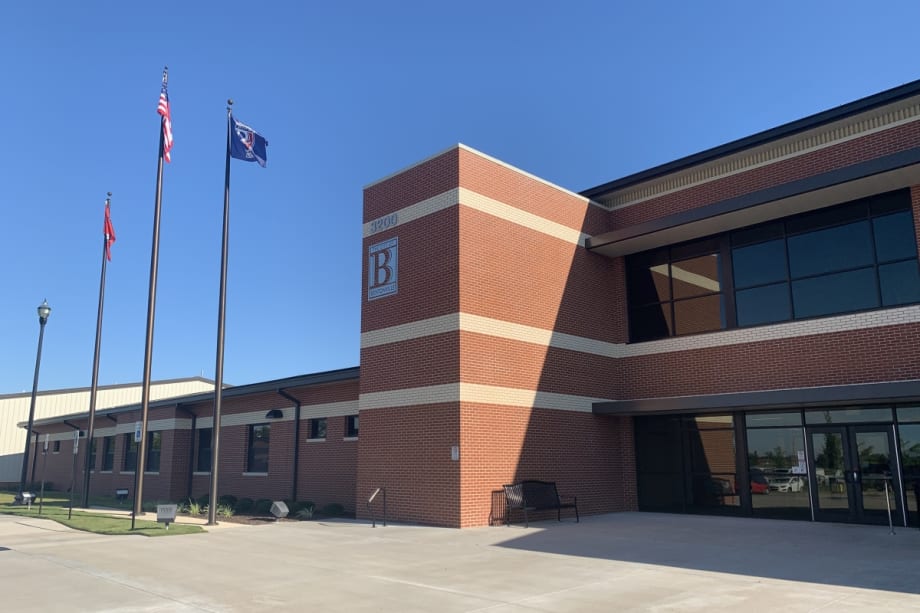
The City of Bentonville, Ark., has grown in population over the past couple of decades, and so has residents’ expectations for winter road maintenance.
Photo courtesy of SnowEx
3 min to read
The City of Bentonville, Ark., has experienced tremendous growth over the past couple of decades. And as the population has grown, so have residents’ expectations for winter road maintenance. One of the city’s latest efforts to meet these expectations is the use of brine.
The street department began testing the waters by building its own equipment to produce brine and then applied it in a couple of different ways. First, the department started spreading salt, followed by a home-made sprayer to apply brine on top of it, thereby activating the salt’s melting capabilities more effectively. This de-icing tactic was mostly used at signalized intersections, allowing the salt to work below the existing ice pack and break it up from underneath.
Secondly, the department used home-made sprayers to pretreat bridges, overpasses, collector streets, and main roads leading into subdivisions with brine before a winter event. The goal was to establish a layer of salt that prevents ice from bonding with the pavement, making it easier to scrape away with a plow or simply keeping the surface clear of ice in the first place.
“Areas we pretreated were melting off much quicker,” said Daniel Clardy, transportation foreman for the City of Bentonville. “In fact, it was melting ten times faster than areas we hadn’t pretreated. And we were using a lot less salt than if we spread it after ice had already formed.”
Due to the success, the purchased a SnowEx Brine Pro brine maker for automated brine production. “Using a touch-screen, you just follow the simple directions, make a couple of minor adjustments and consistently make brine at 23.3% salinity,” Clardy said. The simplicity allowed Clardy and Crew Leader James Bise to quickly get up to speed on making the brine and then train three others to do the same so there is always someone on hand to replenish stockpiles. “The best way I can put it is if you can use a cell phone, you can use this brine maker,” Clardy said. Currently, the municipality is making/storing 10,000 gallons of straight salt brine and 5,000 gallons of a magnesium chloride and salt brine mix.
For application, the city purchased a SnowEx Liqui Maxx sprayer. “With our homemade units, we could only treat one lane at a time,” said Clardy. “With the new sprayer, we could turn on the flood nozzles on either side of the boom and cover three lanes at once. I literally did three to four times more pre-treating than our other sprayers could do over the same period of time.”
Another advantage is the sprayer’s GPS technology. Using speed sensors, the sprayer can be set to automatically adjust the flow rate based on travel speed. The equipment has proven so effective that the city plans to flex in two new sprayers. Furthermore, the neighboring jurisdictions of City of Centerton and Benton County have followed suit with brine usage and equipment selections based on Bentonville’s experiences.
“Making and applying brine has made us more efficient and effective while cutting down on overtime,” Clardy said. “But, most importantly, it’s made everything a lot safer for the traveling public. And that’s the ultimate goal for all of our jurisdictions.”
About the Author: Jon Thorp is a marketing specialist for SnowEx, a manufacturer of snow and ice management equipment.
Subscribe to Our Newsletter
More Operations
Is Keeping Older Fleet Vehicles Really Saving Money?
Is keeping vehicles longer saving money, and what happens when a diagnostic test points to the wrong fix?
Read More →
How Smart Fleet Strategy Can Help Local Government Agencies Do More with Less
Keeping a vehicle longer may ease this year’s budget, but what does it cost the next one? A closer look at fleet decisions can reveal opportunities to reduce spending while protecting essential services.
Read More →
Connect with Government Fleet on LinkedIn
From industry news and fleet management strategies to conversations with peers, Government Fleet's LinkedIn page offers public-sector fleet professionals another way to stay informed and connected.
Read More →
Town of Queen Creek Named Most Successful Fleet Award Winner of Inaugural RTA Fleet Success Awards
Five fleets were honored at RTA Connect 2026 in Chicago for excellence across resource efficiency, intentional culture, risk management, and stakeholder satisfaction.
Read More →
Sponsored•October 14, 2026
A buyer's guide to fleet management software in 2027
Buying fleet management software in 2027 means looking beyond features and price. As fleet operations, technology and expectations evolve, this guide explores what today’s fleet professionals should consider when choosing a system that can deliver value now and adapt to what comes next.
Read More →
Hazard Alerts, Fleet Car Sales Rise and a New Shuttle Concept
Fleet car sales doubled, but the bigger picture tells a different story in this week’s roundup.
Read More →
How St. Johns County Turned Fleet Data Into Better Replacement Decisions
St. Johns County, Florida, had fleet data, but turning it into reliable decision guidance was another matter. Instead of starting over with a new fleet management system, the county connected existing tools and built a scoring system that gives managers an objective look at fleet health.
Read More →
Fleet Forward Conference Introduces One-Day Passes for 2026
New one-day registration lets fleet professionals attend Tuesday, Wednesday, or Thursday, with passes available for $249.
Read More →
ENC Unveils its ZAVIR Medium-Duty Shuttle
Two variants of the concept shuttles were revealed: a low-floor configuration and a high-floor configuration.
Read More →
Could Your Next Fleet Technician Start as an Intern?
What if your next technician hasn’t worked in a fleet shop yet? What fleets are doing to free up time.
Read More →