





Looking for more insights? Check out Lessons Learned from the 2023 Award Winner, Sara Burnam
The Why Matters: Leadership Lessons from Alison Kerstetter
2025 Public Sector Fleet Manager of the Year Alison Kerstetter chats with Government Fleet about what Sacramento is working on, future plans, and best practices.
August 30, 2025
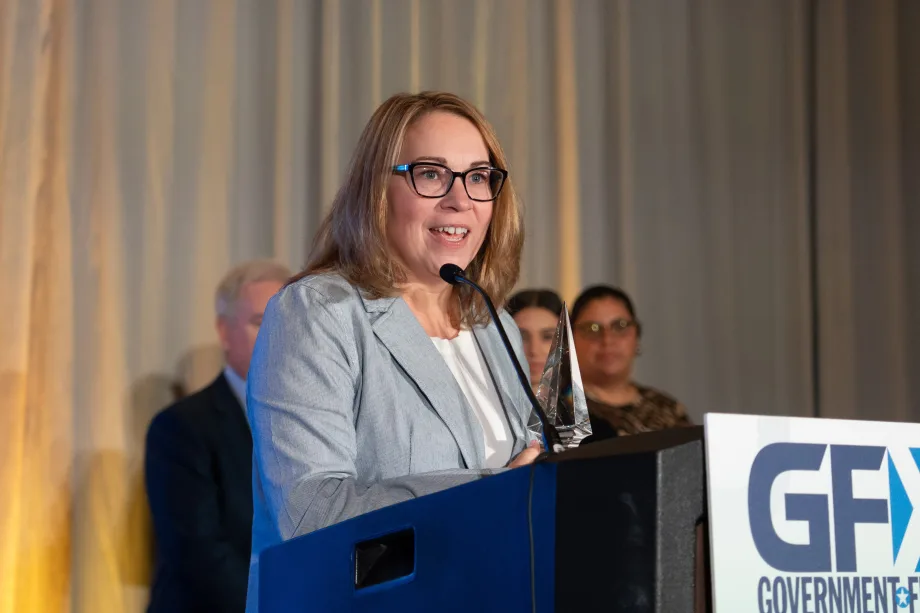
Alison Kerstetter, fleet manager for the City of Sacramento, California, was named the 2025 Public Sector Fleet Manager of the Year during the Honors Celebration at the 2025 Government Fleet Expo & Conference in Charlotte.
Photo: Ross Stewart Photography
8 min to read
A leader, according to your dictionary of choice, can roughly be defined as someone who leads, directs, or acts as a guide to others, whether in the setting of a group or a structured organization. However, the definition becomes a little more nuanced when it comes to individual fleet leadership. What works for one fleet may not work for another. Still, there are plenty of lessons fleet leaders can learn from one another.
We asked 2025 Public Sector Fleet Manager of the Year Alison Kerstetter about her experience as someone who leads a fleet and what those critical turning points in her career have been. Kerstetter takes us on a ride-along—this time through the page—for a closer look at the city of Sacramento’s fleet and her leadership approach.
Government Fleet: What core values/principles have guided your approach to managing a public fleet?
Alison Kerstetter: Staff need to be the priority because without them, the division doesn’t operate. Have integrity with all you do. Be accountable for decisions and staff; if something doesn’t go correctly, accept responsibility, fix it, and move on. In my experience, people are much more appreciative and willing to work with you on this process.
GF: What’s the most significant decision you’ve made that changed how your fleet operates?
Kerstetter: The city of Sacramento Fleet Division has six shops in the North, Central, and South parts of the city. The individual operational procedures for each shop had not been reviewed for many years. We reviewed and continue to review shop operations to create processes and direction to ensure that the operations and tasks in the shops are the same or similar.
For instance, the operating hours of our three largest shops were not the same. Also, there was no standard for vehicle damage as each shop was making a judgment call on which dents and scratches would be repaired. We’ve also made processes like shop and fuel island inspections digital, so we are not dealing with mountains of paper that are kept for compliance purposes.
While the processes and operational functions in the fleet division are not perfect, we have made a lot of positive progress in creating a more efficient and successful team.
GF: How do you define a successful fleet?
Kerstetter: A successful fleet meets the customer’s requirements by maintaining and repairing vehicles to be available when they are needed. This must be done quickly and in the safest manner for both the fleet employee and staff who will be utilizing the vehicle or equipment. Also, fleets that are successful invest in their employees by providing training opportunities for all aspects of the job.
GF: What’s something you’ve learned from your team that changed your perspective as a manager?
Kerstetter: Operations of the division can be very simple and very difficult at the same time. Clear communication on direction and why that direction is being implemented is the biggest lesson. The ‘why’ something is being done is just as important as the communication of the change.
The why provides insight into what is happening within the division, department, and city as a whole. It also allows staff to ask questions about items that may not be completely clear or about situations that haven’t been thought about.
GF: How do you balance short-term needs with long-term goals?
Kerstetter: Short-term needs require quick thinking and implementation. But short-term needs go hand in hand with long-term goals. Short-term needs must be viewed based on the whole organization, even if it is only affecting a small portion of staff or one maintenance shop.
Many times, short-term needs can fall into addressing some part of a long-term goal. For example, technician recruitment and retention is a daily discussion that occurs. We have been moving staff between shops to keep operations available at all locations.
One of our long-term goals is to have a well-rounded group of mechanics and service workers, meaning that they have a working knowledge of the many different types of equipment and vehicles that comprise our fleet. By moving staff to different locations to meet short-term needs, we are also fulfilling a long-term goal by having staff work on different types of vehicles and equipment to obtain more knowledge about the fleet.
GF: What role does data play in your decision-making and how do you avoid getting overwhelmed by it?
Kerstetter: In most fleets today, especially those that use telematics, there is an overload of data to review and analyze. I am a data-driven person, so data analysis, as well as policy adherence, is very important when deciding and providing direction to internal staff and outside departments. Buy-in and compliance are less painful and faster when providing data to back up a decision.
GF: When budget constraints hit, what’s the first area you protect, and what’s the first area you trim?
Kerstetter: The first area that is immediately thought about is staff. Our divisional staff count is small for the work that is completed to manage and maintain the fleet. Our maintenance and administrative staff do a fantastic job keeping vehicles and equipment safe and in-service for the city staff who need the units to complete their jobs. I will always fight for the staff to ensure that the city fleet is taken care of in the most efficient and effective manner.

The first area that is trimmed isn’t so easy to identify. It could be anything. The first thing we have done when asked to save money is to look at the operations and budget. We have removed extra non-billable hours our shops that were occurring, we have tightened up vehicle specifications to only include those must-have items, and implemented different replacement guidelines to cut down on vehicles replacements that are not necessarily needed.
GF: What was the biggest challenge your fleet faced this past year and how did you overcome it?
Kerstetter: Recruitment and retention of technicians are the largest challenges that the city fleet has been facing for the last few years. We changed our outlook on potential candidates and hiring. When applications are reviewed, all aspects of vehicle maintenance experience are considered, not only formal positions.
This has helped with more candidates to interview and hire. We are also providing additional training to retain more staff. This will assist in continued learning and help staff know they are valued and we want to invest more time in them.
GF: What current challenge are you working through, and how are you addressing it?
Kerstetter: Regulations regarding purchase of zero-emission vehicles put forth by the state are the largest challenge that the city of Sacramento fleet is currently facing. Implementing the regulations by purchasing ZEVs, installing infrastructure, and upfitting shops to safely work on the units has and will take a lot of time, planning, and money.
GF: How do you keep your team and yourself motivated through bureaucratic red tape or resource shortages?
Kerstetter: The Fleet Management Division is a great team that tries to keep a positive mindset. Everyone is experiencing some sort of difficulty due to rules and regulations. However, they are there for a reason, some of which may be: to keep transparency for processes and procedures, to ensure citizens’ tax money is being spent wisely and in an effective manner, or to guarantee employee safety.
Normally, processes, procurement, and other city procedures take more time than they would in the private sector due to these rules. It is easier to deal with them and keep motivated to do a good job and the right thing if you keep that in mind. Things will get completed, it just may take a bit longer than you or your team may like.
GF: What’s a trend or development in fleet that you think is overhyped and what’s one that deserves more attention?
Kerstetter: A development, in my opinion, that is overhyped is fully autonomous fleets. My belief is that there is no substitute for a person operating a vehicle. Also, the technology for fully autonomous vehicles is not as advanced as it needs to be to provide people with the same level of comfort that they have with people-driven vehicles.
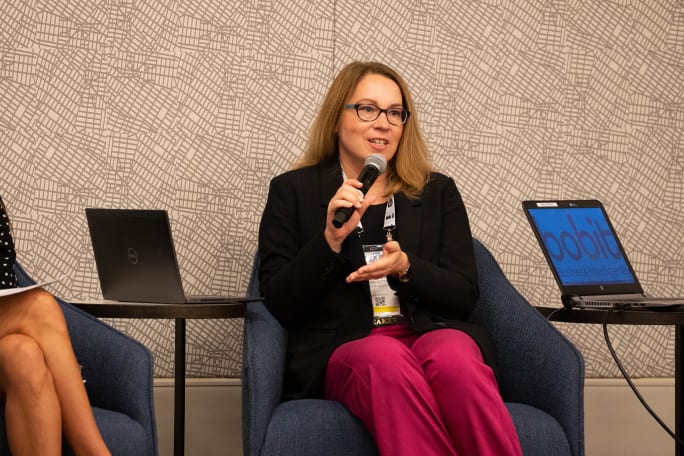
Alison Kerstetter speaks during a Women in Fleet panel at GFX.
Photo: Ross Stewart Photography
There are a lot of hurdles that still need to be overcome, such as the technology, acceptance, infrastructure changes, and regulations for this to be a successful option for fleets.
A development that deserves more attention is trying to get more people interested and trained in the automotive repair field. This is a common issue across all trades, but obviously, I have an obvious interest in the automotive area.
Encouraging young people to investigate trade schools to learn about the mechanical and electrical workings of vehicles. Electric vehicles are bringing an entirely new set of skills for people to learn. The military also has training that can be utilized to secure a job in the auto mechanic field.
People with these skills are in so much demand and will be in greater demand in the future. Discussing this option with young people and others who may want to start over in a career needs to be done more often.
GF: If you could send one piece of advice back to yourself on your first day managing a fleet, what would it be?
Kerstetter: Don’t feel like you must fix everything immediately. There are always opportunities that are found with the shops, staffing, and administration. It is best to work on one or two things at a time and come to completion prior to starting to review or change other items. When you try to work on a multitude of items, they don’t get fully completed, or they fall off your radar.
GF: What do you hope your legacy will be in the public fleet space?
Kerstetter: I hope people know that I made the workplace a better environment and safer space for staff to work within. I would like the fleet to be healthier by providing direction for right-sizing vehicles and the fleet, creating less complicated operations through standardization and more efficient processes, and supporting zero-emission technologies for healthier regional environments.
Subscribe to Our Newsletter
More Operations
Is Keeping Older Fleet Vehicles Really Saving Money?
Is keeping vehicles longer saving money, and what happens when a diagnostic test points to the wrong fix?
Read More →
How Smart Fleet Strategy Can Help Local Government Agencies Do More with Less
Keeping a vehicle longer may ease this year’s budget, but what does it cost the next one? A closer look at fleet decisions can reveal opportunities to reduce spending while protecting essential services.
Read More →
Connect with Government Fleet on LinkedIn
From industry news and fleet management strategies to conversations with peers, Government Fleet's LinkedIn page offers public-sector fleet professionals another way to stay informed and connected.
Read More →
Town of Queen Creek Named Most Successful Fleet Award Winner of Inaugural RTA Fleet Success Awards
Five fleets were honored at RTA Connect 2026 in Chicago for excellence across resource efficiency, intentional culture, risk management, and stakeholder satisfaction.
Read More →
Sponsored•October 14, 2026
A buyer's guide to fleet management software in 2027
Buying fleet management software in 2027 means looking beyond features and price. As fleet operations, technology and expectations evolve, this guide explores what today’s fleet professionals should consider when choosing a system that can deliver value now and adapt to what comes next.
Read More →
Hazard Alerts, Fleet Car Sales Rise and a New Shuttle Concept
Fleet car sales doubled, but the bigger picture tells a different story in this week’s roundup.
Read More →
How St. Johns County Turned Fleet Data Into Better Replacement Decisions
St. Johns County, Florida, had fleet data, but turning it into reliable decision guidance was another matter. Instead of starting over with a new fleet management system, the county connected existing tools and built a scoring system that gives managers an objective look at fleet health.
Read More →
Fleet Forward Conference Introduces One-Day Passes for 2026
New one-day registration lets fleet professionals attend Tuesday, Wednesday, or Thursday, with passes available for $249.
Read More →
ENC Unveils its ZAVIR Medium-Duty Shuttle
Two variants of the concept shuttles were revealed: a low-floor configuration and a high-floor configuration.
Read More →
Could Your Next Fleet Technician Start as an Intern?
What if your next technician hasn’t worked in a fleet shop yet? What fleets are doing to free up time.
Read More →