





Similar Content: Challenge and Change with Sioux Falls Fleet
A Fleet Manager's Retrospective on Fleet Evolution and Why the Right Team is Key
League City Fleet Manager Yvonne Calderon looks back on her journey as a fleet manager, the evolution of the industry, and what advice she would give to someone looking to pursue a similar career path.
February 9, 2023
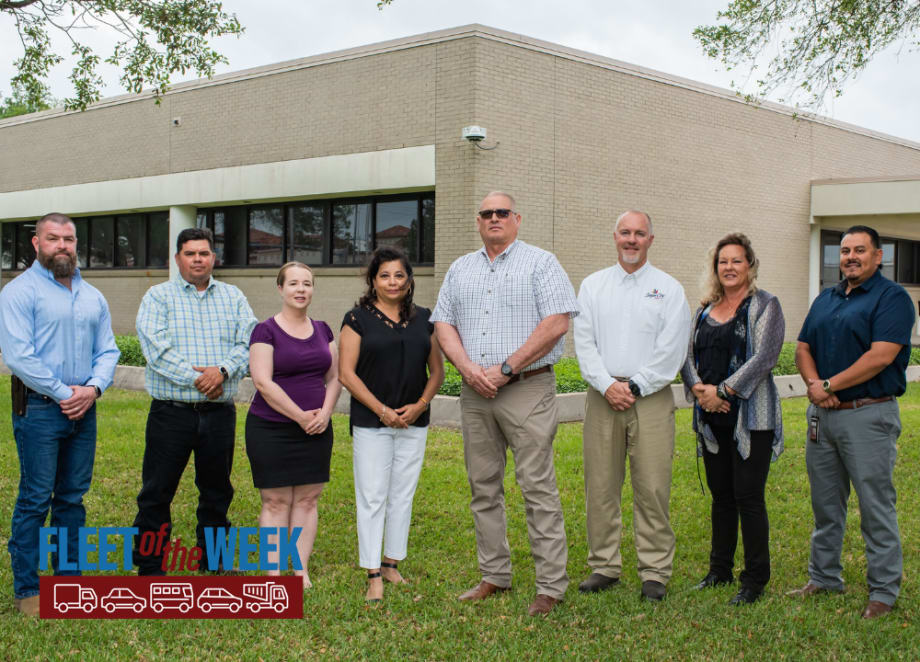
Yvonne Calderon (second from right), fleet manager for League City, with Public Works Director Jody Hooks (fourth from right) and department heads for Public Works.
Photo: City of League City
4 min to read
This is a part of Government Fleet's "Fleet of the Week" series where we will highlight a public sector fleet to talk about trends, challenges, and what's ahead.
If fleet is anything, it's a bit of everything—challenging, groundbreaking, frustrating, fulfilling; that list could go on depending on who you speak with. But it's nothing without its people who metaphorically, and literally, keep the fleet wheels well-oiled and turning. It's important to understand each fleet's unique position and where it is headed.
If you're headed to Texas, take the highway southeast out of Houston nearing the Gulf of Mexico and you'll come to the city of League City, Texas. Here, the city fleet is comprised of 370 vehicles, 198 pieces of equipment (classification includes trailers, generators, and heavy construction equipment), and one shop consisting of 10 bays.
There are 10 employees that make up this department: an administrative assistant; a shop foreman; a service writer and parts lead; and six technicians.
Rounding out the tenth role is Fleet Manager Yvonne Calderon, who is responsible for the vehicles and equipment in the city’s fleet.
Calderon began her career with the city of League City in April 1993 as an office manager for facilities maintenance and emergency management. Around 2005 she participated in a fleet audit of inventory where she found that she enjoyed the day-to-day operations. So when a fleet administrator position opened up in 2007, she put in a transfer request and started her journey in the fleet world.
In 2013, the fleet manager separated from the city and, after applying, Calderon was awarded the position of fleet manager.
Other than the growth of fleet, the biggest change Calderon has seen is the transfer of data to an integrated fleet management information system.
"For over 30 years the fleet was using an antiquated system that was not designed for fleet specifics," she explains. "The majority of repair orders, including preventive maintenance schedules, were handwritten and then entered into the system."
According to Calderon, FASTER was implemented in October 2021 and already fleet staff has seen an increase in productivity and metric tracking. And technicians now operate on tablets with real-time labor and parts calculated.
As for challenges, Calderon points to the supply chain.
"Since 2020, like the majority of the country, we have been having problems with supply chains, vehicles and equipment procurement, and delivery delays," she states, adding that budgeting has also been a big issue as pricing has increased across the board. "So it has been a challenge to anticipate fleet replacement costs and stay within budget."
Still, Calderon looks for those silver linings in challenging times. When asked what she sees as the most exciting thing happening at present, she states this: "The most exciting thing we are experiencing right now is when we see a vehicle ordered over a year ago actually show up."
Her advice for other fleets is to "enjoy what you do, don’t stress, and have fun." Calderon has a hardworking team, but she points out that they also know the importance of being able to laugh and enjoy each other’s company.
"With the challenges we’ve been facing it would be easy for me to stress and worry things aren’t moving fast enough, but I’ve learned to take a deep breath and realize I can only control things going on in my orbit and not the world," she notes.
As for the future, Calderon's time as fleet manager is coming to a close. She plans to retire in the first part of 2024, which means she is working on a succession plan with her team to allow for a smooth transition upon her departure.
"The fleet department has maintained a level of respect with all departments throughout the city," Calderon states. "Other employees realize we work as fast as we can within the limitations we face, such as manpower, parts availability, outsourcing schedules, etc."
By having transition plans in place and cross-training she feels confident there will be a smooth shift upon her departure. As an aside, she advises anyone else looking to enter this field to obtain certifications such as the CAFM or CAFS.
Looking back, Calderon remembers being apprehensive when she first applied for the fleet manager’s position as she was under the mindset that if she wasn’t a mechanic then she shouldn’t be running the office.
However, she learned that it wasn't so much about having a strong automotive background as it was about having the respect and backing of a knowledgeable staff able to communicate and handle the day-to-day technical workload. With that, she realized the position meant she had to support the team as a manager, purchasing agent, attorney, counselor, and financial wizard.
"I love working with such a great team and consider myself fortunate to have a stable and knowledgeable group with the majority having over 20 years in the fleet department," Calderon explains.
Now, with her own fleet experience built up over those years, Calderon can impart her own wisdom when it comes to the fleet world she's been a part of.
"If you enjoy a challenge and wearing multiple hats then don’t let the lack of automotive or heavy equipment knowledge stop you," she explains. "I have learned so much while being here."
If you'd like to have your fleet featured, email us at: nichole.osinski@bobit.com.
Subscribe to Our Newsletter
More Operations
Who Deserves Fleet Recognition and What Could You Teach at GFX?
Who helped shape your fleet career, and what have you learned that could help someone else?
Read More →
What’s Haunting Public Sector Fleets?
Public sector fleet challenges rarely happen in isolation, and addressing one often means understanding how it connects to another.
Read More →
Is Keeping Older Fleet Vehicles Really Saving Money?
Is keeping vehicles longer saving money, and what happens when a diagnostic test points to the wrong fix?
Read More →
How Smart Fleet Strategy Can Help Local Government Agencies Do More with Less
Keeping a vehicle longer may ease this year’s budget, but what does it cost the next one? A closer look at fleet decisions can reveal opportunities to reduce spending while protecting essential services.
Read More →
Connect with Government Fleet on LinkedIn
From industry news and fleet management strategies to conversations with peers, Government Fleet's LinkedIn page offers public-sector fleet professionals another way to stay informed and connected.
Read More →
Town of Queen Creek Named Most Successful Fleet Award Winner of Inaugural RTA Fleet Success Awards
Five fleets were honored at RTA Connect 2026 in Chicago for excellence across resource efficiency, intentional culture, risk management, and stakeholder satisfaction.
Read More →
Sponsored•October 14, 2026
A buyer's guide to fleet management software in 2027
Buying fleet management software in 2027 means looking beyond features and price. As fleet operations, technology and expectations evolve, this guide explores what today’s fleet professionals should consider when choosing a system that can deliver value now and adapt to what comes next.
Read More →
Hazard Alerts, Fleet Car Sales Rise and a New Shuttle Concept
Fleet car sales doubled, but the bigger picture tells a different story in this week’s roundup.
Read More →
How St. Johns County Turned Fleet Data Into Better Replacement Decisions
St. Johns County, Florida, had fleet data, but turning it into reliable decision guidance was another matter. Instead of starting over with a new fleet management system, the county connected existing tools and built a scoring system that gives managers an objective look at fleet health.
Read More →
Fleet Forward Conference Introduces One-Day Passes for 2026
New one-day registration lets fleet professionals attend Tuesday, Wednesday, or Thursday, with passes available for $249.
Read More →