




Denver’s Leading Fleet Rises Above the Rest
Director of Fleet Management Brad Salazar reflects on his 19 years with Denver’s Public Works Department and the honor of being named the No. 1 Leading Fleet for 2019.

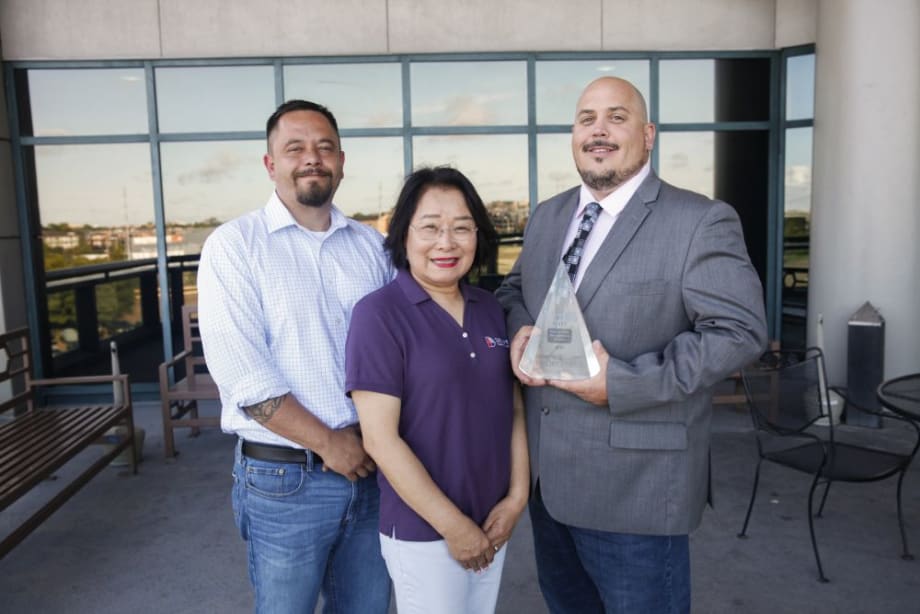
About This Award
The Leading Fleets award recognizes fleet operations that are performing well in leadership, staying efficient and competitive, overcoming challenges, and having a vision and direction for the operation. This year’s award is sponsored by Ford and Geotab.
Photo by Kim Pham
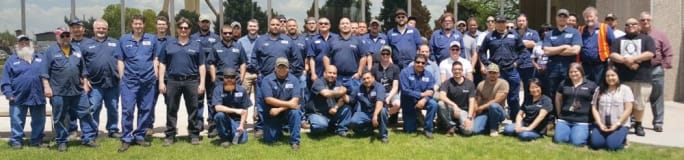
The Denver Department of Public Works fleet team manages more than 2,400 pieces of equipment.
Photo courtesy of Denver
On June 18, the Denver Department of Public Works’ fleet management division was named the nation’s No. 1 Leading Fleet in a special ceremony at the Government Fleet Expo and Conference in New Orleans. On hand was Brad Salazar, director of fleet management, and two team members.
Not having prepared a speech, Salazar said they were walking offstage when he heard “Speech! Speech!” from the crowd. So he returned to the podium.
“I accept this award on behalf of the amazing team that we have, from the technicians to the supervisors and managers, everybody in Public Works, and all our customers,” he said.
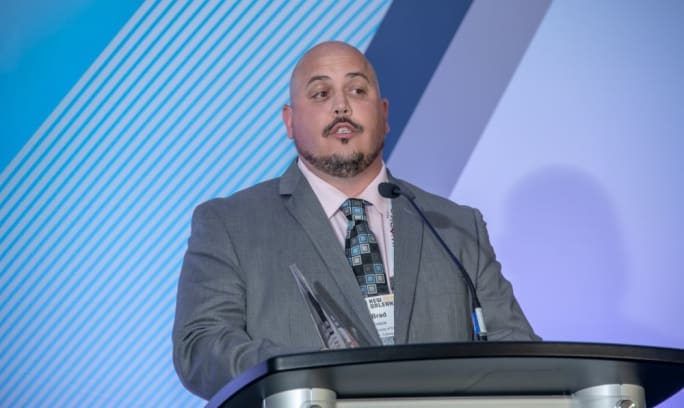
Director of Fleet Management Brad Salazar has been with the Denver fleet for 19 years.
Photo by Yvette Ponthier
Engagement and Retention
Salazar has been with Denver’s Public Works department for 19 years. He started as a fleet technician and worked his way into the management and executive ranks. He was named fleet director in December 2018.
Denver earned Leading Fleet status based partly on a number of forward-looking initiatives. Salazar refuses to take much credit, noting many were past launch before he took over and some came down from the office of Mayor Michael Hancock and Public Works Director Eulois Cleckley. He also points to previous Fleet Director Todd Richardson and Fleet Manager Gary Bales, who served as interim director before Salazar’s appointment.
“I want to give Gary a shoutout. I fortunately did step into a good environment and culture,” Salazar said. “But some of it has been the mayor’s initiatives, such as vehicle electrification, which is coming along. Within the last eight years, we have progressed because of initiatives on electrification and infrastructure, as well as a big push for employee engagement.”
Salazar manages a fleet of more than 2,400 pieces of equipment with an operating budget of more than $16 million. Much of it is spent on the usual expenses — plus investments in new technology, such as telematics and diagnostic software — but a good chunk of it is invested in building a culture focused on personal and career enrichment and, in turn, workforce retention.
In his fleet’s award application, Salazar described a multifaceted approach to professional development, including recognition, performance management, and safety.
“We provide a trustworthy and safe work environment, with competitive pay, and technicians participate in a minimum of three trainings per year,” the application stated. “We also implement and leverage an Innovation & Resolution Committee, resulting in better hearing protection and winter wear, safety training, a three-step increase in technician pay, an ASE [certification] stipend, and a paid meal during snow duty.”
These strategies have helped raise Denver’s fleet availability rate to 95% and lower its technician vacancy rate to 8%. The repair ratio is 61% scheduled to 39% unscheduled. Random inspections are performed on completed repairs to ensure high-quality work across the board.
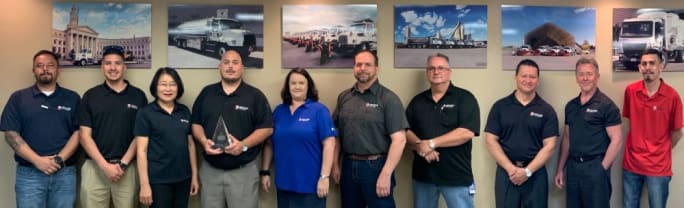
The fleet management team consists of (l-r): Robert Green, Donnie Cruz, Young-Hee Lewis, Brad Salazar, Denise Pitts, John Essex, Bill Zollo, Mauricio Medrano, Gary Bales, and Randy Romero.
Photo courtesy of Denver
Public Works’ own body shop offers comparable rates to the private sector and has saved around 27% in customer repair costs while maintaining fast turnaround times, Salazar said. He also noted that the fleet saved taxpayers $2 million annually by locking in its fuel prices to avoid price hikes.
Of course, as it is for fleets both public and private, successfully recruiting, onboarding, and retaining service technicians remains a challenge. Salazar teamed up with the city’s Human Resources staff to broker meetings with three vocational schools in the area. There, they shared recommendations for a curriculum that would better help meet industry needs.
As a result, one school actually shortened its two-year program to one year, accelerating graduates’ entry into the workforce; the fleet has already hired three students.
The fleet also partnered with outside experts to develop new tests for all incoming candidates — which current technicians are challenged to take and pass as well. The new tests provide “clear and concise instructions, [and] defined scoring guidelines, and set the expectation for candidates and evaluators,” Salazar wrote in the application, noting further enticements such as a $1,500 signing bonus (dependent upon a two-year commitment) and a mentorship program.
Today, 68% of the fleet’s technicians have ASE or comparable certifications, Salazar said, and only two have left the payroll since the new incentives have been in place.
Award-Winning Passion
Salazar said his fleet has worked hard to connect and interact with Denver’s citizenry. Last year, the Denver Day Works program sent six individuals who had experienced homelessness to Public Works, doing low- to no-barrier-level work for a daily wage, meals, and public transit, as well as a meeting with a supervisor.
“Our leadership activities are centered on making a difference for citizens,” the fleet operation noted in its application. “[Denver Day Works] is not only an opportunity for fleet to engage directly with the community, but offers valuable knowledge and the prospect of employment. We are also actively involved in industry events such as FleetPros, American Public Works Association, Government Fleet Expo, NAFA, Waste Expo, and Clean Cities. We actively participate in Smart City planning, leveraging technology and process innovation to improve citizens’ quality of life.”
For all his fleet’s accomplishments, and despite being named the No. 2 Leading Fleet a year earlier, Salazar said his expectations were tempered heading into the awards ceremony.
“They go up onstage and start naming off top 21 to 50. Then from 20 down, they start handing out certificates, then plaques, and then the main awards…The excitement was building. We got into the top five, then the top four, then three, and I was thinking, ‘They haven’t called our name yet. We were No. 2 last year. We can’t be No. 2 again.’ Then they called the final one up, and it was Denver.”
After he “rambled on,” in his words, for a few moments, Salazar returned to Denver’s table and took a photo of the award. He sent the photo to a small group, including the CFO of Public Works, who forwarded it to the entire fleet. Within minutes, the word was out citywide.
Having secured the No. 1 designation for the fleet, Salazar has plans for the future. He said he is focused on a “greener tomorrow” in accordance with a citywide sustainability plan. He and his team are working to minimize fleet-related environmental impacts, making the addition of alternative-fuel vehicles a priority.
His shared goal with the City and County of Denver is to reduce greenhouse gas emissions 80% by 2050 with the use of telematics and upgraded electric vehicle charging infrastructure. The addition of 119 electric vehicles will be supported by 28 new Level 2 charging stations. Telematics-powered route optimization has helped reduce fleet CO2 emissions by 2.7% per year on a miles-traveled basis. The shop has saved an estimated 76,000 quarts of motor oil by using onsite testing to extend drain intervals for heavy-duty vehicles.
The common thread? Big projects, planned carefully and executed with purpose, Salazar said.
“We’ve come a long way, particularly within the last eight years,” he said. “We’re using data to drive decisions. We’re getting heavy on telematics, using dashboards. And it shows. Everybody can see it as soon as they walk into any of our locations.”
More Operations

Is Keeping Older Fleet Vehicles Really Saving Money?
Is keeping vehicles longer saving money, and what happens when a diagnostic test points to the wrong fix?
Read More →
How Smart Fleet Strategy Can Help Local Government Agencies Do More with Less
Keeping a vehicle longer may ease this year’s budget, but what does it cost the next one? A closer look at fleet decisions can reveal opportunities to reduce spending while protecting essential services.
Read More →
Connect with Government Fleet on LinkedIn
From industry news and fleet management strategies to conversations with peers, Government Fleet's LinkedIn page offers public-sector fleet professionals another way to stay informed and connected.
Read More →
Town of Queen Creek Named Most Successful Fleet Award Winner of Inaugural RTA Fleet Success Awards
Five fleets were honored at RTA Connect 2026 in Chicago for excellence across resource efficiency, intentional culture, risk management, and stakeholder satisfaction.
Read More →
A buyer's guide to fleet management software in 2027
Buying fleet management software in 2027 means looking beyond features and price. As fleet operations, technology and expectations evolve, this guide explores what today’s fleet professionals should consider when choosing a system that can deliver value now and adapt to what comes next.
Read More →
Hazard Alerts, Fleet Car Sales Rise and a New Shuttle Concept
Fleet car sales doubled, but the bigger picture tells a different story in this week’s roundup.
Read More →
How St. Johns County Turned Fleet Data Into Better Replacement Decisions
St. Johns County, Florida, had fleet data, but turning it into reliable decision guidance was another matter. Instead of starting over with a new fleet management system, the county connected existing tools and built a scoring system that gives managers an objective look at fleet health.
Read More →
Fleet Forward Conference Introduces One-Day Passes for 2026
New one-day registration lets fleet professionals attend Tuesday, Wednesday, or Thursday, with passes available for $249.
Read More →
ENC Unveils its ZAVIR Medium-Duty Shuttle
Two variants of the concept shuttles were revealed: a low-floor configuration and a high-floor configuration.
Read More →
Could Your Next Fleet Technician Start as an Intern?
What if your next technician hasn’t worked in a fleet shop yet? What fleets are doing to free up time.
Read More →