




Calculating Mechanic Staffing Requirements
Public sector fleet managers often struggle with determining appropriate mechanic staffing levels. Quantifying labor demand and supply and accounting for individual fleet operations can provide the answers.
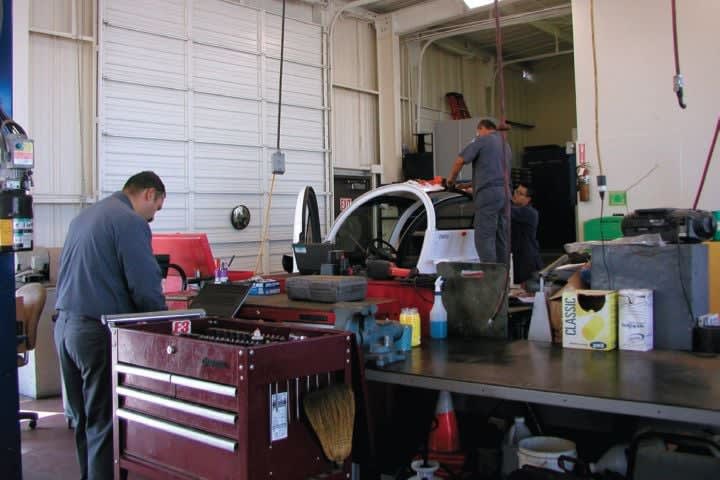
fleet managers have reported staffing levels at their shop have been the same for years and none can recall how the staff size was originally determined.
Photo: Mercury Associates Inc.
How to reasonably assess mechanic staffing in a public sector garage is an often-posed question among government agency fleet managers. Many government organizations do not have a methodology to determine how many mechanics are required to maintain their fleet. Rather, fleet managers have reported staffing levels at their shop have been the same for years and none can recall how the staff size was originally determined.
As a consequence, fleet managers have difficulty defending themselves against a newly elected administration who suggest shop staffing is bloated and should be downsized.
To calculate mechanic staffing requirements, the following data and information are needed:
The average number of labor hours each type of asset in the fleet consumes (i.e., labor demand).
The average number of wrench-turning labor hours each mechanic on staff can produce (i.e., labor supply).
Details about the fleet and fleet maintenance practices that can fundamentally impact the data analysis and calculations.
When fleet managers talk to their boss, elected officials, budget and finance directors, or city managers about mechanic staffing requirements for their shops, it is much better to be armed with calculations resulting from a coherent quantitative methodology than relying on anecdotes and stories. After all, talk is cheap and the “trust me” days of fleet management ended many years ago.
Determining Labor Demand
The historical demand for labor can be determined by reviewing the previous few years of maintenance records. Assuming recordkeeping practices are sound, the fleet manager can determine the average number of labor hours each type of vehicle and piece of equipment has historically consumed, then multiply the result by the number of assets in each class.
For example, if historical labor hours for a class of 10 dump trucks were 400 per year, the average labor demand per year for each vehicle in this class is 40. Repeating this process for each class and type of vehicle yields the total average annual labor demand for the fleet.
A major issue that must be confronted at this point is if historical averages are reasonable, i.e., have mechanics been efficient in the past? This question can be answered by sampling repair task times against industry labor guides (ALLDATA or Mitchell On-Demand) and/or internally established time standards. If past efficiency performance is close to industry standards, a fleet manager can be confident the fleet’s historical labor data accurately reflects labor demand.
Vehicle Equipment Units
Another method of determining labor demand is using a technique known as Vehicle Equivalent Unit (VEU) Analysis. This technique establishes a relative measure that allows evaluating and comparing staffing needs between fleets of dissimilar composition.
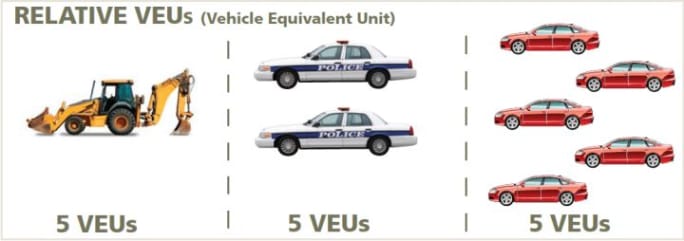
The methodology is used to equate the level of effort required to maintain dissimilar types of vehicles to a passenger car, which is given a baseline VEU (sometimes called a “maintenance repair unit” or “MRU”) of 1.0. The below graph illustrates how this technique works, reflecting VEU values based on Mercury Associates’ experience with hundreds of fleets across North America.
A fleet of one hundred patrol cars, rated at 2.5 VEUs each, constitutes a fleet of 250 VEUs. The number of mechanics/technicians required to maintain this sample fleet is more than a fleet of 100 sedans, but far less than a fleet of 100 dump trucks.
Data from hundreds of fleet organizations has demonstrated a VEU of 1.0 is normally equal to between 10 and 15 annual maintenance labor hours, depending upon a number of factors unique to each organization. In extreme cases, these values can be significantly lower (such as with a brand new fleet) or materially higher (due to fleet age, high use, or challenging operating conditions).
fleet managers have reported staffing levels at their shop have been the same for years and none can recall how the staff size was originally determined.
Photo: Mercury Associates Inc.
Labor Supply = Productivity
Once the labor demand is quantified, the number of productive hours available to service the fleet must be determined. This process involves calculating the number of annual hours available to mechanics to devote to wrench-turning activities.
While mechanics are typically paid for 2,080 hours per year, exclusive of overtime (52 weeks x 40 hours per week), they are clearly not available to work on vehicles this number of hours. Holidays, vacation, sick days — as well as other leave time — must be deducted to arrive at the number of hours a mechanic is actually at work and available for productive work. Then, additional hours must be deducted to account for time a mechanic is at work, but occupied with activities other than turning wrenches such as meetings, training, shop cleanup, etc.
The result of this calculation for all mechanics is the number of productive hours a fleet has available. While a 70-percent of payroll hours (i.e., 1,456 hours per year) measure is a commonly used benchmark, each organization should calculate its actual performance based on detailed time-keeping records.
Fleet organizations with liberal leave policies and a senior staff clearly will have a lower number of available labor hours. Additionally, organizations that do not actively manage labor reporting tend to “lose” hours during the year. This lack of reporting has consequences for both the accuracy of historical repair records and for cost recovery when a charge-back system is in place.
Calculating Mechanic Staffing Requirements
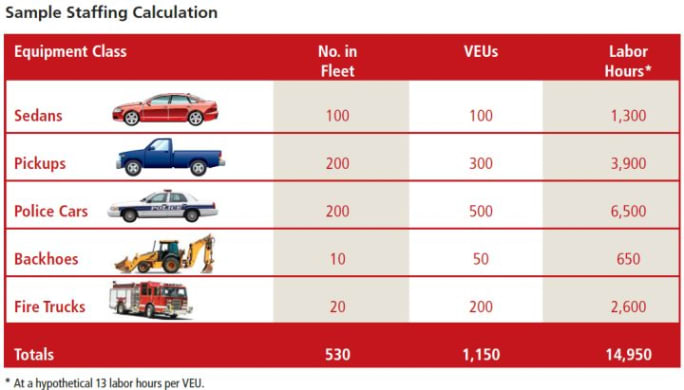
Once the demand and supply of labor is known, mechanic staffing requirements can be calculated. The table below provides an example calculation.
In this example, the labor demand is 10.3 mechanics (14,950 total annual demand for labor hours divided by 1,456 average labor hours available per mechanic.) Labor supply is 10. The difference clearly would be best met through additional outsourcing or overtime rather than hiring another mechanic. Staffing to the peaks rather than valleys in the workload demand is never a good idea.
Note if productive hours were 1,300 hours rather than 1,456, the number of mechanics required for this fleet jumps from 10.3 to 11.5.
Once the demand and supply of labor is known, mechanic staffing requirements can be calculated.
Photo: Mercury Associates Inc.
Factors Impact Calculations
Several factors impact the calculations of labor demand and supply. On the demand side, outsourcing practices are probably the most important factor. Fleets with large geographic service territories, such as state governments, tend to outsource a large percentage of their repair work — 100 percent in some cases. Conversely, some city and county fleet organizations perform nearly all services in-house. This factor clearly must be considered when assessing how many mechanics an organization needs.
Fleet age is another important factor. An old fleet obviously requires more labor to keep in service than a brand new one. Benchmarking fleet age is complicated because fleet composition must be considered. However, the average fleet age for a typical government fleet of mixed vehicle types should range from three to five years. Public Works fleets with a concentration of trucks and construction equipment clearly would be higher in age, while law enforcement fleets typically would be lower.
Other elements that impact labor demand include usage levels, operating environment, and fleet assignment practices (i.e. shared use or take-home vehicles).
On the supply side — in addition to the available productive hours factors already discussed — factors to consider include mechanic training and skill levels, maintenance management practices, work rules (dictated, for example, by collective bargaining agreements), parts provisioning practices, and shop considerations (e.g., facility location, size, layout, condition, equipment, and tooling).
About the Author: Randy Owen is senior vice president of Mercury Associates Inc., headquartered in Gaithersburg, Md.
More Operations

Is Keeping Older Fleet Vehicles Really Saving Money?
Is keeping vehicles longer saving money, and what happens when a diagnostic test points to the wrong fix?
Read More →
How Smart Fleet Strategy Can Help Local Government Agencies Do More with Less
Keeping a vehicle longer may ease this year’s budget, but what does it cost the next one? A closer look at fleet decisions can reveal opportunities to reduce spending while protecting essential services.
Read More →
Connect with Government Fleet on LinkedIn
From industry news and fleet management strategies to conversations with peers, Government Fleet's LinkedIn page offers public-sector fleet professionals another way to stay informed and connected.
Read More →
Town of Queen Creek Named Most Successful Fleet Award Winner of Inaugural RTA Fleet Success Awards
Five fleets were honored at RTA Connect 2026 in Chicago for excellence across resource efficiency, intentional culture, risk management, and stakeholder satisfaction.
Read More →
A buyer's guide to fleet management software in 2027
Buying fleet management software in 2027 means looking beyond features and price. As fleet operations, technology and expectations evolve, this guide explores what today’s fleet professionals should consider when choosing a system that can deliver value now and adapt to what comes next.
Read More →
Hazard Alerts, Fleet Car Sales Rise and a New Shuttle Concept
Fleet car sales doubled, but the bigger picture tells a different story in this week’s roundup.
Read More →
How St. Johns County Turned Fleet Data Into Better Replacement Decisions
St. Johns County, Florida, had fleet data, but turning it into reliable decision guidance was another matter. Instead of starting over with a new fleet management system, the county connected existing tools and built a scoring system that gives managers an objective look at fleet health.
Read More →
Fleet Forward Conference Introduces One-Day Passes for 2026
New one-day registration lets fleet professionals attend Tuesday, Wednesday, or Thursday, with passes available for $249.
Read More →
ENC Unveils its ZAVIR Medium-Duty Shuttle
Two variants of the concept shuttles were revealed: a low-floor configuration and a high-floor configuration.
Read More →
Could Your Next Fleet Technician Start as an Intern?
What if your next technician hasn’t worked in a fleet shop yet? What fleets are doing to free up time.
Read More →