





2026 Public Fleet Hall of Fame Nominations are OPEN!
Electrifying Progress and Building Community: Joseph Mattox's Road to the Public Fleet Hall of Fame
Driven by Community and Sustainability: Mattox’s Approach to Modernizing Municipal Fleet Operations
February 25, 2026

5 min to read
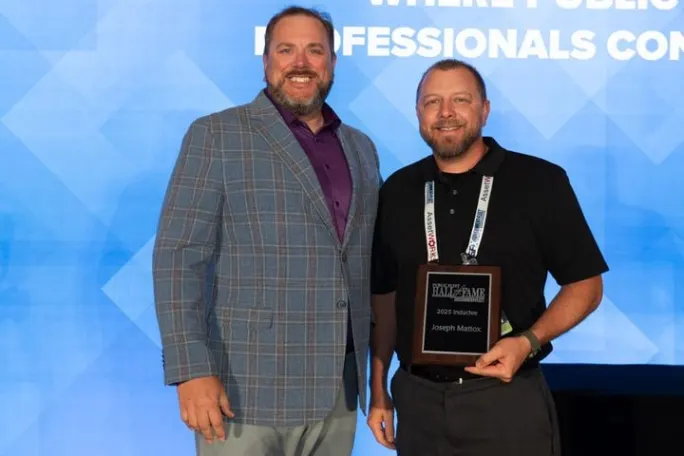
Joseph Mattox, Fleet & Facilities Maintenance Division Manager, Public Works, City of Moreno Valley, California, with Sourcewell's Andy Campbell.
Credit: Ross Stewart Photography
“I am truly honored to be inducted into the Government Fleet Public Fleet Hall of Fame. This recognition means a great deal to me, and I’m truly grateful for the support of my team and the City of Moreno Valley,” was the answer when we asked Joseph Mattox, Fleet & Facilities Maintenance Division Manager for the City of Moreno Valley, what being in the Public Fleet Hall of Fame means to him.
Having graduated from high school in the City of Moreno and now raising his own family there, Mattox is particularly connected with the community he serves.
We reached out to Mattox to learn more about how he made it into the Public Fleet Hall of Fame.
Leading in a Complex Regulatory Environment
Moreno Valley operates in a uniquely demanding landscape. The city is the second largest in Riverside County, the second largest county in California, and is within the South Coast Air Quality Management District.
Mattox and his team look at these characteristics as opportunities.
“Moreno Valley has emerged as a regional leader in Fleet Electrification, with 26% of our active on-road fleet fully ZEV,” he explained. “Our EVolution Moreno Valley initiative has received national recognition, and we have been excited to share our strategies with other agencies facing similar challenges.”
The city’s Evolution Moreno Valley initiative prioritizes electrification by investing in clean technologies that support sustainable fleet operations.
For Mattox, electrification is more than compliance; it is community improvement, long-term sustainability, and proactive planning.
His open-minded approach ensures the city can meet environmental mandates without sacrificing operational performance.
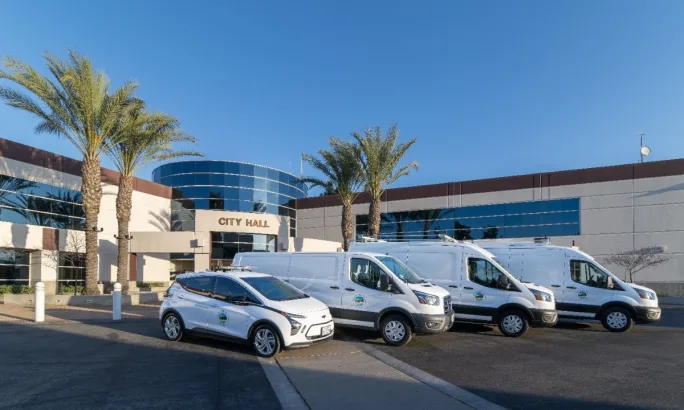
The fleet at City Hall in Moreno Valley.
Credit: City of Moreno
Success in Service
In Moreno Valley, success is measured by how consistently services are provided to residents.
“Success for us is measured by service delivery,” Mattox said. “The true cost of a vehicle down is not the repair costs, but the impacts to the services that the vehicle was assigned to.”
Mattox uses this belief to guide his management priorities and to keep service efficiency a core component of municipal service. Public works, safety operations, and community programs depend on vehicles and equipment functioning as expected. When the fleet performs well, the community experiences seamless city services.
This service-first mindset influences everything from preventive maintenance to capital planning, ensuring that fleet strategy always aligns with the city’s broader mission.
Innovation Beyond the Computer
Like many public agencies, the City of Moreno has faced its share of challenges amid changing economic conditions.
“The 2008 recession led to severe and lasting impacts on our fleet budget. This eventually caused us to create what we consider the three pillars of our fleet operations, which are the Fleet Lease Program, the Fleet Replacement Program, and the Preventive Maintenance Program. It literally caused us to change the way we do business to ensure the impacts never happen again,” he explained.
The Fleet Lease Program has become a cornerstone of Moreno Valley’s financial resilience. Lease fees are structured to cover anticipated maintenance, replacement, and even inflationary costs over an asset’s lifecycle. This ensures replacement funding is available when needed, eases the budget burden on individual departments, and maintains life-cycle discipline across the fleet.
This initiative also aligns with Mattox’s community-centered leadership, enabling local providers to offer financing and further engage the community system.
By embedding long-term funding into the program structure, Mattox has helped shield the fleet from the boom-and-bust cycles that can derail capital planning.
Developing Future Leaders
For Mattox, excellent fleet leadership begins with one word: passion.
“I think when you are passionate about what you do, that energy is felt by the team and encourages everyone to deliver their best,” he said.
That passion translates into a deliberate approach to developing future leaders inside the shop. Effective communication, including the reasoning behind decisions, is central to his strategy. He is intentional about explaining broader strategies and ensuring staff understand how information prepares them for career growth.
Equally important is trust. Mattox emphasizes creating an environment where employees feel comfortable asking questions, taking responsibility, and even taking calculated risks. By fostering both clarity and confidence, he builds not just skilled technicians but future supervisors and managers.

Moreno Valley embraces sustainability by implementing initiatives like solar panels for the charging infrastructure.
Credit: City of Moreno
Embracing Technology
While Mattox acknowledges that municipal fleets face a variety of challenges, including regulatory compliance and even severe weather, he sees technology as continually impacting his fleet.
“For us, I anticipate battery technology will continue to make a huge impact on the types of vehicles, especially vocational vehicles, that we can deploy while ensuring the highest service levels are achieved. Secondly, A.I. technology will continue to transform our asset management systems, from data collection to routing. We seem to find new uses daily!” he said.
His team’s resilience has been tested in crisis situations. Beyond the recession, a severe storm response pushed available equipment to its limits. Through after-action analysis with management, police, fire, and emergency management partners, the city implemented new redundancies and strategies to strengthen preparedness.
These experiences reinforced a culture of proactive planning, not just reacting to events, but learning from them and institutionalizing improvements.
Consistent Communications
The City of Moreno has taken a proactive approach to how they keep in contact with its community.
Through strong partnerships with the city’s media team and support from elected officials, the division actively engages residents through events, showcases, and even behind-the-scenes tours of the Corporate Yard, where they can see the vehicles and equipment that power city services.
This transparency fosters a strong connection between the city and its residents and deepens public understanding of how the city works.
A Personal Commitment
Mattox’s personal connection to the City of Moreno inspires his leadership and underscores why his Hall of Fame induction resonates beyond individual accomplishment.
It celebrates a career defined by innovation, fiscal responsibility, environmental leadership, and community service.
Through electrification initiatives, resilient funding models, and a people-first culture, Joseph Mattox has demonstrated what it means to lead a modern municipal fleet.
Subscribe to Our Newsletter
More Operations

How St. Johns County Turned Fleet Data Into Better Replacement Decisions
St. Johns County, Florida, had fleet data, but turning it into reliable decision guidance was another matter. Instead of starting over with a new fleet management system, the county connected existing tools and built a scoring system that gives managers an objective look at fleet health.
Read More →
Fleet Forward Conference Introduces One-Day Passes for 2026
New one-day registration lets fleet professionals attend Tuesday, Wednesday, or Thursday, with passes available for $249.
Read More →
ENC Unveils its ZAVIR Medium-Duty Shuttle
Two variants of the concept shuttles were revealed: a low-floor configuration and a high-floor configuration.
Read More →
Could Your Next Fleet Technician Start as an Intern?
What if your next technician hasn’t worked in a fleet shop yet? What fleets are doing to free up time.
Read More →
How Phoenix Is Building Its Next Generation of Fleet Technicians
With more than 8,000 vehicles and pieces of equipment to maintain, the City of Phoenix could not afford to wait for fully trained technicians to walk through the door. Instead, they revamped their entire workforce strategy and showed how public fleets can create their own talent pipeline while preparing existing employees for increasingly complex vehicles.
Read More →
What’s Slowing Your Fleet Down?
Could a change in how work gets done help your fleet return vehicles to service sooner?
Read More →
Can Public Fleets Trust the Data Driving Their Decisions?
Public fleets have more data than ever, but inconsistent records and missing information can still undermine maintenance, replacement, and cost decisions.
Read More →
John Deere Introduces 40 P-Tier Compact Excavator
John Deere is adding a compact excavator designed for crews that need to move equipment between jobsites and handle multiple types of work with one machine. The 40 P-Tier weighs less than 10,000 pounds and offers configurable hydraulics, attachment options, and connected fleet-management capabilities.
Read More →
How Leading Fleets Improve and Why Business Plans Matter
This week, we look at what past Leading Fleet winners can teach us about making progress, plus how to build a business plan your fleet will actually use.
Read More →
Nominate a Fleet Leader for the 2027 Public Fleet Hall of Fame
Do you know a fleet leader who has made a lasting impact on the industry? Nominate this fleet professional for the 2027 Public Fleet Hall of Fame.
Read More →