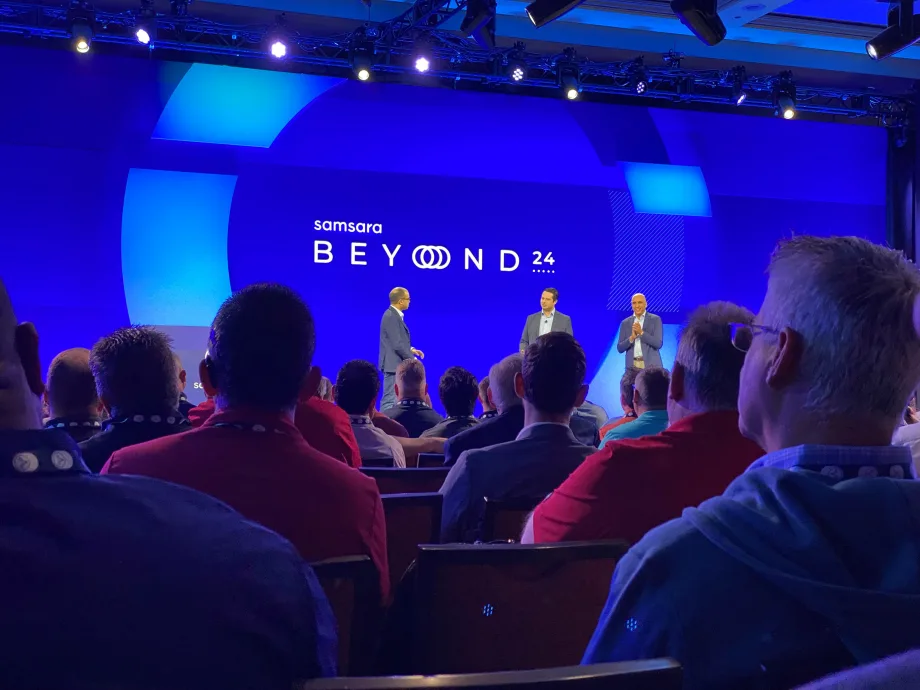
Samsara CEO and Co-Founder Sanjit Biswas speaks with two international Samsara customers.
Photo: Government Fleet
4 min to read
At this year’s Samsara Beyond event, the conversation centered on data's potential and the insights it can provide to enhance safety in the fleet world. Industry experts discussed a variety of topics, from the latest AI-driven safety features to the integration of IoT technologies.
Highlights included Samsara’s efforts in drowsiness detection, lane departure warnings, and collision warning systems. The company has also been focused on partnerships with major companies like DHL and new innovations in smart trailer solutions and electric vehicles. One key focus throughout the conference was how data can enhance asset visibility and tracking across different industries.
Ad Loading...
The Need for Data-Driven Safety Initiatives Among Fleets
With the announcement of various technologies, such as the Samsara Asset Tag, the focus was on using data to improve driver safety and reduce accidents. Samsara's platform, which processed around 60 billion miles driven in the past year also reported 75 billion API calls, which translates to data.
“The number of data points is up to 9 trillion a year. That's a staggering amount of data that we can use to compute and find results,” said Samsara CEO and Co-Founder Sanjit Biswas, adding, “So when we look, we can start to see patterns like, who are the top drivers, to really understand risk at a deep level.”
One example used was DHL’s deployment of Samsara dash cams which led to a 26% reduction in accidents and a 49% decrease in driver turnover. Recognizing and addressing drivers' safety needs proved critical in achieving these results. New AI-driven features such as drowsiness detection, lane departure warning, and forward collision warning provide real-time alerts to drivers, helping to prevent accidents before they occur.
Technological Innovations and Sustainability Are on the Rise
Samsara’s smart trailer solutions and electric vehicle integration were major topics during Beyond 24. Speaking to the audience, Biswas acknowledged that many professionals are looking at upcoming emissions regulations and sustainability targets and trying to understand what they mean for their fleets.
Addressing the anxiety around charging EVs at scale and how to get enough electrical capacity, Biswas explained how Samsara added a new feature, Charge Insights, to their telematics solution to help solve this problem.
Ad Loading...
The feature allows visibility of charging activities across the operation to create charging schedules for each vehicle to spread out charging activities throughout the day. The objective is to minimize the peak load on charging infrastructure and compare planned versus actual charging activities.
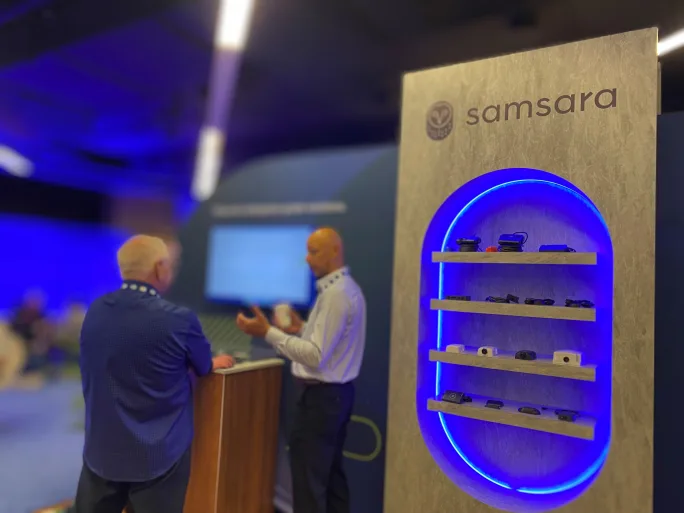
New technology is changing the way fleets operate, from tracking assets to monitoring unit usage.
Photo: Government Fleet
A Global Perspective on Electrification
Otto Car CEO Gurinder Dhillon discussed their move towards electric vehicles, highlighting a project to transition 4,000 vehicles from petrol to electric to reduce carbon emissions. Autocar’s electric vehicles are not only reducing carbon emissions but also improving driver efficiency. The company has also been using Samsara’s data for battery degradation and monitoring to see driving patterns and the effects of harsh acceleration and harsh braking.
Addressing Challenges with Asset Tracking
As anyone in fleet knows, due to the amount of assets within an operation, keeping eyes on every piece of equipment is a must. And not every security system put in place is foolproof. Tracking and monitoring equipment can be a useful way to know when everything is in its place, and when it’s not. Samsara’s Asset Tag device, designed to communicate over Bluetooth, was an indication of where security is headed for fleets.
Vice President Hardware Engineering at Samsara David Gal said the company has heard several pain points that are specifically related to smaller assets.
“These assets are really good as product legs, like any asset, but it seems like the smaller the asset, the more powerful legs,” he said. “And what we've heard from our customers is that there's a lot of money spent on repurchasing tools; 30%, for many of you, annually purchasing.”
Ad Loading...
Gal said one customer had even reported repurchases of tens of millions of dollars every single year on these smaller, mission-critical assets.
“The other aspect is when you don't have that tool looking for it because you don't have that visibility,” Gal said. “And so we have seen statistics, we've talked to customers and have first first-party data that shows that workers are wasting tons of time to try to find the thing they need.”
Catching the Wave of Fleet Advancement in the Public Sector
Operators within the public sector are increasingly broadening their telematics objectives beyond initial implementations to encompass compliance, fuel efficiency, and operational optimization. But for next steps, it’s important to look at the pivotal role of comprehensive fleet management in monitoring all aspects of the fleet.
Fleets should know their goals and start working toward those. As is the case for many fleets at the moment, this usually encompasses the transition to EVs. The recommendation? Start with the infrastructure first.
A starting point could look like this: One electric vehicle and then one charger, and then maybe two electric vehicles and two chargers, and so on.
Ad Loading...
Remember to get the basics down first. Know the cost and if there is enough power for the utility to charge all the vehicles; plan out the routes that will be taken. It’s not an overnight process but, like most advancements in fleet, with the right tools and resources those fleet goals can be met.
Keeping a vehicle longer may ease this year’s budget, but what does it cost the next one? A closer look at fleet decisions can reveal opportunities to reduce spending while protecting essential services.
From industry news and fleet management strategies to conversations with peers, Government Fleet's LinkedIn page offers public-sector fleet professionals another way to stay informed and connected.
Five fleets were honored at RTA Connect 2026 in Chicago for excellence across resource efficiency, intentional culture, risk management, and stakeholder satisfaction.
Buying fleet management software in 2027 means looking beyond features and price. As fleet operations, technology and expectations evolve, this guide explores what today’s fleet professionals should consider when choosing a system that can deliver value now and adapt to what comes next.
St. Johns County, Florida, had fleet data, but turning it into reliable decision guidance was another matter. Instead of starting over with a new fleet management system, the county connected existing tools and built a scoring system that gives managers an objective look at fleet health.