




Ill. City Moves Out of ‘Prehistoric’ Garages
The City of Springfield, Ill., has moved into a $1.2 million consolidated fleet facility that replaced five separate, older maintenance repair shops to improve operational efficiency.
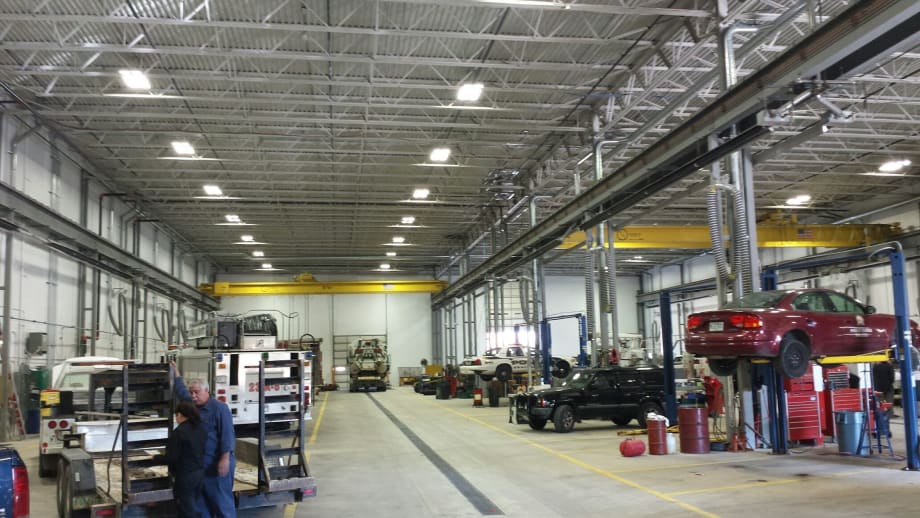
The new consolidated fleet facility has 20 bays. Photo courtesy of city of Springfield.
The new consolidated fleet facility has 20 bays. Photo courtesy of city of Springfield.
The City of Springfield, Ill., has moved into a $1.2 million consolidated fleet facility, which replaced five separate, older maintenance repair shops, to improve operational efficiency.
The city ugraded a building that was once used by a concrete wall manufacturer and configured it for fleet use. The structure measures 30,000 square feet and includes 20 bays.
“We will now take care of all the city fleet maintenance needs,” said William McCarty, director of the Office of Budget and Management (OBM) that houses the fleet division.
The facility represents much more than just physically moving maintenance shops, McCarty said. The new fleet department under fleet manager Mike Palazzolo represents a consolidation of four independent maintenance operations of four departments. Employees from these departments, who previously belonged in four different unions, will become employees of OBM within one union.
The cost of the facility and fleet consolidation effort is approximately $1.6 million. The facility came with two 10-ton overhead cranes that cover the entire length and width of the shop floor. Staff, working in two shifts, will maintain about 900 pieces of rolling stock and about 200 other items.
The facility is a major upgrade from the old buildings, McCarty said. Public works and fire didn’t have lifts, and technicians used jacks or drove vehicles onto wooden blocks to work on them. Some shops didn’t have designated bays or any lines marking work areas — instead, vehicles were parked wherever there was space, and that was where technicians would work on them. Ceilings on public works maintenance facilities were so low, technicians sometimes had to work on vehicles outside because they couldn’t lift them very high.
“We took prehistoric operations and modernized them,” McCarty said. “One of our fire mechanics told me he’s been working on fire trucks for over 20 years. He said it’s the first time he walked under [a fire truck on a lift].”
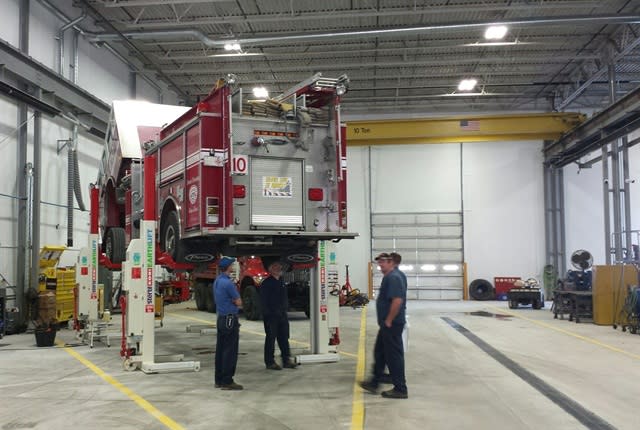
Previously, fire department technicians didn't have vehicle lifts. Photo courtesy of city of Springfield.
In May 2011, when the consolidation effort began, there were 47 people associated with fleet maintenance, McCarty said. As of this month, there are 32 positions, and McCarty expects this fall into the 20s within a few years.
“We are saving the city more than $1 million in costs versus the operational matrix that was in place in 2011,” he said. “Based upon our plans in the next few years, I expect annual savings to reach $1.5 million within five years and possibly $2 million within 10 years.”
By Thi Dao
More Operations
Is Keeping Older Fleet Vehicles Really Saving Money?
Is keeping vehicles longer saving money, and what happens when a diagnostic test points to the wrong fix?
Read More →
How Smart Fleet Strategy Can Help Local Government Agencies Do More with Less
Keeping a vehicle longer may ease this year’s budget, but what does it cost the next one? A closer look at fleet decisions can reveal opportunities to reduce spending while protecting essential services.
Read More →
Connect with Government Fleet on LinkedIn
From industry news and fleet management strategies to conversations with peers, Government Fleet's LinkedIn page offers public-sector fleet professionals another way to stay informed and connected.
Read More →
Town of Queen Creek Named Most Successful Fleet Award Winner of Inaugural RTA Fleet Success Awards
Five fleets were honored at RTA Connect 2026 in Chicago for excellence across resource efficiency, intentional culture, risk management, and stakeholder satisfaction.
Read More →
A buyer's guide to fleet management software in 2027
Buying fleet management software in 2027 means looking beyond features and price. As fleet operations, technology and expectations evolve, this guide explores what today’s fleet professionals should consider when choosing a system that can deliver value now and adapt to what comes next.
Read More →
Hazard Alerts, Fleet Car Sales Rise and a New Shuttle Concept
Fleet car sales doubled, but the bigger picture tells a different story in this week’s roundup.
Read More →
How St. Johns County Turned Fleet Data Into Better Replacement Decisions
St. Johns County, Florida, had fleet data, but turning it into reliable decision guidance was another matter. Instead of starting over with a new fleet management system, the county connected existing tools and built a scoring system that gives managers an objective look at fleet health.
Read More →
Fleet Forward Conference Introduces One-Day Passes for 2026
New one-day registration lets fleet professionals attend Tuesday, Wednesday, or Thursday, with passes available for $249.
Read More →
ENC Unveils its ZAVIR Medium-Duty Shuttle
Two variants of the concept shuttles were revealed: a low-floor configuration and a high-floor configuration.
Read More →
Could Your Next Fleet Technician Start as an Intern?
What if your next technician hasn’t worked in a fleet shop yet? What fleets are doing to free up time.
Read More →