




Related: Photos: Ford's Hybrid Police Vehicles at N.Y. Auto Show
Ford Hosts Police Responder Ride-and-Drive Tour
Law enforcement agencies and government officials will have the opportunity to drive the Police Responder Hybrid Sedan and the F-150 Police Responder. The tour begins April 23 and stops in 14 major cities.
by Staff
April 19, 20182 min to read
Ford is hosting a nationwide Police Responder ride-and-drive tour. The tour spans nearly two months and stops in 14 major cities. Law enforcement agencies and government officials will have the opportunity to drive the Police Responder Hybrid Sedan and the F-150 Police Responder.
The Police Responder Hybrid Sedan is the first-ever pursuit-rated hybrid police vehicle. The hybrid powertrain is ideal for law enforcement due to extended idling to power electrical equipment, according to Ford. It uses a lithium-ion hybrid battery to power equipment such as lights, radios, and computers. This allows the gas engine to shut off when the vehicle is stopped, only coming on intermittently to chare the battery.
The vehicle gets 40 mpg (city) and has the 0-100 mph time equivalent to the V-8-powered Crown Victoria Police Interceptor, as shown in the 2017 Michigan State Police vehicle tests (compared to 2011 test results for the Crown Victoria). Ford estimates users can achieve potential savings of up to $3,900 per year/per vehicle.
The F-150 Police Responder is the first-ever pursuit-rated pickup truck and provides the largest interior passenger room of any pursuit-rated police vehicle. It also has more horsepower (375) and torque (470 lb.-ft.) of any pursuit-rated police vehicle as well as the most standard towing (7,000 lbs.) and payload capacity (2,030 lbs.) of any pursuit-rated police vehicle.
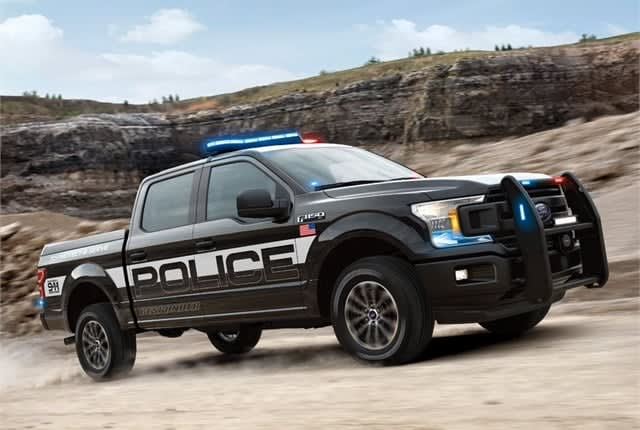
Ford F-150 Police Responder. Photo courtesy of Ford
The tour’s 14 stops are:
Seattle, Wash. (April 23)
San Francisco, Calif. (April 26)
Los Angeles (April 30)
Phoenix, Ariz. (May 3)
Denver, Colo. (May 7)
Austin, Texas (May 11)
Detroit (May 17)
Atlanta, Ga. (May 22)
Orlando, Fla. (May 25)
Chicago (May 30)
Columbus, Ohio (June 1)
New York City (June 5)
Boston (June 8)
Washington D.C. (June 14)
To register, visit fordpolicerespondertour.com.
More Operations

Is Keeping Older Fleet Vehicles Really Saving Money?
Is keeping vehicles longer saving money, and what happens when a diagnostic test points to the wrong fix?
Read More →
How Smart Fleet Strategy Can Help Local Government Agencies Do More with Less
Keeping a vehicle longer may ease this year’s budget, but what does it cost the next one? A closer look at fleet decisions can reveal opportunities to reduce spending while protecting essential services.
Read More →
Connect with Government Fleet on LinkedIn
From industry news and fleet management strategies to conversations with peers, Government Fleet's LinkedIn page offers public-sector fleet professionals another way to stay informed and connected.
Read More →
Town of Queen Creek Named Most Successful Fleet Award Winner of Inaugural RTA Fleet Success Awards
Five fleets were honored at RTA Connect 2026 in Chicago for excellence across resource efficiency, intentional culture, risk management, and stakeholder satisfaction.
Read More →
Sponsored•October 14, 2026
A buyer's guide to fleet management software in 2027
Buying fleet management software in 2027 means looking beyond features and price. As fleet operations, technology and expectations evolve, this guide explores what today’s fleet professionals should consider when choosing a system that can deliver value now and adapt to what comes next.
Read More →
Hazard Alerts, Fleet Car Sales Rise and a New Shuttle Concept
Fleet car sales doubled, but the bigger picture tells a different story in this week’s roundup.
Read More →
How St. Johns County Turned Fleet Data Into Better Replacement Decisions
St. Johns County, Florida, had fleet data, but turning it into reliable decision guidance was another matter. Instead of starting over with a new fleet management system, the county connected existing tools and built a scoring system that gives managers an objective look at fleet health.
Read More →
Fleet Forward Conference Introduces One-Day Passes for 2026
New one-day registration lets fleet professionals attend Tuesday, Wednesday, or Thursday, with passes available for $249.
Read More →
ENC Unveils its ZAVIR Medium-Duty Shuttle
Two variants of the concept shuttles were revealed: a low-floor configuration and a high-floor configuration.
Read More →
Could Your Next Fleet Technician Start as an Intern?
What if your next technician hasn’t worked in a fleet shop yet? What fleets are doing to free up time.
Read More →