




Click here to learn more about achieving EPA compliance with automated wastewater treatment
Conserving Fuel and Water Resources During Sewer Cleaning
Rising costs and resource scarcity have forced municipalities to utilize more efficient nozzles and expert training to save fuel, water, time, and labor.
by By Del Williams
September 20, 2022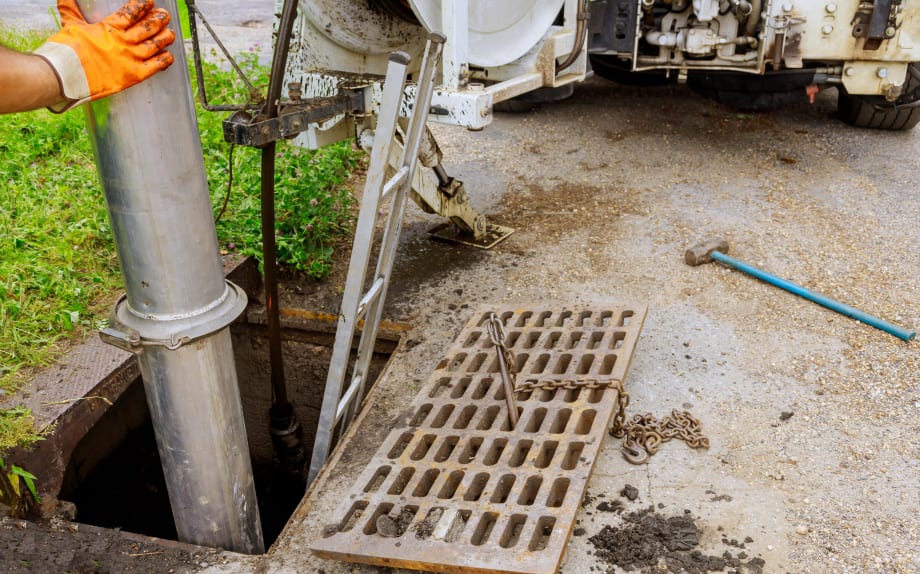
Inefficient sewer cleaning tools, such as nozzles, as well as poor cleaning techniques can cause crews to make multiple passes to clear a line resulting in fuel and water waste.
Photo: Pexels
8 min to read
Municipalities responsible for keeping sewer lines free from debris have the added challenge of maintaining these lines during rising fuel prices and water scarcity.
Fuel is also consumed to operate sewer trucks, vacuum systems, water pumps, operating platforms, and pressure/flow compensation hydraulic systems. Inefficient sewer cleaning tools, such as nozzles, as well as poor cleaning techniques can cause crews to make multiple passes to clear a line resulting in fuel and water waste. When crews inefficiently utilize water, additional fuel, time, and labor may be required to drive to the nearest fire hydrant to refill the tank.
“For years, sewer crews didn’t pay much attention to water conservation. Today they must pay attention, or they can’t do their jobs. With sky high fuel prices and a scarce water supply, municipalities are looking to stretch their resources, including labor, with better tools and training,” said Dan Story, operations manager at KEG Technologies.
Increasing Fuel and Water Efficiency
Normally, sewer crews utilize jetting and/or vacuuming systems to remove debris and blockages.
With jetting, a high-pressure water hose with a high-performance nozzle is placed into the line. Operators release high-pressure water from the sewer jet truck to dislodge debris and flush it into a manhole.
As debris is removed, the hose is pushed deeper into the sewer. Jetting typically involves using between 50-85 gallons of water per minute with ¾-1 inch hose from the truck to flush out debris such as grease, grime, sludge, stones, and other items lodged in the pipe. A vacuum may also be used to remove dislodged debris and transfer it to disposal bins.
High-Efficiency Tools
One of the most effective ways to decrease water and fuel use while improving cleaning efficiency of sewer vacuum trucks is by utilizing a high-performance, Tier 3 nozzle. With improved fluid dynamics, these optimize the cleaning process while utilizing less water, revolutions per minute (RPMs) and pressure (PSI).
The high-performance nozzles cost more, but dramatically reduce fuel and water costs, and enable faster job completion.
Although nozzles with many configurations are used in the industry, nozzles are classified in three tiers, based on efficiency:
Tier 1 (approximately 30 percent efficient)
Tier 2 (50 to 60 percent efficient)
Tier 3 (75 to 98 percent efficient).
According to Story, a surprising number of municipalities and third-party contractors still do not use Tier 3 nozzles for sewer cleaning, despite the benefits.
What sets the most efficient Tier 3 nozzles apart is the fluid mechanics engineering on a par with the aerodynamics of race cars. After exiting the jetter hose, water travels into the body of the nozzle before moving through smooth, curved channels.
This design enables the water to maintain its power and speed before entering the nozzle’s replaceable titanium ceramic inserts, which help to straighten the water stream. Next, the water is further funneled to enable an even tighter water pattern to emerge.
The internal workings of the nozzle (including the way the water gets turned) redirect the energy of the high-pressure water entering the nozzle so it performs as efficiently as possible. This results in what is needed for the task: more thrust and power using less water.
“If there is turbulence in the water as it exits the nozzle, it dramatically reduces the overall cleaning power,” said Story. “The most effective Tier 3 nozzles create tight water patterns that efficiently clean the pipe wall and produce a powerful water stream to move debris long distances while propelling the nozzle through the lines.”
In the case of KEG’s Tier 3 nozzles, such as the Torpedo and OMG models, the high-performance design of the fluid mechanics leaves little room for power losses and excessive turbulence and so can achieve 98% efficiency. A properly designed Tier 3 nozzle can also be used at lower operating pressure (PSI) and RPMs.
“With less efficient Tier 1 or 2 nozzles, operators may run at 2,000 PSI to provide more power. Because of the superior fluid mechanics of a Tier 3 nozzle, ample power is generated at 1,200 PSI, which saves water and fuel,” said Story.
He explained that when water hits the nozzle wall of Tier 1 and 2 nozzles, they stop the flow of water and change its direction, which creates considerable turbulence. In contrast, Tier 3 nozzles are designed not to impede or stop the water flow.
The result essentially eliminates water turbulence and produces a much more powerful flow of water directed from the nozzle.
“The most efficient Tier 3 nozzles are designed to move water like it is on a curved race track or roller coaster. The water never stops moving so it retains more power,” Story said, adding that a Tier-1, 30-degree drilled nozzle running 72 gallons a minute at 2,200 PSI will only exert 13 pounds of force to move debris nine feet away from the nozzle. In contrast, a high-efficiency Tier-3 nozzle running 60 gallons a minute at 2,000 PSI will exert 98 pounds of force nine feet away.
Story notes that efficient Tier 3 nozzles also allow a lower water pressure to be used from the truck, which saves water.
“When the nozzles are set at a certain rate of pressure in gallons per minute, if you lower the pressure, you lower the gallons of water being used per minute," Story said. "This results in water savings. With the Tier 3 nozzles, you can lower the required water pressure in PSI without compromising power."
Better Cleaning Techniques
In addition to water savings, cleaning techniques can also reduce fuel, time, and labor. To improve sewer cleaning performance, KEG offers onsite or online training customized to the needs of the municipality or contractor.
According to Story, the main mistake most operators make is when they do not understand how their cleaning speed affects their performance.
“The hardest thing to overcome is that for years operators were taught to quickly spray water on the way up the sewer line and then clean as they return – but that wastes water because it does not move the debris or clean the walls sufficiently,” he says.
With poor techniques, operators often are forced to make several passes to remove the material, which wastes a tremendous amount of water.
“Even after that, I have been in situations where after a cleaning the CCTV camera operator radios back to ask if the line was even cleaned.” “Most operators want to run up the line in a hurry and clean as they come back because it is how they were taught, but it is impossible to ‘dig a hole from the bottom up.’ When they shoot past all the debris going in, they are trying to bring it all out at once, which is more difficult,” he adds.
Instead, Story advises operators to go slow when cleaning lines.
“You want to go in slow, between 30 feet and 60 feet per minute. Remember, at 60 feet per minute, you are traveling one foot per second. However, at one foot a second, you are wetting the pipe, not cleaning it.”
He advises operators to pull the nozzle down as they go into a line, observe how dirty it is, and then adjust their cleaning speed accordingly.
“The first 50 feet of a line will tell you how dirty it is and how you should adjust your speed. If you are not getting a lot of debris back in the first 50 feet, then you can increase your cleaning speed,” says Story.
When the operator reaches a manhole in the line, he advises dialing down the water pressure to 900 to 1,000 PSI as they return.
“You clean the line, remove all the organic materials going in, and some of the rocks in it will fall out of the flow. By cleaning as you go in, however, you’re able to get the dirt and debris out of the line, so on the return the rocks will move much easier inside the pipe,” he says.
He points out that operators often compensate for a lack of power cleaning with Tier 1 or 2 nozzles by increasing the pressure to 2,000 PSI, and the water flow to 50-60 GPM or higher on the way back through the line. With a Tier 3 nozzle, however, a lower pressure is possible because it provides more cleaning power due to its efficiency in directing water flow without turbulence.
“A Tier 3 nozzle can generate the same amount of cleaning power as a Tier 1 or 2 using 40 gallons and 1,200 PSI, saving time, water, and fuel. But the trick to that is cleaning as you go in," Story said. "Chop the debris up and let the flow work like a conveyor belt, carrying the debris out."
“When you get to the end of the line, just dial your pressure back down and rinse the pipe as you come out. When you come back, the job is done,” says Story. “You don’t have to send it back in a second time.”
With 6-to-15-inch diameter sewer lines, it should be possible 95% of the time to go from manhole to manhole and clean in a single pass, says Story.
“This takes a fraction of the time and resources to make one pass versus making several passes to remove the same material.”
It also eliminates extra trips to a nearby fire hydrant to refill the water tank, which can cost crews an hour or more to put all equipment back on the truck and set it up again when they return. With a combination of the right tools and techniques, Story estimates that sewer crews can save approximately 9-17% in vehicle fuel costs, including travel to refill water tanks.
As municipalities and contractors seek to reduce the use of costly fuel and scarce water, using the most efficient Tier 3 nozzles and cleaning methods will go a long way to stretch their funds and conserve valuable resources. Just as important, adopting industry-proven cleaning techniques will help to protect against future increases in the cost of fuel and water.
More Operations

Is Keeping Older Fleet Vehicles Really Saving Money?
Is keeping vehicles longer saving money, and what happens when a diagnostic test points to the wrong fix?
Read More →
How Smart Fleet Strategy Can Help Local Government Agencies Do More with Less
Keeping a vehicle longer may ease this year’s budget, but what does it cost the next one? A closer look at fleet decisions can reveal opportunities to reduce spending while protecting essential services.
Read More →
Connect with Government Fleet on LinkedIn
From industry news and fleet management strategies to conversations with peers, Government Fleet's LinkedIn page offers public-sector fleet professionals another way to stay informed and connected.
Read More →
Town of Queen Creek Named Most Successful Fleet Award Winner of Inaugural RTA Fleet Success Awards
Five fleets were honored at RTA Connect 2026 in Chicago for excellence across resource efficiency, intentional culture, risk management, and stakeholder satisfaction.
Read More →
Sponsored•October 14, 2026
A buyer's guide to fleet management software in 2027
Buying fleet management software in 2027 means looking beyond features and price. As fleet operations, technology and expectations evolve, this guide explores what today’s fleet professionals should consider when choosing a system that can deliver value now and adapt to what comes next.
Read More →
Hazard Alerts, Fleet Car Sales Rise and a New Shuttle Concept
Fleet car sales doubled, but the bigger picture tells a different story in this week’s roundup.
Read More →
How St. Johns County Turned Fleet Data Into Better Replacement Decisions
St. Johns County, Florida, had fleet data, but turning it into reliable decision guidance was another matter. Instead of starting over with a new fleet management system, the county connected existing tools and built a scoring system that gives managers an objective look at fleet health.
Read More →
Fleet Forward Conference Introduces One-Day Passes for 2026
New one-day registration lets fleet professionals attend Tuesday, Wednesday, or Thursday, with passes available for $249.
Read More →
ENC Unveils its ZAVIR Medium-Duty Shuttle
Two variants of the concept shuttles were revealed: a low-floor configuration and a high-floor configuration.
Read More →
Could Your Next Fleet Technician Start as an Intern?
What if your next technician hasn’t worked in a fleet shop yet? What fleets are doing to free up time.
Read More →