





Related: Understanding Electric Vehicle Battery Operations: DCAS Report
Keith Kerman Shares Lessons from Fleet Electrification
Keith Kerman shares what has worked for his fleet as they continue their electrification and sustainability efforts.
September 29, 2025
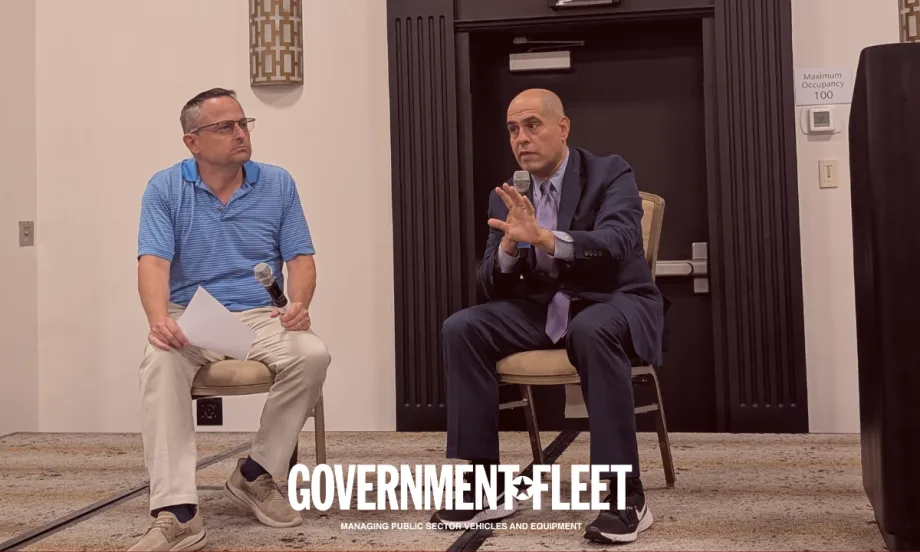
Chris Brown of Automotive Fleet and DCAS Deputy Commissioner Keith Kerman at the Fleet Forward Tour in Somerset.
Photo: Government Fleet
3 min to read
Keith Kerman, Chief Fleet Officer and Deputy Commissioner of the NYC Department of Citywide Administrative Services (DCAS), leads the most sustainable public fleet in the country with 5,700 electric vehicles (EVs), including the Staten Island Ferry, which is powered by renewable diesel.
Kerman stopped by Automotive Fleet’s Fleet Forward Tour Somerset stop to share what he has learned on the path of electrification.
Operational Insights: What Fleets Can Learn
With the largest public EV fleet in the country, Kerman had much to share on how to successfully scale and deploy EVs.
With his research-forward approach, Kerman had much insight on the operational efficiencies of managing a sustainable fleet.
“We just published a report on EV battery operations. We studied 6.5 million miles of EV battery operation in actual operation through our fleet office of real-time traffic, and found that EVs, in actual operation, are 900% more efficient than the combustion engine,” Kerman explained.
While there is an impact on range during the winter months, a 35% decrease in range, the extent of the impact depends on the degree of cold. Even with this reduction in rage, it can be planned for, and adjustments can be made as needed.
Even with this road bump, the savings and benefits far outweigh the challenges with maintenance savings of over 70% from ICE vehicles.
Forward Momentum with the EV Fleet
NYC is the largest operator of the Chevy Bolt, with 1,200 vehicles in operation, all of which have between 5,000 and 8,000 miles.
Battery degradation over time was initially a concern; however, one study found that battery degradation is not substantial over time.
“Within the scope of how we all normally operate at most, you know, gapping 80% using 80% of the tank or a battery, it's no impact at all,” he added.
When asked about medium-duty vehicles, Kerman confirmed that they have heavy-duty garbage trucks, both 20-yard and 25-yard models, sweepers, box vans, and electric school buses.
DCAS has found success with EV cargo vans and is exploring higher-range models for the future.
He explained that, although they are a municipal fleet, they operate more like a business. A van that works one way for one department can be used completely differently for another.
“We call it a municipal fleet, but it's not. It's 400 or 500 different businesses, and they're all kind of unique. How DOT sanitation parks use a passenger van has nothing to do with how that exact same make and model passenger van is being used by the police department. They're completely different operations, with different outfitting and duty cycles,” Kerman said.
He added that EV adoption for police vehicles is more challenging and will take longer to implement.
Charger Maintenance
DCAS runs the largest charging network currently in NY with 2,300 ports, 400 fast charging, 160 solar or independent carports, and the rest being level two.
Maintenance for these chargers is a challenge. To address this issue, Kerman scaled up a four-person team consisting of two field personnel and two city auto mechanics. They are the city's maintenance and repair team for electric charging.
At its launch, 22% of the city's chargers were out of service. Since its inception, they have maintained a steady rate of 5%.
They have also invested in portable chargers, in case a car breaks down due to running out of charge, although he notes that it has never happened.
Subscribe to Our Newsletter
More Operations

Is Keeping Older Fleet Vehicles Really Saving Money?
Is keeping vehicles longer saving money, and what happens when a diagnostic test points to the wrong fix?
Read More →
How Smart Fleet Strategy Can Help Local Government Agencies Do More with Less
Keeping a vehicle longer may ease this year’s budget, but what does it cost the next one? A closer look at fleet decisions can reveal opportunities to reduce spending while protecting essential services.
Read More →
Connect with Government Fleet on LinkedIn
From industry news and fleet management strategies to conversations with peers, Government Fleet's LinkedIn page offers public-sector fleet professionals another way to stay informed and connected.
Read More →
Town of Queen Creek Named Most Successful Fleet Award Winner of Inaugural RTA Fleet Success Awards
Five fleets were honored at RTA Connect 2026 in Chicago for excellence across resource efficiency, intentional culture, risk management, and stakeholder satisfaction.
Read More →
Sponsored•October 14, 2026
A buyer's guide to fleet management software in 2027
Buying fleet management software in 2027 means looking beyond features and price. As fleet operations, technology and expectations evolve, this guide explores what today’s fleet professionals should consider when choosing a system that can deliver value now and adapt to what comes next.
Read More →
Hazard Alerts, Fleet Car Sales Rise and a New Shuttle Concept
Fleet car sales doubled, but the bigger picture tells a different story in this week’s roundup.
Read More →
How St. Johns County Turned Fleet Data Into Better Replacement Decisions
St. Johns County, Florida, had fleet data, but turning it into reliable decision guidance was another matter. Instead of starting over with a new fleet management system, the county connected existing tools and built a scoring system that gives managers an objective look at fleet health.
Read More →
Fleet Forward Conference Introduces One-Day Passes for 2026
New one-day registration lets fleet professionals attend Tuesday, Wednesday, or Thursday, with passes available for $249.
Read More →
ENC Unveils its ZAVIR Medium-Duty Shuttle
Two variants of the concept shuttles were revealed: a low-floor configuration and a high-floor configuration.
Read More →
Could Your Next Fleet Technician Start as an Intern?
What if your next technician hasn’t worked in a fleet shop yet? What fleets are doing to free up time.
Read More →