





Looking for more advice? Check out Adapting to Challenges as a Seasoned Fleet Manager
Tales from the Fleet: Advice, Opinions, and More
A look back at what fleet managers have said and advised regarding the fleet industry and the challenges and changes they have faced.
December 25, 2023
Individuals in fleet management can share their own experiences when it comes to challenging issues within fleet.
Photo: Government Fleet via Canva.com
5 min to read
If there's anyone to seek advice from, it's the fleet managers who have been through similar experiences and found ways to keep their fleet efficiently running despite the roadblocks that come up. Government Fleet looks back on the sound advice from industry leaders regarding some of hte biggest pain points fleets face as well as general advice to keep your operation running smoothly on a day-to-day basis.
Planning for Retirement and Transitioning Positions
“It seems OEMs are limiting our supply of equipment needed to take care of our citizens, while earning record profits by producing less vehicles," said George S. Hrichak, CEM, CPFP, MSM. After twenty-two years and eight months with the city of Chesapeake, Virginia, George Hrichak retired on August 31, 2023. He added, "the whole vehicle ordering process is chaotic. Now we must buy vehicles and equipment when order banks are open even though they might not be at the top of our priority, because we don’t know when we’ll be able to get it again. Then, when our number one priority order bank opens, we may have already used up funds on low-priority items, which means we may not get to purchase all we need.”
Read From Aircraft Maintenance to Virginia Fleet Manager with George Hrichak
“Don’t reinvent the wheel. Take advantage of the networking opportunities to learn what works and what doesn’t. Use the Leading Fleets and 100 Best Fleets contests as a foundation for setting goals and objectives with your team to continuously improve,” said Keith Leech who retired as the fleet division & parking enterprise chief for Sacramento County, California.
Read Sacramento County’s Keith Leech to Retire, Looks Back on Career
“When you as a leader, can find ways to match up the strengths of all those differences, success will follow. And that goes beyond just the fleet department, extending out to police, fire, public works, administration," said Ben Roueche, CPFP, associate director of fleets for Salt Lake County, Utah.
Fleet Transitions: A Conversation with Salt Lake County's Ben Roueche
“One thing I've had to learn in this industry is you have to open your ears and listen. Listen to what your staff saying, listen to what your peers are saying, and listen to what your bosses are saying. You have to adapt to [what’s happening in your department] to move forward," said Darryl Syler, CPFP, fleet services division chief for the city of Alexandria, Virginia.
Pass the Baton: Planning the Perfect Handoff

Electrification, Infrastructure, and Budgeting
“We did [make commitments], and then the manufacturer couldn’t produce the vehicles. So we had a choice: either purchase a traditional vehicle and get it, or have nothing. There are a lot of factors out there that we ‘government fleets’ have no control over. We can have all the greatest ideas and make those bold commitments, but in the end, we don’t have the power to make them come to fruition," said Charlotte Ashcraft, director of fleet management for Franklin County, Ohio, Commissioners.
'It’s Not that Simple,' Fleet Managers Say About Electrification Cost Savings Analysis
“You have to look at the traffic flow in your yard after you make these changes. We had multiple revisions with the engineers on how the traffic flow will work in the yard. And we had to move our bus wash to a different location. We also had to add four bays," said David Renschler, CPFP, fleet division manager for the city of Fairfield, California.
A Tale of Two Cities: The EV Infrastructure Switch
“I take advantage of competitive bidding to get the best price...I can save as much as 20% by paying for the vehicle in advance," said Pittsburgh Fleet Services Manager Brandon Walton.
Managing Today's Fleet Budgets: ‘A Tight-Knit Team’ in Pittsburgh
“But once you lay out and implement that initial plan, constantly allow comments from everybody on improvements,” said Cedric Roberts, CAFM, director of equipment management for the city of Birmingham, Alabama.
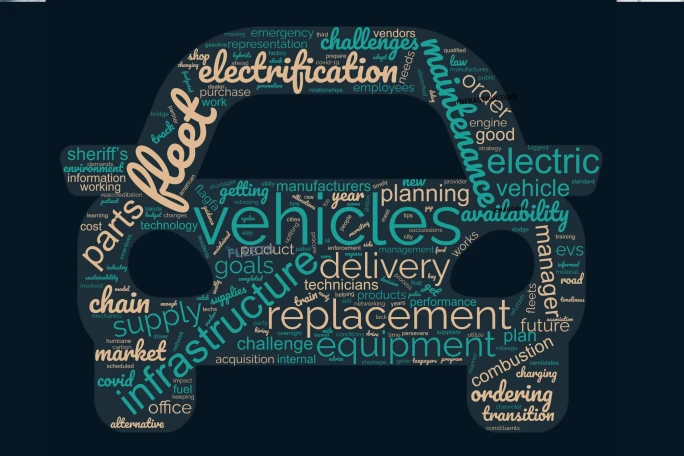
This word cloud shows the most popular topics and issues discussed by fleet leaders recently.
Photo: Government Fleet
Data Collection and the Modernization of Fleets
“I can’t imagine running the fleet without data...By using the data, we have been able to apply for and receive recognition as a platinum-rated fleet under [Canada’s] E3 Fleet program, contribute toward reduction in overall greenhouse gas emissions for the city, measure the benefit of greener technologies, and more,” said said Public Works Operations Director Suzanne Bycraft, who previously was the manager of fleet & environmental programs for the city.
How to Collect Reliable Fleet Data & What to Do With It
“We want to take care of everything possible at that time since we're already taking it away from [the customer] for a day or for hours, or whatever it might be. Let's get everything done at once, so that when we give it back to you, it won't break down between now and the next scheduled service. By getting to a predictive system of maintenance, we can catch these things before they happen. And that enables us to reduce the downtime and all its negative effects," said Long Beach Fleet Services Manager Dan Berlenbach, CPFP.
The Future is Now: Using AI Predictive Maintenance for Your Fleet
“You better know what your applications are for your assets. You better know what your total cost of ownership is...You better know all of these pieces, so that you can plan accordingly to take out ICE vehicles and put in electric vehicles," said Kelly Reagan, fleet administrator for the city of Columbus, Ohio, Division of Fleet Management.
The Future of Vehicles Through the Lense of Research
“We’re missing the information from manufacturers regarding product availability, how allocations will affect our ordering and, to some degree, we’re missing representation with the transition that’s going on in the market. We need that representation from the factory to keep us informed, helping us plan for the future, that’s the biggest challenge. It’s not today, it’s two to three years from now. Are we going to have the right information to give the right guidance to our administration?” said Leon County Sheriff’s Office Fleet Director Tim Coxwell.
Navigating the Challenges of Fleet Management: Insights from Industry Leaders
Subscribe to Our Newsletter
More Operations

Is Keeping Older Fleet Vehicles Really Saving Money?
Is keeping vehicles longer saving money, and what happens when a diagnostic test points to the wrong fix?
Read More →
How Smart Fleet Strategy Can Help Local Government Agencies Do More with Less
Keeping a vehicle longer may ease this year’s budget, but what does it cost the next one? A closer look at fleet decisions can reveal opportunities to reduce spending while protecting essential services.
Read More →
Connect with Government Fleet on LinkedIn
From industry news and fleet management strategies to conversations with peers, Government Fleet's LinkedIn page offers public-sector fleet professionals another way to stay informed and connected.
Read More →
Town of Queen Creek Named Most Successful Fleet Award Winner of Inaugural RTA Fleet Success Awards
Five fleets were honored at RTA Connect 2026 in Chicago for excellence across resource efficiency, intentional culture, risk management, and stakeholder satisfaction.
Read More →
Sponsored•October 14, 2026
A buyer's guide to fleet management software in 2027
Buying fleet management software in 2027 means looking beyond features and price. As fleet operations, technology and expectations evolve, this guide explores what today’s fleet professionals should consider when choosing a system that can deliver value now and adapt to what comes next.
Read More →
Hazard Alerts, Fleet Car Sales Rise and a New Shuttle Concept
Fleet car sales doubled, but the bigger picture tells a different story in this week’s roundup.
Read More →
How St. Johns County Turned Fleet Data Into Better Replacement Decisions
St. Johns County, Florida, had fleet data, but turning it into reliable decision guidance was another matter. Instead of starting over with a new fleet management system, the county connected existing tools and built a scoring system that gives managers an objective look at fleet health.
Read More →
Fleet Forward Conference Introduces One-Day Passes for 2026
New one-day registration lets fleet professionals attend Tuesday, Wednesday, or Thursday, with passes available for $249.
Read More →
ENC Unveils its ZAVIR Medium-Duty Shuttle
Two variants of the concept shuttles were revealed: a low-floor configuration and a high-floor configuration.
Read More →
Could Your Next Fleet Technician Start as an Intern?
What if your next technician hasn’t worked in a fleet shop yet? What fleets are doing to free up time.
Read More →