


At a glance
Major initiatives at the City of Oakland include:
A Master Lease program to catch up on vehicle replacements
Continued investment in alternative fuels
Increased training for technicians.
 MENU
MENU SEARCH
The City of Oakland, Calif., Equipment Services Division is planning for the next big thing, embracing sustainability and building up its team despite limited resources.

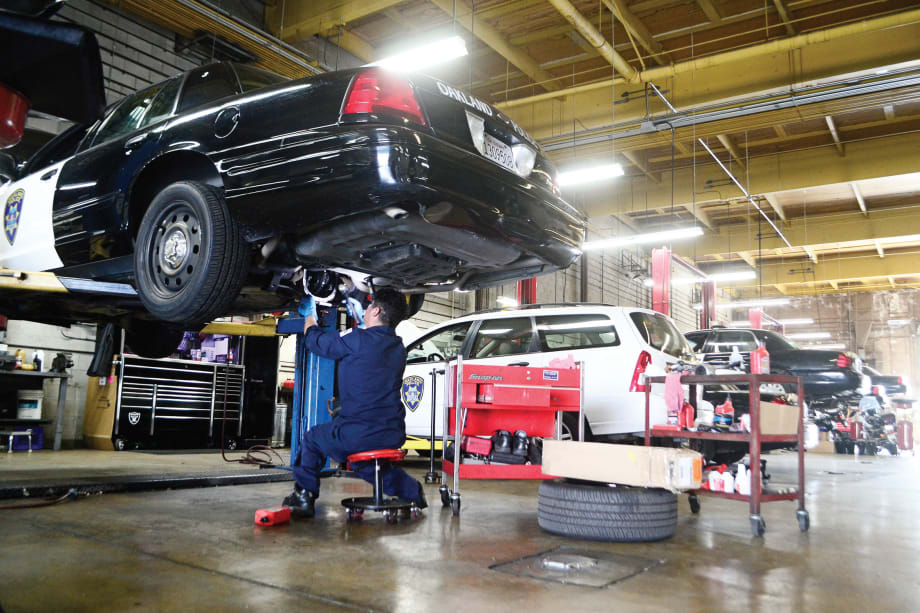
Fleet maintenance is managed across five shops and two parts rooms in two locations. Photo: Thi Dao
Fleet maintenance is managed across five shops and two parts rooms in two locations. Photo: Thi Dao
Just across the bridge from San Francisco sits the City of Oakland, Calif., one of the most diverse cities in the country. The city has built a reputation for its sustainability efforts. Even more impressive, it achieved this on a limited budget. But Richard Battersby, CAFM, CPFP, acting bureau of infrastructure & operations assistant director, jokes that the city has always had a green fleet.
“We’re still retiring stuff from the ’90s. I know that’s hard to believe, but if we walk around the yard, you’ll see them,” he said. “People talk about green fleet, and we really have a green fleet here at the City of Oakland. It’s a faded pastel green that used to be the city color, but those are all from 2002 or older.”
Equipment Services, a division of the Bureau of Infrastructure & Operations, manages about 1,500 mobile units, from riding lawn mowers to police and fire to aerial units. It purchases most of the city’s vehicles, and user departments pay a monthly lease rate that covers procurement, maintenance, and insurance.
Despite a 12-year pause on vehicle replacements and several vacancies, Battersby and Joseph Williams, CPFP, acting equipment services manager, are leading the fleet team to develop a sustainable fleet ahead of industry trends.
Between advancing technologies and government mandates, fleet greening is a hot topic, especially in California. And the Oakland fleet is at the forefront of the conversation; it no longer buys gasoline-powered sedans, opting for vehicles that run on alternative fuels.
The City of Oakland adopted renewable diesel in 2015, which offers the same chemical properties as petroleum diesel but burns cleaner, allowing fleets to make the switch without additional investment or engine modifications. The city has stopped using petroleum diesel completely, and plans to expand its renewable diesel fleet to light-duty vehicles — the fleet has ordered 12 Chevy Cruze Diesel sedans to run on the fuel. The city also manages a fleet of Honda Civics that run on compressed natural gas (CNG).
The most prominent example of the green fleet, however, is in electrification. Currently, the fleet is purchasing Nissan LEAFs. In his experience, Battersby noted, battery-electric vehicles carry significantly more incentives than a plug-in hybrid. Level 2 and DC Fast chargers are installed at the fleet facility and at user departments.
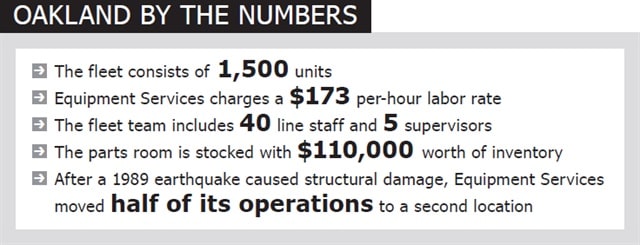
Like many fleets, the City of Oakland has had to deal with limited budgets and delayed vehicle replacements. Unlike others, this problem arose years before the recession hit. In 2002, the city put a pause on all new vehicle purchases, which continued for 12 years and led to rising maintenance and repair costs.
In 2014, the fleet began a Master Lease program that allowed it to purchase vehicles quickly. Instead of buying vehicles outright, the city takes out loans for new vehicle purchases and puts the allotted funds toward semi- annual payments. This allows it to cycle older vehicles out more quickly and get new vehicles on the road.
“We know we’ve got $2.5 to $3 million available a year for capital purchases and we can go out and buy $2.5 to $3 million worth of equipment, but that doesn’t get you very far in a 1,500-unit fleet,” Battersby said. “So we go out to a lender and see how many vehicle acquisitions we can finance with that $2.5 to $3 million we pay each year.”
For now, the program helps the fleet catch up on replacements quickly. Williams acknowledged that it is not a long-term solution.
“But it digs you out of the hole,” he said. “And when you go 12 years without vehicle replacements, you’re in a pretty deep trench. To get out of the trench, where you realize those savings, is through repairs and maintenance.”
This is the third cycle of the program with no signs of stopping for the foreseeable future, as there are more replacements to go.
“At some point you want to taper off the financing programs,” Battersby said. “If you have enough capital available where you could just buy the vehicles outright, that makes perfect sense. I don’t know how long it’s going to take to get there.”
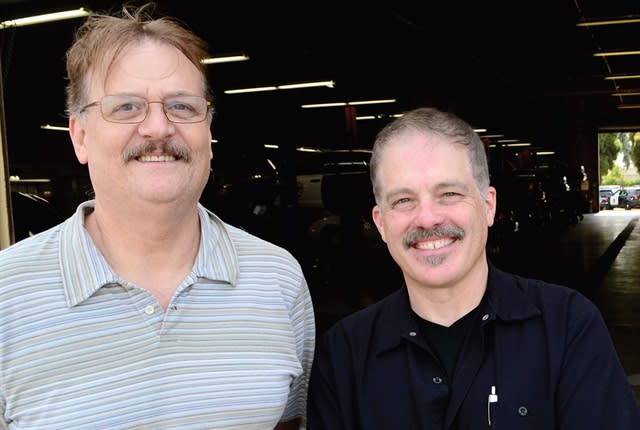
Richard Battersby, CAFM, CPFP, and Joseph Williams, CPFP, lead the Oakland fleet team, which includes five supervisors and 40 line staff. Photo: Thi Dao
In recent years, Equipment Services has lost employees to retirement or positions at other agencies. The local union limits the work that line staff can and cannot do, which impedes the fleet’s ability to train and grow employees for higher positions. As a result, positions are filled from outside the fleet more frequently than desired.
“We’ve been in discussions for several years with the union to create an apprenticeship program and add incentive pay for ASE certifications,” said Williams. “Unfortunately, it’s a long and at times difficult process to implement.”
The fleet is looking to OEMs for training. To maximize the reach, it is working to keep training local and available to as many employees as possible.
There are options for training. Ford, for example, offers online training in which each employee is allocated four hours each month to participate. To ensure fleet does not have to hunt down funding, training is generally negotiated when vehicles are procured.
“If we’re going to buy Nissan LEAFs, we ask them to quote or include in the cost factory training, either on-site or at an external location,” Battersby said. “That way we don’t have to constantly look for training dollars. We try to build it into the acquisition of the vehicle.”
Is keeping vehicles longer saving money, and what happens when a diagnostic test points to the wrong fix?
Read More →
Keeping a vehicle longer may ease this year’s budget, but what does it cost the next one? A closer look at fleet decisions can reveal opportunities to reduce spending while protecting essential services.
Read More →
From industry news and fleet management strategies to conversations with peers, Government Fleet's LinkedIn page offers public-sector fleet professionals another way to stay informed and connected.
Read More →
Five fleets were honored at RTA Connect 2026 in Chicago for excellence across resource efficiency, intentional culture, risk management, and stakeholder satisfaction.
Read More →
Buying fleet management software in 2027 means looking beyond features and price. As fleet operations, technology and expectations evolve, this guide explores what today’s fleet professionals should consider when choosing a system that can deliver value now and adapt to what comes next.
Read More →
Fleet car sales doubled, but the bigger picture tells a different story in this week’s roundup.
Read More →
St. Johns County, Florida, had fleet data, but turning it into reliable decision guidance was another matter. Instead of starting over with a new fleet management system, the county connected existing tools and built a scoring system that gives managers an objective look at fleet health.
Read More →
New one-day registration lets fleet professionals attend Tuesday, Wednesday, or Thursday, with passes available for $249.
Read More →
Two variants of the concept shuttles were revealed: a low-floor configuration and a high-floor configuration.
Read More →
What if your next technician hasn’t worked in a fleet shop yet? What fleets are doing to free up time.
Read More →