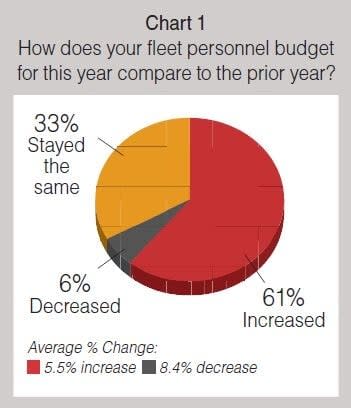
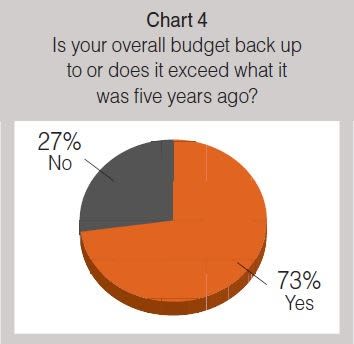
Nearly three of four respondents to Government Fleet’s 2016 financial survey said budgets have returned to 2010 levels, and low fuel cost was one of the biggest contributors to operating budget reductions.
Government fleet budgets continue to improve, according to results from the latest survey of fleet finances conducted by Government Fleet magazine. This is most notable for personnel budgets and replacement budgets, but less so for operating budgets.
At a Glance
Personnel budgets have risen to pay for raises and additional benefits costs as well as to hire new technicians
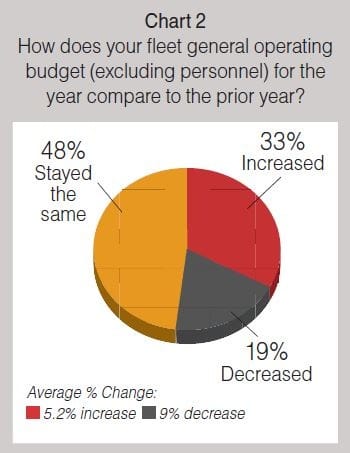
Nearly half of respondents said fleet operating budgets had stayed the same
Replacement budgets fluctuate, but fleets with higher budgets are ramping up their replacement programs or catching up on purchases.
Public agencies continue to recover from the recession, although slowly. These public agencies’ finances can be used to predict how fleet finances will fare, although fleet funding isn’t always on the top of the priority list when it comes to spending.
Ad Loading...
The National League of Cities’ annual survey of city finance officers shows that budgets in cities across America seem to have stabilized after the recession. The group’s 2015 report stated that general fund revenues were expected to grow 0.31% in 2015, property tax revenues would grow 1.2%, and sales tax revenue would grow 2.3%. Revenues have grown for three consecutive years, but these 2015 revenue numbers are lower than the previous year’s growth. Revenue bases are still below pre-recession levels.
The report stated that ending balances, which are similar to reserve funding, were budgeted at 25.2%, which reaches pre-recession levels. This shows “cities’ desire to be more prepared for future fiscal downturns and recognition that key tax revenues, along with state and federal aid, have become less reliable,” according to the report.
State budgets also continue to grow for fiscal-year 2016, its sixth consecutive year of growth, according to The Fiscal Survey of States, published by the National Association of State Budget Officers. However, this projected general spend funding growth of 4.1% is lower than the estimated 4.6% increase in fiscal-year 2015. In fact, 2015 spending has remained below the 2008 pre-recession peak after accounting for inflation.
How Personnel, Operating & Replacement Budgets Fare
In November 2015, Government Fleet sent out a survey to its readership to determine the state of fleet budgets in 2016. We asked respondents to use data from the fiscal year that includes January. The data from this survey, along with responses to a similar financial survey for 2014, shows that fleets are mostly doing better financially.
Personnel Budgets Rise for Higher Salaries, More Staff
More fleet personnel budgets have risen in 2016 than two years ago. The financial survey conducted for 2014 showed 42% of fleets had increased budgets and 18% had decreased budgets, in comparison to this year’s 61% increase and 6% decrease.
Ad Loading...
For fleets with at least a 5% increase, most stated they had added staff members. Most of those with smaller personnel budget increases said this was due to pay raises, cost of living adjustments, or increased worker’s costs such as for insurance and benefits. One fleet professional stated his agency had raised initial entry salaries by $4,000 to attract technicians, while another increased the hourly rate by $2.
Half of fleets with decreased budgets said they were hiring new staff at lower rates.
Operating Costs Stabilize
More fleets reported increased operating budgets (33%) than decreased budgets, but the increase is less than reported two years ago (42% increase). Nearly half of respondents said their operating budgets will stay the same for 2016.
The most common reason stated for increased cost of operating budgets is the increased cost of products and services. Other reasons include increase in supplies needed, increase in maintenance due to retaining vehicles longer or more miles driven, and adding products such as telematics.
At Manatee County Fleet Services in Florida, Fleet Division Manager Michael Brennan, CEM, said the 2.5% increase in operation budget was mostly due to increased shipping costs.
Ad Loading...
“Over the past two years, shipping and freight charges have increased 5-8%, which in turn has increased part pricing for non-contract items similarly,” Brennan explained.
At the City of Olympia, Wash., the operating budget increased by 4% due to increased overhead for building rent and administrative support. “We’re trying to insource more work to offset these increases,” said Fleet and Facilities Supervisor Paul Hanna, CAFM.
Lowered fuel cost was the most common reason cited for reduced operating budgets, and disposal of costly older equipment was another common reason.
For the City of Tulsa, Okla., which is reducing its operating costs by 11.3%, this fuel cost reduction leads to a large chunk of change: $1.8 million in decreased cost, which more than offset increases in parts and supplies and outside vehicle repairs, explained Brian Franklin, CPFP, administrative manager.
However, reduced costs aren’t always positive. At the City of Lawton, Okla., Dennis Bothell, equipment maintenance superintendent, said fleet saw a 5% decrease in operating budget due to reduced tax base and water sales. To combat this, the fleet will “defer non-essential, non-critical repairs,” he said.
Ad Loading...
Replacement Programs & Catch-Up Purchases Increase Capital Budgets
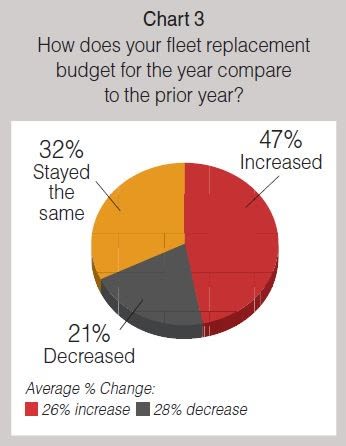
Compared to two years ago, more fleets have increased replacement funds. In the previous survey, 38% of fleets saw increased replacement budgets while this year, 47% will have an increase.
Replacement budgets often fluctuate due to changing vehicle replacement needs. Oftentimes, change in capital budget is just part of the replacement cycle, with more vehicles or more expensive vehicles falling into the most recent budget cycle for those with higher budgets and the opposite for those with lower budgets.
Not all fleets fall into this category, however.
A small number of respondents reported at least double their budget from the prior year either to create or renew existing vehicle replacement programs.
Other fleets stated they were catching up on replacements or trying to phase out very old vehicles, with a couple of respondents stating they were replacing vehicles specifically to comply with California Air Resources Board emissions regulations.
Ad Loading...
A profitable year for one utility means good news for fleet replacements.
“Since we are general funded, this has provided an opportunity to catch up on replacements,” said Paul Chamberlain, fleet services manager, Clark Public Utilities in Vancouver, Wash.
The Texas Department of Public Safety has increased its replacement budget in order to increase its fleet size.
“Texas DPS is a growing agency with the single largest border to Mexico where ongoing operations to control cartel activity are unforgiving. The fleet size has grown in conjunction with the need for law enforcement presence along the border and throughout the state,” said Brian Reynolds, director of fleet operations.
Fleets reporting small budget increases said it was mostly to cover the increased cost of vehicles.
Ad Loading...
Those with decreased replacement budgets report various reasons: agency funding going toward other budget priorities, such as infrastructure maintenance, emergency response, and pension obligations; and anticipated lower tax collection revenue.
Other fleets have planned out their decreased budgets. One fleet with a reduced replacement budget stated that the replacement budget had been funded as requested for the past three years, which meant he could taper off the rate of replacement. Another fleet manager said a milder winter will result in lower use of equipment, which means a smaller capital budget.
To handle budget reductions, fleets will purchase fewer vehicles, refurbish vehicles, extend life cycles even further, and be more aggressive with the preventive maintenance program to make sure vehicles last.
Even some of those with the same amount of funding as the prior year are having problems: One fleet professional said the replacement fund had been the same low level for three years, and vehicle life cycles had already been extended.
Improving Economy Helps Fleet Budgets Rise
Many fleets were optimistic about their financial futures, and 73% said their fleet budgets were back up to or higher than they were five years ago, in comparison to 59% reported in the previous survey.
Ad Loading...
Those who said yes provided numerous explanations, from higher budgets due to the improved economy to stable or slowly rising budgets. Those who said no cited lower capital budgets, less tax revenue, lower fuel costs reducing fleet costs, and improved efficiency.
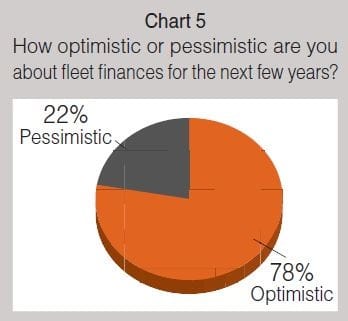
In 2014, 80% of fleet respondents said they were optimistic about fleet finances in the future, just slightly higher than the current 78%.
Those who said they were optimistic attributed this to a long-established and protected replacement program, good relationships with administration officials, the creation of new replacement plans, a better agency budget than in previous years, and a projected growth in tax base.
“The economy is doing better, fuel has been relatively stable, and our city planners have done a fantastic job with development, which will ensure a strong tax base over the next decade and beyond,” explained Kevin Devery, CPM, fleet manager for the City of Tempe, Ariz.
Fleet professionals who were pessimistic cited a predicted spike in fuel costs that will increase operating costs, unresolved debt obligations and borrowing limits, reduction in sales tax, and fear of another downturn in the economic cycle.
Ad Loading...
A Detailed Look at Vehicle Purchasing Methods
For the finance survey, we also asked how often fleets used the following methods to purchase vehicles and whether they will change their funding methods for 2016.
Purchasing using replacement funding was by far the most common method used by fleet respondents, followed by use of general funds (See Chart A below).
Those who said their funding methods were changing said they were setting up or eliminating replacement funds, going after grant funding or ending grant searches due to lack of grant funds, and starting leasing.
Twenty-one percent of respondents said they were changing their purchasing patterns for the year (see Chart B below). Of these, many said they were looking to purchase more fuel-efficient vehicles or buy alternative-fuel vehicles such as compressed natural gas (CNG) and electric vehicles. Others said they were looking into standardizing their fleets.
Government Fleet sent out a survey to its readership in November 2015, receiving 104 qualified responses. Fleets were asked to provide data for the fiscal year that included January 2016. The data included fleets from cities, counties, state agencies, utilities, and special districts.
Keeping a vehicle longer may ease this year’s budget, but what does it cost the next one? A closer look at fleet decisions can reveal opportunities to reduce spending while protecting essential services.
From industry news and fleet management strategies to conversations with peers, Government Fleet's LinkedIn page offers public-sector fleet professionals another way to stay informed and connected.
Five fleets were honored at RTA Connect 2026 in Chicago for excellence across resource efficiency, intentional culture, risk management, and stakeholder satisfaction.
Buying fleet management software in 2027 means looking beyond features and price. As fleet operations, technology and expectations evolve, this guide explores what today’s fleet professionals should consider when choosing a system that can deliver value now and adapt to what comes next.
St. Johns County, Florida, had fleet data, but turning it into reliable decision guidance was another matter. Instead of starting over with a new fleet management system, the county connected existing tools and built a scoring system that gives managers an objective look at fleet health.