




Bright Ideas: Fleet Manager Creates Innovative Vehicle Justification Model
When David Vasquez created a vehicle justification model to better assess take-home vehicle need, he not only lowered costs by avoiding excess commuter miles, but also gained a better handle on costs of ownership.

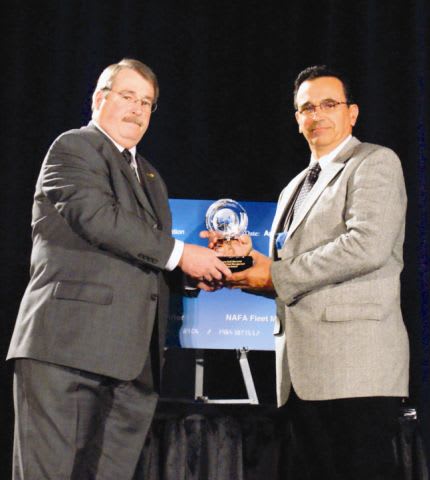
Dave Vasquez (right), manager of fleet operations for SECO Energy, accepts the 2010 Larry Goill award from Marvin Fletcher, director of fleet services for Hanover County, Va. Vasquez was recognized for developing a solution to reduce the use of take-home vehicles when he served as director of fleet maintenance for Lake County, Fla.

Each year NAFA recognizes fleet managers whose innovative ideas improved productivity or resulted in bottom-line savings for their employers. The Association, along with Bell Canada, presented its annual Larry Goill Memorial Quality Fleet Management Idea Award at the 2010 Institute & Expo this spring in Detroit.
One fleet manager awarded this year discovered an easy solution to a difficult problem. David Vasquez, manager of Fleet Operations for SECO Energy, entered the Goill Awards with an idea that actually helped his former employer.
"I'm honored that NAFA chose my project for a Goill award," Vasquez said.
Prior to joining SECO, Vasquez worked as director of fleet maintenance for Lake County in Tavares, Fla. While at Lake County, Vasquez recognized a large number of county vehicles were assigned as take-home vehicles without proper justification — a situation that negatively impacted the County's fleet budget.
According to Goill award judges, Vasquez' idea was a great example of a simple, low-cost solution that provided great savings and improved efficiency.
Vasquez developed a simplified process to justify vehicle assignments based on the percentage of commuting use versus business use.
"My vehicle justification model, which is based on NAFA's Lifecycle Cost Analysis, authored by Chris Amos, CAFM, several years ago, calculates vehicle assignment based on actual costs, defining cost of ownership by year, month, and mile," he said. "This model helps lower fleet costs."
Justification Model Leads to Unexpected Benefits
The model has several user-adjustable parameters, including months in service and targeted mileage, and it compares those figures against the anticipated monthly use and mileage. In addition, it also breaks down the annual and lifetime costs of business use versus commuting use and compares the cost of a county-supplied vehicle against the IRS reimbursement rate.
The model features a decision-making formula that assesses whether a county vehicle assignment is more economical than employee reimbursement and whether an assignment can be justified based on anticipated mileage and business need.
"I started out using the model to justify requests for new-vehicle assignments, but ended up using it to highlight and reduce commuting use, which ultimately resulted in reducing the fleet size," he said. "The biggest bang for the buck came from the number of commuting miles that were avoided. The bottom line results in a break-even mileage cost that will support justification."
The County ultimately reduced its more than 110 dedicated take-home assignments to about 18 — half of which were left for Fire Rescue and emergency medical personnel.
More Operations
Who Deserves Fleet Recognition and What Could You Teach at GFX?
Who helped shape your fleet career, and what have you learned that could help someone else?
Read More →
What’s Haunting Public Sector Fleets?
Public sector fleet challenges rarely happen in isolation, and addressing one often means understanding how it connects to another.
Read More →
Is Keeping Older Fleet Vehicles Really Saving Money?
Is keeping vehicles longer saving money, and what happens when a diagnostic test points to the wrong fix?
Read More →
How Smart Fleet Strategy Can Help Local Government Agencies Do More with Less
Keeping a vehicle longer may ease this year’s budget, but what does it cost the next one? A closer look at fleet decisions can reveal opportunities to reduce spending while protecting essential services.
Read More →
Connect with Government Fleet on LinkedIn
From industry news and fleet management strategies to conversations with peers, Government Fleet's LinkedIn page offers public-sector fleet professionals another way to stay informed and connected.
Read More →
Town of Queen Creek Named Most Successful Fleet Award Winner of Inaugural RTA Fleet Success Awards
Five fleets were honored at RTA Connect 2026 in Chicago for excellence across resource efficiency, intentional culture, risk management, and stakeholder satisfaction.
Read More →
A buyer's guide to fleet management software in 2027
Buying fleet management software in 2027 means looking beyond features and price. As fleet operations, technology and expectations evolve, this guide explores what today’s fleet professionals should consider when choosing a system that can deliver value now and adapt to what comes next.
Read More →
Hazard Alerts, Fleet Car Sales Rise and a New Shuttle Concept
Fleet car sales doubled, but the bigger picture tells a different story in this week’s roundup.
Read More →
How St. Johns County Turned Fleet Data Into Better Replacement Decisions
St. Johns County, Florida, had fleet data, but turning it into reliable decision guidance was another matter. Instead of starting over with a new fleet management system, the county connected existing tools and built a scoring system that gives managers an objective look at fleet health.
Read More →
Fleet Forward Conference Introduces One-Day Passes for 2026
New one-day registration lets fleet professionals attend Tuesday, Wednesday, or Thursday, with passes available for $249.
Read More →