




Are Your Technicians Happy? What They're Saying About Their Workplaces and What They Want You to Do About It
Government Fleet's exclusive survey reveals how fleet technicians feel about their jobs and what makes them stay. Find out what they're proud of and what they want you to change.

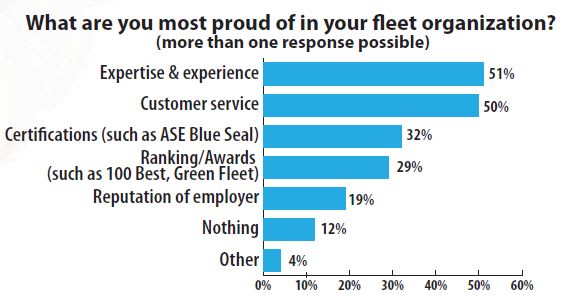
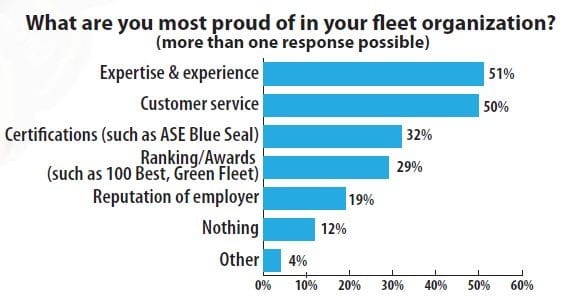
At a Glance |
Fleet employees who responded to the survey said:
|
What keeps most government employees at their jobs? Most would say the stability and benefits, but for some government agencies, these benefits are slowly being reduced and there are increasing concerns of job security.
At a time when many public agencies are cutting back their budgets, some fleet agencies are feeling threatened by outsourcing, lowered benefits, furlough days resulting in lower pay, not to mention salary freezes. Fleet managers are worried about employee retention and the retirement of the aging work force, resulting in loss of skilled veteran technicians. So are fleet technicians happy, or do they want out? What’s keeping them at their jobs, and can you do anything about it?
Government Fleet conducted a survey in May asking fleet employees on the shop floor about their satisfaction level, concerns, and ways management can improve their jobs. One hundred and eighty qualified fleet employees from agencies in 24 states responded to the survey.
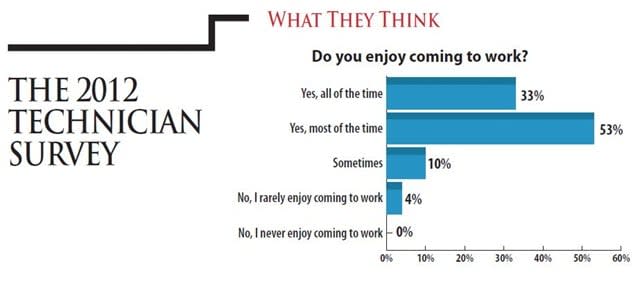
Survey results show that 86% of fleet employees enjoy coming to work most or all of the time. Yet 47% of respondents said they would definitely or probably leave their agency if they were offered another position with slightly better compensation or comparable benefits.
Benefits and job stability are the top reasons why fleet employees stay at their jobs, and only 40% of fleet employees cite compensation as a factor. Higher compensation, not surprisingly, tops the wish list for changes, with some survey respondents stating they hadn’t received a pay increase in five to six years.
The following pages go into the details of the survey, including employee suggestions, in their own words, about how fleet management can help them.
What They Like and Don’t Like
GF reached out to a few respondents who wanted to discuss their thoughts further, keeping their responses anonymous.
Fleet employees state that they enjoy their jobs and the new technologies that make their jobs a continually evolving process. “In automotive repair, nothing is a carbon copy,” a fleet technician in Texas said. “Every one of them presents a little different challenge, and I enjoy the challenge.”
Other things technicians and fleet supervisors said they liked about their operations include newer facilities, tools, and equipment if they have them.
However, the job they enjoy does take a toll. The Texas technician, who is 63, said one problem he has is the “congestion underneath the vehicles. With my body getting a little aged, it’s hard to get in there.”
As for management, he said, “they’re looking for a way to work smarter, not necessarily harder.” He noted that management does often know what technicians need but aren’t able to quickly acquire things such as costly up-to-date diagnostic equipment.
While management knows what’s going on in some fleets, one Southern California-based shop supervisor said: “Management isn’t really in tune to daily goings-on of the shop environment and what happens on a day-to-day basis. When there are decisions being made regarding anything that involves work environment, these decisions are being made without the input of people it actually affects.”
For full survey results, click here.
[PAGEBREAK]
A senior parts technician for a Northern California agency said his parts department had been cut down from three people to one, meaning significantly increased workload for him. His biggest problem is “not ever catching up, not ever finishing,” he said.
One change an East Coast utility mechanic noticed from his days working at a dealership and at private garages was that things moved quicker. He added that it’s also hard to show appreciation for his team “without running into union issues.”
Since being promoted to a lead mechanic position, he has been trying to create a team environment in the workplace. “I tried to identify the strengths of each individual. There’s always some [task] guys like to do more than others,” he said. “I tried to empower them to take charge of others…to empower them to try to show what they’ve learned to other guys, which gives them a sense of accomplishment.”
As for benefits and job security, the Southern California shop supervisor said: “I used to feel pretty good, but now that’s starting to go away with negotiations, where they’re taking away some of the benefits we used to have.” He began worrying about job security a couple of years ago. “I didn’t used to,” he said.
From the Perspective of Fleet Managers
When fleet managers are facing salary freezes themselves, and as numerous public agencies are cutting budgets and not filling open positions, there’s little chance of them being able to ask for salary increases for fleet staff. Sam Lamerato, CPFP, fleet superintendent for the City of Troy, Mich.; Charlie Caudill II, CPFP, fleet manager for the City of Yuma, Ariz.; and J.D. Schulte, fleet manager for the City of Moline, Ill., offer the following suggestions for improving employee morale and retention:
● Talk to technicians about climbing the management ladder.
● Try to provide additional compensation for certifications such as ASE or ASE Master.
● Provide training manuals and guides for testing, available for checkout.
● Pay for ASE certification testing.
● Allow employees to adjust their schedules on ASE testing day so they don't have to take time off.
● Publicize employee accomplishments such as certifications through City-wide newsletters.
● Provide clean uniforms and steel-toe boots, as well as winter clothing and gloves.
● Provide or offer to pay for training seminars on management skills, computer classes, etc.
● Confer with fleet supervisors when making decisions where they can provide input, such as which technician to send to a specific training program.
● Control rumors by giving employees the facts during meetings.
● Send technicians out to vendor training sessions held nearby. Offer to host these events in exchange for free training so more technicians can attend.
● Allow second- and third-shift employees the option of working a flexible schedule, such as four 10-hour nights.
● Bring back vendor-provided giveaways collected at trade shows to the shop and distribute them to those who weren't there.
For full survey results, click here.
Sources:
Charlie Caudill II, CPFP, fleet manager, City of Yuma, Ariz.
Sam Lamerato, CPFP, fleet superintendent, City of Troy, Mich.
J.D. Schulte, fleet manager, City of Moline, III.
Numerous fleet technicians, supervisors, parts employees, etc. who responded to the survey and contributed to this story.
More Operations
Who Deserves Fleet Recognition and What Could You Teach at GFX?
Who helped shape your fleet career, and what have you learned that could help someone else?
Read More →
What’s Haunting Public Sector Fleets?
Public sector fleet challenges rarely happen in isolation, and addressing one often means understanding how it connects to another.
Read More →
Is Keeping Older Fleet Vehicles Really Saving Money?
Is keeping vehicles longer saving money, and what happens when a diagnostic test points to the wrong fix?
Read More →
How Smart Fleet Strategy Can Help Local Government Agencies Do More with Less
Keeping a vehicle longer may ease this year’s budget, but what does it cost the next one? A closer look at fleet decisions can reveal opportunities to reduce spending while protecting essential services.
Read More →
Connect with Government Fleet on LinkedIn
From industry news and fleet management strategies to conversations with peers, Government Fleet's LinkedIn page offers public-sector fleet professionals another way to stay informed and connected.
Read More →
Town of Queen Creek Named Most Successful Fleet Award Winner of Inaugural RTA Fleet Success Awards
Five fleets were honored at RTA Connect 2026 in Chicago for excellence across resource efficiency, intentional culture, risk management, and stakeholder satisfaction.
Read More →
A buyer's guide to fleet management software in 2027
Buying fleet management software in 2027 means looking beyond features and price. As fleet operations, technology and expectations evolve, this guide explores what today’s fleet professionals should consider when choosing a system that can deliver value now and adapt to what comes next.
Read More →
Hazard Alerts, Fleet Car Sales Rise and a New Shuttle Concept
Fleet car sales doubled, but the bigger picture tells a different story in this week’s roundup.
Read More →
How St. Johns County Turned Fleet Data Into Better Replacement Decisions
St. Johns County, Florida, had fleet data, but turning it into reliable decision guidance was another matter. Instead of starting over with a new fleet management system, the county connected existing tools and built a scoring system that gives managers an objective look at fleet health.
Read More →
Fleet Forward Conference Introduces One-Day Passes for 2026
New one-day registration lets fleet professionals attend Tuesday, Wednesday, or Thursday, with passes available for $249.
Read More →