




Public Sector Fleet Managers’ Plans for Retirement, Successors
More than half of respondents in Government Fleet’s biennial Industry Handbook survey plan to retire in less than 10 years. Breaking down the data and identifying succession plans.

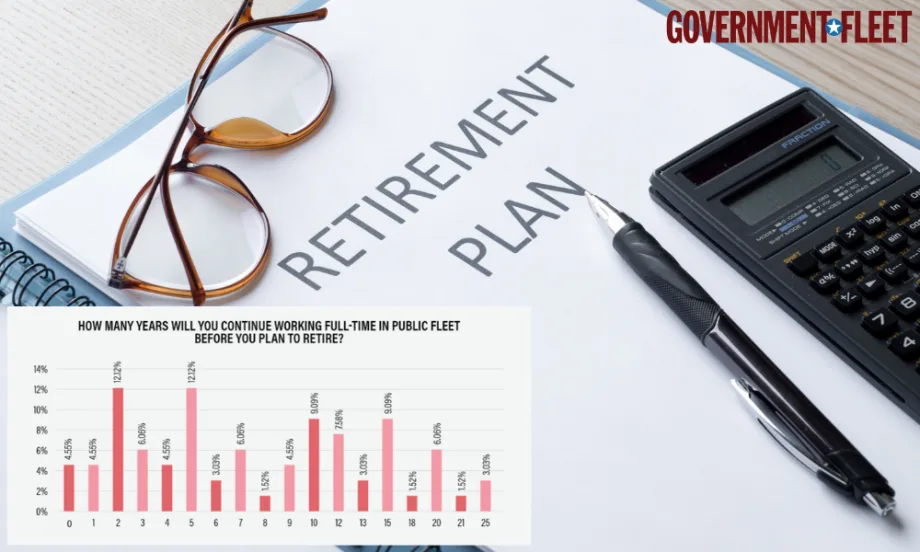
More than half of survey respondents — approximately 59% — plan to retire in less than 10 years.
Photo: Government Fleet/Canva
Retirement is in the near future for numerous public sector fleet managers, and succession plans are underway across many fleet operations.
Fleet managers shared their retirement and succession plans in Government Fleet’s biennial Industry Handbook survey. Here’s a look at how the results broke down.
Retirement on the Horizon
More than half of survey respondents — approximately 59% — plan to retire in less than 10 years. This is in line with what generation the respondents identify with. That portion of the survey revealed that the vast majority of respondents — about 91% — identify with either Generation X or the Baby Boomers.
About 41% of respondents plan to remain in the industry for 10 years or more before retiring.
Looking Ahead: What’s Next?
When asked whether they plan to stay at their current agency until they retire or leave the industry, just over two-thirds of respondents said they do. Approximately 15% of respondents said they do not, and 18% said they are unsure.
Most respondents have some sort of succession plan in place. Around 70% of respondents either have a succession plan already in place or in progress. The other 30% of respondents do not have a succession plan in place.
When compared to the retirement plan responses, the succession plan totals suggest that those who are less than 10 years away from retirement are likely to have a succession plan in place or in process.
About a third of survey respondents believe their successor currently works in their operation, while another third of respondents are unsure, and the final third of respondents do not believe their successor is currently employed within their operation.
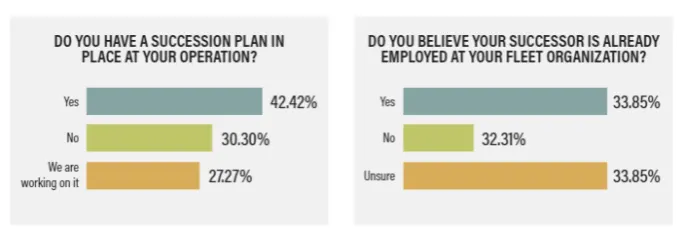
About a third of survey respondents believe their successor currently works in their operation, while another third of respondents are unsure, and the final third of respondents do not believe their successor is currently employed within their operation.
Photo: Government Fleet
What Does Your Succession Plan Consist Of?
Government Fleet asked survey respondents what their succession plans consist of. For this response, respondents could choose multiple options listed. This is what they said:
Actively train someone currently on staff to take over: 49.21%.
Plan to stay for a period of time after retirement starts to train him/her: 25.40%.
Provide a detailed written list of job responsibilities, contacts, advice, etc.: 36.51%.
Plan to work as a contract employee for the agency after retirement: 11.11%.
None: 26.98%.
Other: 9.52%.
Additionally, some respondents listed administration turnover and the political climate as reasons why staff members may not want to move into higher roles.
About the Data
In June and July 2023, Government Fleet magazine solicited responses to a biennial survey from its readership, receiving 81 qualified responses from a diverse group of public fleet professionals.
The information and analysis above come from this opt-in survey.
Want to participate in our next survey? Government Fleet is teaming up with Work Truck and Automotive Fleet to conduct a salary survey for fleet managers to determine the average salary for a fleet management position in both commercial and public sector fleets. The deadline for responses is Jan. 31, 2024.
More Operations

Is Keeping Older Fleet Vehicles Really Saving Money?
Is keeping vehicles longer saving money, and what happens when a diagnostic test points to the wrong fix?
Read More →
How Smart Fleet Strategy Can Help Local Government Agencies Do More with Less
Keeping a vehicle longer may ease this year’s budget, but what does it cost the next one? A closer look at fleet decisions can reveal opportunities to reduce spending while protecting essential services.
Read More →
Connect with Government Fleet on LinkedIn
From industry news and fleet management strategies to conversations with peers, Government Fleet's LinkedIn page offers public-sector fleet professionals another way to stay informed and connected.
Read More →
Town of Queen Creek Named Most Successful Fleet Award Winner of Inaugural RTA Fleet Success Awards
Five fleets were honored at RTA Connect 2026 in Chicago for excellence across resource efficiency, intentional culture, risk management, and stakeholder satisfaction.
Read More →
A buyer's guide to fleet management software in 2027
Buying fleet management software in 2027 means looking beyond features and price. As fleet operations, technology and expectations evolve, this guide explores what today’s fleet professionals should consider when choosing a system that can deliver value now and adapt to what comes next.
Read More →
Hazard Alerts, Fleet Car Sales Rise and a New Shuttle Concept
Fleet car sales doubled, but the bigger picture tells a different story in this week’s roundup.
Read More →
How St. Johns County Turned Fleet Data Into Better Replacement Decisions
St. Johns County, Florida, had fleet data, but turning it into reliable decision guidance was another matter. Instead of starting over with a new fleet management system, the county connected existing tools and built a scoring system that gives managers an objective look at fleet health.
Read More →
Fleet Forward Conference Introduces One-Day Passes for 2026
New one-day registration lets fleet professionals attend Tuesday, Wednesday, or Thursday, with passes available for $249.
Read More →
ENC Unveils its ZAVIR Medium-Duty Shuttle
Two variants of the concept shuttles were revealed: a low-floor configuration and a high-floor configuration.
Read More →
Could Your Next Fleet Technician Start as an Intern?
What if your next technician hasn’t worked in a fleet shop yet? What fleets are doing to free up time.
Read More →